

Halo: Reach
From Halopedia, the Halo wiki
| Halo: Reach | |
|---|---|
.png)
| |
|
Primary developer: |
|
|
Support developer(s): |
|
|
Publisher(s): |
|
|
Writer(s): |
|
|
Composer(s): |
|
|
Engine: |
|
|
Platform(s): |
Xbox 360 |
|
Release date(s): |
September 14, 2010 |
|
Genre(s): |
|
|
Mode(s): |
|
|
Rating(s): |
ESRB: Mature (M) for Blood and Violence |
- "From the beginning, you know the end."
- — Game tagline[2]
Halo: Reach is a first-person shooter video game set in the Halo universe and direct prequel to Halo: Combat Evolved, depicting the Fall of Reach. It was developed by Bungie, LLC. and published by Microsoft Game Studios for the Xbox 360 console.[3][4] It was announced by Joe Staten during Microsoft's Media Briefing at E3 2009; Reach was released on September 14, 2010, in North America, Europe, Australia, and Asia with the exclusion of Japan whose release was a day later.[5] On December 17, 2015, Halo: Reach became available on the Xbox One via backwards compatibility.[1] After several testing flights, it was added to Halo: The Master Chief Collection on December 3, 2019.
Upon the first day of release, Reach grossed over $200 million, surpassing Halo 3's record of $170 million.[6]
Synopsis[edit]
Backstory[edit]
- Main article: History of the United Nations Space Command
By the 26th century, humanity has expanded beyond the confines of Earth's Solar System and now inhabits hundreds of worlds in other star systems under the ultimate control of the Unified Earth Government and the United Nations Space Command, the Earth government's military and scientific arm. However, colonization did not come without its problems. By the late 25th century, various rebel and secessionist factions commonly known as Insurrectionists emerged in the Outer Colonies, actively opposing the UNSC-imposed rule on the outlying worlds. In 2517, the SPARTAN-II program was initiated by the UNSC to counter the threat of an imminent all-out civil war in the Outer Colonies by producing a group of biologically-enhanced supersoldiers.
In 2525, humanity made first contact with a powerful alien hegemony known as the Covenant on the distant farming world of Harvest. Following an unfortunate chain of events set in motion by the contact at Harvest, the Covenant's religious leaders deemed humans "unclean beings" and waged an all-out genocidal campaign with the intent of wiping the human race out of existence. In the years that followed, the technologically superior Covenant swept through the Outer Colonies, systematically wiping out human colonies by plasma bombardment. Even with the all-encompassing Covenant threat, many human insurgent movements lived on, forcing the UNSC to fight a two-front war.
In 2531, the UNSC initiated another supersoldier project known as the SPARTAN-III program. The SPARTAN-III commandos, while greater in numbers than the SPARTAN-IIs, were created to assault high-value targets en masse, in suicide missions in which they often succeeded, at the cost of entire companies. However, despite their best efforts, humanity could only slow down the Covenant's advance. By 2552, virtually all of the Outer Colonies have been devastated by the Covenant, who now ravage the Inner Colonies. Reach remains as humanity's last military stronghold and is often considered the only thing that stands between the Covenant and Earth.
Reach[edit]
- Main article: Reach
The titular planet Reach, located in the Epsilon Eridani system at Earth's metaphorical doorstep, is arguably the UNSC's most important military stronghold and shipyard. With a population of over 700 million, it is also one of the most populous human colonies. A harsh world filled with towering mountain ranges and deserts, Reach's settlements range from remote, self-sufficient farming communities to futuristic metropolitan cities such as New Alexandria. Reach also has several unique indigenous creatures such as the Moa and the Gúta, which are interacted with over the course of the campaign.
As the nexus of the UNSC military, Reach is protected accordingly; possessing a grid of 20 orbital defense platform and a defensive fleet of over 100 ships at any time. Reach has garrisons of ground forces from all military branches of the UNSC, including the UNSC Army which serves as the primary NPC ally throughout the game.
NOBLE Team[edit]

- Main article: NOBLE Team
The game follows NOBLE Team, a six-man special operations unit of one SPARTAN-II and five SPARTAN-III commandos. Serving under Special Warfare Command, NOBLE Team's SPARTAN-IIIs are among the few that were deemed too valuable to be wasted on suicide missions and were subsequently assigned to serve in other special forces units. Stationed on Reach, NOBLE Team reports to Colonel Urban Holland.
The player assumes the role of the team's latest member, SPARTAN-B312 or "Noble Six", a SPARTAN-III from Beta Company with a mysterious past, assigned to the team as a replacement for its previous sixth member. Other members of the team include Carter-A259, the leader; Catherine-B320, the intelligence specialist and Carter's second-in-command; Jorge-052, an experienced heavy weapons specialist and only SPARTAN-II on the team; Emile-A239, an audacious assault and close combat specialist; and Jun-A266, the team's talkative sharpshooter.
Plot synopsis[edit]

On July 24, 2552, SPARTAN-B312, the player character, arrives at a UNSC outpost on Reach. It is here that the players are introduced to the main cast and given their first mission from NOBLE Team's commanding officer, Colonel Urban Holland. The team is called in to investigate the sudden blackout of the Visegrad Relay, one of the planet's primary communications hubs. Expecting a confrontation with Insurrectionists, the team lands in the remote rural area and proceeds to the relay. After interrogating a farmer and finding suspicious signs in the area, it is soon discovered that the loss of communications is the work of the Covenant, as the team is engaged by Covenant ground forces. After they have made their way into the relay station, the team are attacked by the Devoted Sentries, an Elite Zealot advance team, who were on a mission to steal information from the relay. After the team successfully secures the relay, Carter uses the damaged relay to contact Colonel Holland and explain the situation, leading to the declaration of the planetary emergency directive WINTER CONTINGENCY.

Two days later, on July 26, NOBLE Team is called in to ONI Sword Base near the Babd Catha Ice Shelf. As explained to the team by the AI Auntie Dot, Sword Base is under attack from a Covenant corvette, but due to the sensitive nature of the facility, the use of orbital MAC rounds is prohibited. NOBLE Team clears the main courtyard of enemies, and is then sent on a mission to re-activate Farragut Station, a communications station they can use to get into contact with command, and Airview Base, where they need to activate an anti-air battery to clear the skies. The Spartans move into Sword Base and NOBLE Six assists Emile in driving off several Phantoms and Banshees. After the skies have been cleared, the UNSC sends in a pair of Longswords to push the corvette away from the base's immediate vicinity. The Covenant vessel begins to retreat, only to be shot out of the sky by an orbital strike. After the mission, NOBLE Team is debriefed by Dr. Catherine Halsey, who inquires as to the death of one of her scientists, who was doing research at the relay. She says he mentioned a "latchkey" discovery and that the information was essential. Learning that he was killed by Zealots, Halsey reprimands Carter for not pursuing the leader, as the scientist's research was potentially important to their religion. Fortunately, Kat had stolen the data module off of the scientist, and hands it over to Halsey.
Two and a half weeks later, NOBLE Six and Jun are sent to perform a night reconnaissance mission to reconnoiter the Covenant "dark zone" in the Viery Territory. After stealthily eliminating guards at multiple outposts, the two Spartans meet up with a group of civilian militiamen, who guide them to a hydro-plant further into the dark zone, where the team discovers a Covenant stealth pylon. After planting an explosive charge on the pylon, the team moves deeper into the dark zone, where they discover a massive Covenant invasion force. Kat then orders them back so they can prepare for the attack on the next day.

On the morning of August 12, 2552, a massive UNSC joint assault force is put together, with the objective of mounting a counterattack on the Covenant-occupied Viery Territory. As revealed by Auntie Dot in the mission briefing, the Covenant have infiltrated the region in force, deploying ground forces and installations, including several massive Deployment spires. NOBLE Team's objective is to destroy one of these spires, designated Spire One. After pushing through Covenant forces and destroying several Covenant anti-air batteries, Jorge and NOBLE Six deploy to the spire in a Falcon. However, the aircraft crashes after being disabled by the electromagnetic field created by the Spire's shield. After the crash, the pair proceed into the Spire, where it is revealed that the Spires actually contain teleporters used to transport Covenant forces to the surface, linked to an unknown source. After proceeding to the Spire, NOBLE Six utilizes a gravity lift to reach the top, and disables the shield. Noble Six is flown away from the tower by a Falcon containing Carter and Jorge. UNSC Grafton, a heavy frigate, uses a MAC round to demolish the spire. Seconds later, a Covenant supercarrier uncloaks and fires on the Grafton, completely destroying it.
NOBLE Team contemplates how to destroy the Covenant supercarrier, Long Night of Solace, as the UNSC no longer possess tactical nuclear devices on Reach. Instead, Kat proposes they use a slipspace drive as a makeshift bomb to destroy the ship. It also becomes apparent that Noble Six was a pilot in the top-secret Sabre Program at some point. Carter contacts Holland and the plan is approved.
On August 14, NOBLE Team arrives at the Sabre Program Launch/Research Range, where Noble Six and Jorge commandeer a UNSC YSS-1000 "Sabre", a recent development intended for Inner Colony orbital defense. They launch into the hostile space over Reach, where they protect a UNSC space station, Anchor 9, until its defenses come back online. Next, they rendezvous with the UNSC Savannah, which sacrifices its slipspace drive for the mission. They then board the Covenant corvette, Ardent Prayer, and using its re-fueling course at the supercarrier as an excuse, get close enough to detonate the slipspace bomb and destroy the Long Night of Solace. Unfortunately, the detonator for the makeshift bomb is damaged and Jorge is forced to manually detonate it, sacrificing himself to destroy the supercarrier. However, the victory is short lived: mere moments later, a massive Covenant fleet arrives, making the destruction of one supercarrier pointless.

Noble Six is flung away from the corvette by Jorge, falling all the way down into Reach's atmosphere, saved by an M-Spec reentry pack. After landing, Six continues to the city of New Alexandria, arriving there on August 23. Six then regroups with UNSC forces and assists in the evacuation of Traxus Tower, where many civilians have taken refuge. After, Six helps UNSC Army troops to activate anti-air missile batteries, which damage a Covenant corvette, providing the time needed for the massive civilian transports to escape the city. Kat orders Noble Six to rejoin NOBLE Team, Noble Six meets Carter on a rooftop in New Alexandria. Kat orders Noble Six to assist in the destruction of several Covenant communications jammers in the area, along with several other tasks, including protecting Gunnery Sgt. Edward Buck's Falcon as he is transported to the rest of his unit, defending different groups of Army soldiers around the city, and assisting in more civilian evacuation. Kat then calls on Noble Six to come to her aid in the evacuation of the Office of Naval Intelligence HQ.
Once inside, NOBLE Team is reunited, in what Emile calls a "family reunion." Colonel Holland makes emergency contact to the team, ordering them to immediately re-deploy to Sword Base to destroy sensitive information. The communications are cut off, and Jun notes several Covenant vehicles leaving the area. Soon afterward, the Covenant begin to glass the city near the building, generating a massive shockwave NOBLE Team barely manages to avoid. The team takes an elevator down to the bottom level, where they run to an underground radiation bunker as Carter explains that they are to be redeployed to Sword Base to destroy all sensitive data. Just before they get inside, Kat is killed with a single shot from a Needle Rifle to the back of her head fired by a Field Marshal Orsu Lar 'Ahtalee, in an overhead Phantom. Resulting in Noble Team to return fire upon that Phantom, however, the Phantom is able to retreat. Three days later, the team exits the shelter, and a Pelican arrives to transport them to Sword Base.
On August 29, Noble Six is deployed with a group of Orbital Drop Shock Troopers in order to take out several Covenant anti-air towers around Sword Base, opening the defenses so the rest of NOBLE Team can be deployed to the base via Falcons. After fighting their way into Sword Base, NOBLE Team discovers the coordinates they were given to be empty, a last stand full of dead troopers. The coordinates are then revised by an unknown AI, and NOBLE Team moves into caves below Sword Base. NOBLE Team rides a cart down the tunnel, and discover that it was Dr. Halsey who ordered them back to the base, despite the existence of reports that she had died. As they descend down the elevator, a massive artifact built by an ancient civilization in the ice cavern is revealed.

Halsey asks NOBLE Team to buy her more time in order to decrypt the artifact's data. NOBLE Team sets up a defensive perimeter at the entrance to Halsey's lab, deploying Wolf Spider Turrets in the area before fighting off waves of incoming Covenant. After the process is complete, NOBLE Team falls back to Halsey's lab, where she then shows a fragment of the AI Cortana to the team and explains that she has been assigned the custodian of the artifact's data, and she needs to be brought to the Asźod ship breaking yards in order to be deployed onto a UNSC Halcyon-class light cruiser which is being sent on a special mission. Dr. Halsey explains that Cortana has picked Noble Six to be her carrier, and entrusts her to the Spartan.
They make their way to a landing pad outside, where two Pelican dropships await. Jun is assigned by Carter to take one of the Pelicans to escort Dr. Halsey to CASTLE Base, while the rest of the team deploys on the other dropship to the ship breaking yards. On the way, the Pelican piloted by Carter is damaged, forcing Emile and Noble Six to initiate a low level altitude aerial insertion and move towards the UNSC Pillar of Autumn.

The pair are blocked by a Scarab, but Carter arrives and sacrifices himself, piloting the Pelican in a kamikaze strike on the Scarab. Noble Six and Emile continue towards the Pillar of Autumn. Once there, Emile mans a Mk. 2488 Onager MAC, while Noble Six fights off masses of Covenant infantry. Captain Jacob Keyes then arrives and receives the AI from Noble Six. Before the Captain can take off, a Covenant battlecruiser arrives, and prepares to fire on the Autumn. Meanwhile, a Covenant Phantom arrives on scene and dispatches the Devoted Sentries to Emile's location. Emile kills one with a shotgun, before being stabbed through the abdomen by another. The Marines on Keyes's dropship offer that Noble Six board the Pelican, but Six declines, as without cover from the MAC, the Pillar of Autumn couldn't escape. After fighting through the Zealots, Noble Six takes control of the cannon and defends the Pelican as it returns to the Autumn. As the Covenant ship prepares to fire, Noble Six fires into its main weapon, disabling the Cruiser as the Pillar of Autumn escapes from the planet.

The final cutscene portrays the beginning of the opening cutscene in Halo: Combat Evolved, where the Pillar of Autumn comes out of slipspace. Keyes asks if they have evaded the Covenant, to which Cortana replies "I think we both know the answer to that". The credits roll on the right as the ship drifts off towards Installation 04.
After the credits, Noble Six is shown to still be at the ship breaking yards, preparing for a final stand against Covenant forces being deployed in the area. Six fights off several waves of Covenant forces, before succumbing to plasma fire, discarding his/her damaged helmet. Six fights desperately with several Sangheili soldiers until overwhelmed and stabbed by a Sangheili Zealot's energy dagger. The epilogue, set over 30 years later in the year 2589 on a re-terraformed Reach, shows Noble Six's helmet sitting in what is now a grassy field. Dr. Halsey provides a eulogy to Noble Team as the camera shows a human ship landed on the planet, showing the re-colonization of Reach.
Data pads[edit]
- Main article: Data pads
In addition to the main storyline, Halo: Reach features 19 hidden data pads which tell a self-contained story of their own. The data pads, found in various locations throughout the campaign, focus on a powerful human Artificial Intelligence collective known as the Assembly. Composed of a Minority, Majority and the Committee of Minds for Security, the minds of the Assembly are behind many significant events in human history, having been manipulating humanity in secret since the 24th century.
Gameplay[edit]

Halo: Reach features many new additions to the Halo sandbox while still retaining the core gameplay. The player damage system is similar to that of Halo: Combat Evolved and Halo 3: ODST. The HUD highlights environmental features and overlay information about them, and the motion tracker display is three-dimensional. Halo: Reach also introduces a refined equipment system known as "Armor Abilities." Pieces of equipment can now be selected upon respawning (or picked up of the ground for certain gametypes and campaign); armor abilities are reusable with a recharge time between uses. A new assassination system is also featured, in which holding down the melee button will trigger a context-sensitive, third-person assassination animation. Simply hitting the melee button allows for the old-instant-kill assassination, now called beat-downs. Melee kills, which were called beat-downs, are now called pummels.
The returning features of energy shielding and health bar are different from their predecessors. In Halo: Combat Evolved and Halo 3: ODST, the health bar remains still when taking damage. In Halo: Reach, it features sustainable damage in addition to the standard energy shield regeneration. When a player takes damage after the shield is down, the health bar would be reduced, but after a brief amount of time during shield regeneration, the health bar would also increase. The upper limit of regeneration depends on how much damage the player has taken as it would be split into 33%, 66%, or 100% health. Should the player take damage down to 50% health, for example, the player would only be able to recover up to 66% of health when the shield is regenerating. Any damage taken would recover depending on the remaining health. For full recovery, the player would need to take a health pack or use the Drop Shield armor ability.
The weapon selection has been streamlined from that of Halo 3, so that every weapon has a specific role. The number of different grenade types has also been reduced from that of Halo 3, and incendiary grenades and spike grenades did not return. Human weapons all hit more or less instantly after pulling the trigger, as opposed to the projectiles being affected by in-game physics. There is no longer dual-wielding available in Halo: Reach, following the same path as Halo 3: ODST. Compensating for this, the weapons that were known as dual weapons in Halo 3 that are now in Halo: Reach became drastically stronger. The M6G Magnum, for example, is now almost as powerful as the M6D Pistol in Halo: CE, and has an even higher rate of fire.
Players are able to personalize their character's armor with a greater variety of customization options, and the appearance is consistent across campaign and multiplayer, unlike in Halo 3 where it would only be seen during multiplayer matches. Like in Halo 3, the armor permutations are only to be cosmetic and do not affect gameplay. The design of multiplayer models in Halo: Reach differs than those previously used in Halo 3; players are limited to a SPARTAN multiplayer model but given the option of changing their character's gender. Players are given the option to play as an Elite multiplayer model, though only in specific gametypes such as Firefight Versus, Invasion and other Elite-specific gametypes. Both multiplayer models have different gameplay properties; the Elite multiplayer model is physically superior, has a fully recharging health and faster shield regeneration than their SPARTAN counterpart. Overall, their only disadvantage is their massive size which makes them slower and much more noticeable targets.
While the rest of NOBLE Team accompany the player for most of the game, Halo: Reach does not feature any kind of tactical squad mechanic. Much like the Arbiter Thel 'Vadam in Halo 3, the rest of the squad fight alongside the player, but do not interact with the player, other than certain scripted actions and dialogue. The levels in the game are more open and teleportation in co-op is far less strict.[7][8]
As originally revealed in the E3 2010 trailer, a small section of the Halo: Reach campaign level Long Night of Solace involves space combat, a new element to the game. This space battle above Reach is the first space combat section played in the Halo saga.[9][10]
Campaign[edit]
The campaign in Halo: Reach consists of eleven levels, ten of which are playable.
- Noble Actual - "Welcome to Reach." (Cinematic)
- Winter Contingency - "There's a disturbance on the frontier."
- ONI: Sword Base - "Covenant are attacking a vital ONI base. Drive the bastards off."
- Nightfall - "Move in behind enemy lines and evaluate the opposition."
- Tip of the Spear - "Two massive armies clash! Time to go to war against the Covenant."
- Long Night of Solace - "Move up the beach and secure the launch facility. Take the battle to the Covenant Super Carrier."
- Exodus - "All is not lost. Evacuate civilians from an occupied city."
- New Alexandria - "Provide air support in a forest of crumbling skyscrapers."
- The Package - "Your orders are to destroy Sword Base... Or are they?"
- The Pillar of Autumn - "Deliver Halsey's data package to the Pillar of Autumn."
- Lone Wolf - "Spartans never die. They're just missing in action..."
Multiplayer[edit]
A total of 34 multiplayer maps are available in Halo: Reach, with 24 standard multiplayer maps and 10 Firefight maps.
Default Noble Map Pack
Defiant Map Pack
Anniversary Map Pack
|
Defiant Map Pack Anniversary Map Pack |
Appearance[edit]
Armor Permutations[edit]
- Main article: Armor customization (Halo: Reach)
Armor Permutations return in Halo: Reach with far deeper customization options than Halo 3. Players can purchase different armor sets with credits from The Armory.
| ||||||||||||||||||||
Multiplayer Emblems[edit]
- Main article: Multiplayer Emblems
An Emblem is a highly customizable image that appears on the right side of a Spartan's chestplate during gameplay, they are there to give a player an identity for themselves.
Armor Effects[edit]
- Main article: Armor Effects
Armor Effects are customizable effects available in The Armory.
Colors[edit]
There are ten base and primary colors, each with three shades of one another that are used to customize your multiplayer color and emblem.
- Steel, Silver, and White
- Red, Mauve, and Salmon
- Orange, Coral, and Peach
- Gold, Yellow, and Pale
- Sage, Green, and Olive
- Teal, Aqua, and Cyan
- Blue, Cobalt, and Sapphire
- Violet, Orchid, and Lavender
- Crimson, Rubine, and Pink
- Brown, Tan, and Khaki
- Black can still be used but, only in Forge or Custom gametypes, as a forced player color under general settings.
- Zombie a slightly more yellowish version of Green to make players look like zombies. Only available in Forge or Custom gametypes as a forced player color under general settings.
Appearances[edit]
Original Halo: Reach[edit]
Halo: The Master Chief Collection only[edit]
- Main article: Halo: The Master Chief Collection
Following the addition of Halo: Reach to Halo: The Master Chief Collection, more story elements have appeared.
Vehicles
Technology and equipment
Miscellaneous
|
Development[edit]
- "Where there will be a full three-year cycle, it's got all-new tech, akin to the change from Halo 2 to Halo 3, not like ODST, which was just built on top of the foundation."
- — Bungie Community Manager, Brian Jarrard.
Reach had been in development since the completion of Halo 3, in the tradition of a full three-year cycle and used a completely new game engine created specifically for the game. It was confirmed in October 2009 that Martin O'Donnell, Bungie's lead composer, had begun casting voice actors for Reach.[12][13] In the early stages of development, the team at Bungie explored a number of ideas for the game's campaign and setting, including a potential Halo 4, following up with the Master Chief's story post-Halo 3. Ultimately, the team at Bungie did not want pick up where they'd left off and all of the baggage that came with it, and instead elected to tell a prequel story. Like the previous release, Halo 3: ODST, Reach was intended to be fully self-contained and accessible to newcomers to the series to make sure Bungie weren't starting new plot threads they wouldn't be finishing.[14]}}
The Halo: Reach Multiplayer Beta, used to gather information and tweak gameplay features in the game, ran from May 3 through May 20, 2010. The Zero-bug release milestone in Halo: Reach's development was reached on June 24, 2010,[15] and the game's audio, including soundtrack, voices and sound effects, was finished on July 15, 2010.[16] As of August 5, 2010, Halo: Reach has "gone gold", meaning all development of the game has been completed and mass manufacturing of the game has begun.[17] The game was released on September 14, 2010 as planned. Interestingly, there were 117 days between the end of the Beta and the release of the full game, referencing John 117, the Master Chief.
Design[edit]
Bungie took a new design direction with Halo: Reach, aiming for a more somber and gritty atmosphere. The more serious tone is also reflected in camera angles; instead of long, sweeping shots, the cinematic camera angles are actually made to look as if shot with actual cameramen.
In many ways, the character designs, especially those of Sangheili and human personnel, harken back to Halo: Combat Evolved. Models for enemies and allies boast remarkable levels of new detail in form of higher-resolution textures and more polygons. Enemies and allies have more individual features to denote ranks and provide more visual variety.[18] Bungie made an effort to make the Covenant feel more alien and threatening; for example, the Covenant speak in their own languages instead of English.
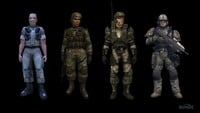 A comparison of the human allies.
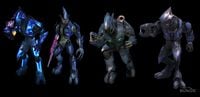 A comparison of the Sangheili.
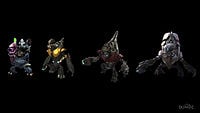 A comparison of the Unggoy.
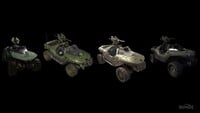 A comparison of the Warthog.


Engine[edit]
Bungie made use a completely redone version of the Halo engine for Halo: Reach, with no component left untouched.[7][8][19]
The environments, while larger than in the previous games, are far more detailed. The graphical effects have been drastically improved, allowing for a new atmospheric effects system and more dynamic lighting for dramatic shadows and moving light sources in interiors. The engine was improved with "impostering" technology; this allows very cheap textures far away, and moving closer will make them improve.[19] This was proved with the map, Forge World. Rain and fogging effects are also improved. Halo: Reach also features a new animation system, which smoothly blends movement between standing, walking and running as well as jumps, grenade throws and firing. The facial animation system has been completely revamped, including motion capture. Weapon effects are amplified to be more powerful and visceral than before, giving them a more serious tone. Human weapons sound more powerful and emit smoke and showers of sparks. Plasma bolts now burn through material as they hit, and explosions throw clouds of dirt and debris around.
Halo: Reach's engine is able to support up to 40 active AI characters or 20 vehicles with AI characters on screen at once, twice as many as in Halo 3. In addition, distant battles between AI characters follow automated behavior models, which convert into scripted behaviors as the player gets closer, and finally convert to full AI.[7][8]
Audio[edit]
- "I want it to be more visceral, to have a bigger sense of loss, a personal feeling of sacrifice"
- — Martin O'Donnell, on the audio design of Halo: Reach[20]
A more serious and realistic approach has been taken in the audio design of Halo: Reach than in the previous Halo games.
The music of Reach was referred to as being more somber and more visceral, as the plot is more character-driven than previous Halo titles and that it focuses on a planet known to have fallen.[21] While stated before release that the Halo Theme would not appear in Reach,[7][8] an orchestral re-imagining does indeed appear as the opening segment of the track Tip of the Spear, while certain motifs are also present in several other tracks.
The in-game effects such as weapon sounds have also been amplified to sound more powerful and realistic. In addition to various different audio filters for interiors and exteriors, the space environment in the level Long Night of Solace required an entirely new audio filter to make the environment feel more realistic.[22] A significant improvement in the game's audio technology allows for more fluid transition between different layers of music; whereas the first Halo could barely manage more than two layers of music at once, Reach can run seven layers at once, coordinating which ones fade in and out based on relatively minor changes in the player's behavior.[20]
It was announced by Bungie that the Halo: Reach Original Soundtrack would be released on September 28, 2010.
Matchmaking[edit]
Halo: Reach's matchmaking allows players to compete with each other over the Xbox Live online service or System Link, for 16 players on the Xbox. The matchmaking system has been improved and redesigned from Halo 3; instead of having experience and rank as two separate features, Halo: Reach combines these two into a credit system where the player is scored on how well they play in each individual performance, instead of a win/loss system. As players gain credits, they achieve higher military rank, and are able to buy armor permutations to customize their SPARTAN and Elites character model. A new matchmaking system called the Arena is introduced for hardcore/competitive players where they play in month-long seasons and be put into divisions of either Onyx, Gold, Silver, Bronze or Iron, depending on how well they play. Along with this, Bungie announced that Campaign would also have matchmaking support.[23] Players are able to vote on which Campaign mission to play, similar to how voting works in competitive Matchmaking. On October 25, Bungie announced in the weekly update that Campaign Matchmaking has been released, and can now be accessed in the Co-op playlists along with Firefight Matchmaking and Score Attack.[24]
The multiplayer mode features standard multiplayer gametypes such as Slayer, Capture the Flag and King of the Hill, as well as reintroducing Race, a gametype that was once made exclusive only to Halo: Combat Evolved. Firefight mode, a cooperative gameplay mode that was made present in Halo 3: ODST, is featured in Halo: Reach with much more customizable features, from the skulls that turn on every round to the very enemies the player will face every wave, as well as having Matchmaking support. Halo: Reach also introduces new gametypes to multiplayer such as Invasion, Stockpile, and Headhunter.
The character models in Halo: Reach differs significantly than their previous architecture in Halo 3; both character models are now composed of different hitboxes and have different gameplay properties. The Elite character models are formidably larger, and physically superior, having faster shield regeneration and the ability to regain health fully over time than their SPARTAN counterpart. SPARTANs are smaller and weaker than their Elite counterpart and would only regain health to thirds over time unless they pick up a health pack. For these balancing issues, only specific gametypes in matchmaking allow SPARTANs and Elites to face each other in team-based games.
Marketing promotions[edit]
Halo: Reach Multiplayer Beta[edit]
- Main article: Halo: Reach Multiplayer Beta
The Halo: Reach Multiplayer Beta was a phase in the development of Halo: Reach, produced by Bungie, LLC and organized by Microsoft Game Studios. The beta was made available to those who bought Halo 3: ODST and it was released from May 3 through May 20, 2010. More than 2.7 million players participated in the beta during its three-week run on LIVE. After July 21, 2010, Bungie stopped supporting stats and files from the beta. Players who participated in the beta on their current LIVE accounts receive a Halo: Reach Beta Visual Flair for use with their gamertags, which is represented with an MA37.
Trailers[edit]
E3 2009 Announcement[edit]
- Main article: Halo: Reach - Announcement Trailer
Shortly after the Halo 3: ODST E3 2009 Trailer premiered, it was soon followed up by the first official announcement trailer for Halo: Reach.
2009 VGA Trailer[edit]
- Main article: Halo: Reach Video Games Awards Trailer
At the 2009 Spike TV Video Games Awards, the first official in-game trailer was shown. This 2:36 video was an opening cinematic that showed a glimpse of the new characters and graphics.
Once More Unto the Breach[edit]
- Main article: Halo: Reach ViDoc: Once More Unto the Breach
The Once More Unto the Breach ViDoc focused on the graphical and gameplay changes to the game between Halo 3 and Halo: Reach. This 7:45 video showed the development of the series over the years.
Carnàge Carnivàle[edit]
- Main article: Halo: Reach ViDoc: Carnàge Carnivàle
The Carnàge Carnivàle ViDoc focused on the new multiplayer in Halo: Reach. This 8:20 video shows the many gameplay enhancements that have been added.
E3 2010 Demo[edit]
- Main articles: Halo: Reach E3 Campaign Demo, Halo: Reach E3 2010 Trailer
On June 14, 2010, at E3 2010, Bungie released a demo displaying a section of campaign in Reach. It introduced various new vehicles, and the new feature of space combat. A shorter gameplay trailer of the same level was also released.
Firefight 2.0[edit]
- Main article: Halo: Reach Welcome to Firefight 2.0 Trailer
On June 16, 2010, Bungie released a collage of clips from Halo: Reach's Firefight feature.
Red vs Blue Halo: Reach PSA: Deja View[edit]
- Main article: Red vs. Blue Halo: Reach PSA: Deja View
On July 7, 2010, in honor of Bungie Day, Rooster Teeth, the creators of the popular Halo machinima Red vs Blue, released a special PSA revealing the return of Blood Gulch, the classic Halo: Combat Evolved multiplayer map. The video teases the rest of Forge World in the form of a scene where Sarge stands on a cliff admiring the view and commenting on the map's large size.
Forge World[edit]
- Main article: Halo: Reach ViDoc: Forge World
The Forge World ViDoc was released July 23, 2010. It was focused on the new multiplayer map, Forge World, the largest map in the Halo franchise.
The Battle Begins[edit]
- Main article: The Battle Begins
The Battle Begins campaign trailer was released July 29, 2010.[25] The 1:06 trailer showcased several cinematic scenes from the campaign.
A Spartan Will Rise[edit]
- Main article: Halo: Reach ViDoc: A Spartan Will Rise
The 'A Spartan Will Rise' ViDoc was released August 17, 2010. The ViDoc focused on the characters of the game, with Dr. Halsey acting as the main narrator.
Noble Map Pack Trailer[edit]
- Main article: Noble Map Pack Trailer
The Noble Map Pack Trailer was released October 25, 2010. The trailer released new information about the Noble Map Pack.
Defiant Map Pack Trailer[edit]
- Main article: Defiant Map Pack Trailer
The Defiant Map Pack Trailer was released February 14, 2011. The trailer released new information about the Defiant Map Pack.
2010 VGA Trailer[edit]
- Main article: Halo: Reach Video Games Awards 2010 Trailer
As a post-game trailer, it was released on 2010 in Bungie.net's Halo: Reach Multimedia section. The trailer showcased campaign cutscenes, gameplay and has been warned as being a spoiler.
Viral campaign[edit]
Birth of a Spartan[edit]
- Main article: Birth of a Spartan
On April 26, 2010, a website was created by Microsoft as part of a viral marketing campaign to promote Halo: Reach. At first, the site merely consisted of a teaser image which showed the UNSC emblem washed out by static, with the words "Augmentation Begins April 28, 2010".[26] On April 28, both the standard and extended versions of the Birth of a Spartan live-action trailer were released.
Remember Reach[edit]
- Main articles: Remember Reach, Day Before, Patrol, New Life, Spaceport (Remember Reach), Deliver Hope
An advertising campaign titled Remember Reach was launched on August 17, 2010. The campaign includes the website rememberreach.com, as well as several live-action shorts.[27]
Merchandise and promotions[edit]
| Features | Standard | Limited Edition | Legendary Edition |
|---|---|---|---|
| Image of contents |
|

|

|
| Game disc & manual | Yes | Yes | Yes |
| ONI-themed case & artifact bag | No | Yes | Yes |
| Waypoint avatar gear | No | Yes | Yes |
| Exclusive Sangheili armor | No | Yes | Yes |
| Exclusive SPARTAN armor effect | No | No | Yes |
| Exclusive digital content | No | No | Yes |
| Noble Team statue | No | No | Yes |
| Large UNSC-themed case | No | No | Yes |
| UA multi threat chest | Yes, Gamestop pre-order only | ||
| Recon helmet | Yes, launch day purchase (North America)/Pre-order only (other countries) | ||
Halo: Reach was released in three different versions. The Standard Edition comes with the game disc and manual. The Limited Edition is cased in an ONI "black box" and includes an exclusive Sangheili armor set for use in multiplayer modes and an artifact bag containing Dr. Halsey's personal journal and other classified documents and effects that unravel long-held secrets of the Halo universe. The Legendary Edition contains everything from the Limited Edition along with extra SPARTAN armor effect for use in the game, along with an exclusive hand-painted and numbered NOBLE Team statue by McFarlane Toys in UNSC-themed custom packaging. Those in North America who purchased Halo: Reach on launch day received a new variation of the coveted MJOLNIR Recon Armor. Recon was also available to any who pre-ordered the game.[28] As a bonus, the UA/Multi-Threat [W] armor was given to customers who pre-ordered the game at GameStop.
In addition, Bungie has announced that players who have/buy a copy of Halo: Combat Evolved for PC, can use that same authentication key to obtain a special in-game Halo: Combat Evolved symbol on their nameplate . Players of Xbox's Halo 2 before the April 14th, 2010 cutoff (Shutdown of Xbox Live v1 Service) will be awarded a special in-game Halo 2 symbol on their nameplate. If your current gamertag has changed since the last time you played Halo 2, or if your current gamertag never played Halo 2, you will not be receiving this item.[29] Halo 3, Halo 3: ODST, Bungie Pro, Halo: Reach Beta flairs are also displayable in a similar way.
Also, a Reach themed Xbox was announced.[30] The Xbox included a 250-gigabyte hard drive, two Reach themed wireless controllers, standard wired headset, and a standard copy of Halo: Reach. The Reach Xbox 360 also featured exclusive Elite Armor, Waypoint Avatar Gear, and Halo Legends episode: "The Package",[31] as well as custom Halo sound effects from the Xbox itself.
In addition the controllers and headset sold separately for $59.99 and $49.99 respectively. The controller also includes a token for a downloadable animated Covenant Banshee avatar item. The theme includes ONI property tags and more, which according to Microsoft, is canon material in the Halo universe.[32]
The game has brought the proposal for merchandise, such as action figures. McFarlane Toys had announced that they were planning to release a series of Reach 5-inch scaled figures in September 2010.[33] Square Enix has also showcased several figures for their new Reach line of action figures.
A new comic book series, titled Halo: The Fall of Reach - Boot Camp, was released alongside Halo: Reach. Boot Camp is a graphic novel adaptation of Halo: The Fall of Reach.
Re-releases[edit]
- 2013 - Re-released as a part of the Halo Origins Bundle, which also included Halo: Combat Evolved Anniversary.[34]
- 2019 - Re-released in Halo: The Master Chief Collection for Xbox One and PC, all Multiplayer activities included in base-game.[35]
Soundtrack[edit]
- Main article: Halo: Reach Original Soundtrack
Halo: Reach Original Soundtrack was released on September 28, two weeks after the release of Halo: Reach. The soundtrack features twenty new tracks heard in the game, composed by Martin O'Donnell and Michael Salvatori.[36]
Release and reception[edit]
| Internet sites | |
| Reviewer | Score |
|---|---|
| Gamepro | 5/5 |
| TeamXbox | 9.5/10 |
| IGN | 9.5/10 |
| GameInformer | 9.5 |
| 1up | A+ |
| Gametrailers | 9.3/10 |
| Famitsu | 8.5/10 |
| ComputerVideogames | 9.2/10 |
| GamersHell | 8.5/10 |
| Compilation websites | |
| Metacritic | 91% |
| Game Rankings | 91.71% |
Halo: Reach was released to critical and commercial success. 1Up praised the campaign, calling it "a grand re-telling of the Battle of Thermopylae, but portrayed from a gritty, ground-level perspective across multiple missions like Band of Brothers, and all done with typical Halo flourish".[37] IGN noted that though the past games had repetitive landscapes and complicated plots, Reach was an altogether different matter.[38] Gamepro stated "the only thing missing from this impressive entry is a number “4” in the title, because for all intents and purposes, Reach feels like the next big thing in the Halo franchise".[39]
Many reviewers praised the enhanced graphics and audio, calling them "top-notch". Some reviewers noted that large amounts of action on-screen occasionally resulted in frame rate slowdowns and that the friendly non-player character artificial intelligence was less advanced than that of enemies, especially while driving.
However, the game was criticized by certain members of the online Halo community, namely that it conflicts with the previously established canon in the novel Halo: The Fall of Reach. These members argued that since the game has too many inconsistencies with the novel, it should not be considered canon. Even though Bungie had already stated that "the game's events supersede anything else",[40] a website, named "Halo: Reach is not canon.net", dedicated to such criticism was launched, and the site became a source for debating across the internet.[41] However, most of the inconsistencies are later explained in the Halo: The Essential Visual Guide, Dr. Halsey's personal journal included in the game's limited edition, the 2011 edition of the Halo Encyclopedia (2009 edition), and the Data Drops released on Halo Waypoint.
Microsoft listed Reach as an Xbox Live Marketplace download on August 12, 2010, at a price of 99999 Microsoft Points (~US$1250); A spokesperson confirmed the download was for media review purposes, and that there were no plans to distribute the game to the public through Games on Demand. Four days later, hackers managed to access, download, and distribute the game online; Microsoft claimed to be actively investigating the matter.
Trivia[edit]
- Early on in the game's development, before coming up with the idea of a prequel to Halo: Combat Evolved, Bungie considered making a follow-up to Halo 3, with John-117 as the protagonist.[42]
- On the project page for Reach, located in the "Multimedia" section, the soundtracks to a couple of Reach trailers, "Lone Wolf" and "Uphill, Both Ways" by Martin O'Donnell, are available for download for free from Bungie.net.
- Halo: Reach's original achievement set has 49 achievements, which is a reference to Bungie's love of the number seven, since seven times seven is 49.[43]
- Currently, Halo: Reach has 59 achievements, with 7 achievements added during the release of the Noble Map Pack on November 30, 2010, and 3 added with the release of the Defiant Map Pack on March 15, 2011. This could still be a reference to 7 (5 + 9 = 14, 14 / 2 = 7)
- All of the Campaign achievement titles, along with many of the others, are quotations from the Halo games and books.
- The game's release date, September 14, is the same day when Earth's Orbital Defense Platforms were activated in 2552.[44]
- Many of the Army troopers and Marines encountered in the game are named after Bungie employees and notable community members.
Gallery[edit]
Logos[edit]
 Title art.

Box art[edit]
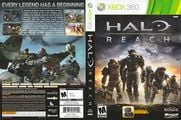 Box art for Halo: Reach.
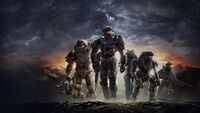 Full cover art.


Concept art[edit]
 A "kickoff" illustration for the game.
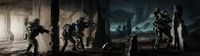

 Three Sangheili lead a squad of Unggoy.
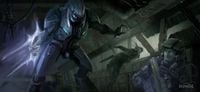 A Sangheili attacks two UNSC infantrymen.
 Landscape of Reach.
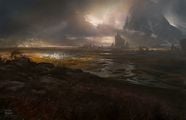 Landscape.
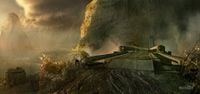 A bridge leading over a canyon.
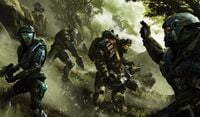 NOBLE Team in combat position.
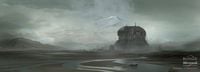 A UNSC facility.
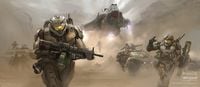 An early concept of SPARTANs and other UNSC forces.
 Sangheili in a forest.
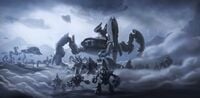 A Covenant army.
 A skybox concept.
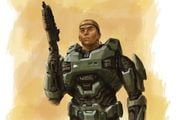 Concept art for Spartans.
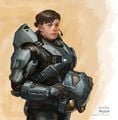 Concept art for Spartans.
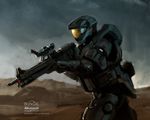 Concept art for Spartans.
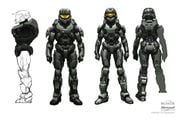 Concept art for Spartans.
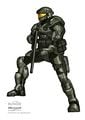 Concept art for Spartans.
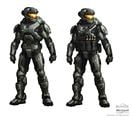 Concept art for Spartans.


Menu background art[edit]
 Main menu.
 Multiplayer menu.
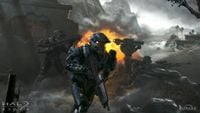 Firefight menu.
 Forge menu.


Screenshots[edit]
 Planet Reach is glassed by the Covenant.
 A nebula in the game's opening cinematic.
 Reach, seen from orbit.
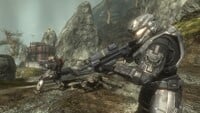 Pre-release screenshot of the Winter Contingency level.
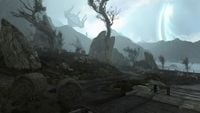 Landscape on the level Winter Contingency.
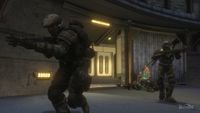 An Army Trooper and Noble Six.
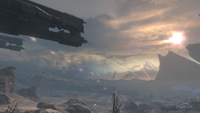 A large battle on Tip of the Spear.
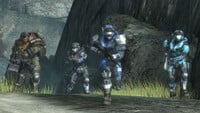 A customized Noble Six with NOBLE Team.
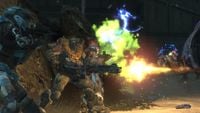 NOBLE Team in a battle with the Covenant.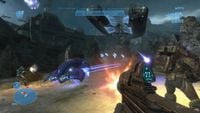
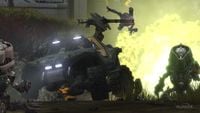 Firefight on Beachhead.
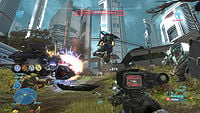 First-person view of a Spartan as he uses the H-165 target locator.
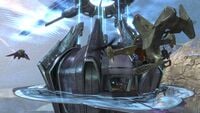 A multiplayer match on Spire.


Sources[edit]
- ^ a b Xbox Wire: Halo: Reach Hits Xbox One Backward Compatibility Today
- ^ Halo: Reach Announcement Trailer
- ^ Bungie.net: Halo: Reach Project Page
- ^ Worthplaying.com - "Halo 3: ODST" Developer Interview
- ^ Bungie.net: Halo: Reach Launches 09.14.2010!
- ^ Game Informer: How Much Cash Did Halo Reach Bring In On Day One?
- ^ a b c d EDGE Magazine, February 2010
- ^ a b c d GameInformer: February 2010
- ^ YouTube: E3 2010 Extended Reach Campaign Mission HD
- ^ Halo: Reach E3 Campaign Demo
- ^ Halo: Reach, level Overlook, Overlook radio conversation
- ^ Bungie.net: Bungie Weekly Update 10/16/2009
- ^ Bungie.net: Bungie Weekly Update 10/23/2009
- ^ MTV, Bungie Considered "Halo 4," Starring Master Chief, Instead of Reach Prequel (Retrieved on Jun 1, 2020) [archive]
- ^ Noble Actual: Final stretch
- ^ Bungie.net: Bungie Weekly Update: 07.16.10
- ^ Bungie.net: Bungie Weekly Update 08.06.10
- ^ Bungie.net: Bungie Weekly Update: 07.02.10
- ^ a b ComputerAndVideoGames: Interview: Halo Reach
- ^ a b Popular Mechanics: How Halo: Reach Perfected Video Game Audio
- ^ GameVideos: Halo Reach VGA Interview
- ^ GameTrailers TV — Episode 102
- ^ Bungie.net: Bungie Weekly Update 8/20/20
- ^ Bungie.net: Bungie Weekly Update 9/17/10
- ^ Bungie.net: Bungie Weekly Update 07.30.10
- ^ WelcomeToNobleTeam.com: Homepage
- ^ www.rememberreach.com
- ^ Bungie.net: Halo: Reach Launches 09.14.2010!
- ^ Bungie.net: This is the End
- ^ Bungie.net: Halo: Reach Unboxed
- ^ You Tube:Unboxing Reach
- ^ Wired.com: New Halo: Reach Xbox to Sport 360 Design, Custom Sound - The imagery and text on the console isn't just gibberish. It will all have meaning for Halo die-hards.
- ^ McFarlane Toys: MCFARLANE TOYS TO PRODUCE 'HALO: REACH' ACTION FIGURES
- ^ http://www.bestbuy.com/site/halo-origins-bundle-xbox-360/3101005.p?id=1219087370856&skuId=3101005&ref=25&loc=SHP&srccode=cii_45538312&cpncode=26-300353605-2
- ^ https://www.express.co.uk/entertainment/gaming/1212647/Halo-Reach-MCC-release-PC-Xbox-On-Microsoft-free-update
- ^ SumthingDigital: Halo: Reach Original Soundtrack
- ^ 1Up: Halo: Reach Review
- ^ IGN: Halo: Reach Review
- ^ Gamepro: Halo: Reach review
- ^ MTV Multiplayer: Bungie On The Contradictions Between 'Halo: Reach' And 'Halo: The Fall Of Reach' Novel
- ^ canon.net HRINC: Halo Reach Is Not Canon
- ^ MTV Multiplayer: Bungie Considered "Halo 4," Starring Master Chief, Instead Of "Reach" Prequel
- ^ Bungie.net: Bungie Weekly Update 07.09.10
- ^ Halo: First Strike, page 104
Related links[edit]
Internal[edit]
- Halo: The Fall of Reach
- Halo: First Strike
- Halo: Reach - Announcement Trailer
- Halo: Reach Video Games Awards Trailer
- Reach
External[edit]
- Bungie.net: Official Halo: Reach project page
- Welcome To Noble Team: Viral Campaign
- VANITY: Halo: Reach Player Image Generator
| ||||||||||||||||||||||||||||||||||||||||||||


