
Firefight
From Halopedia, the Halo wiki

- "Welcome to the last day of the rest of your life."
- — The announcer[1] (Halo: Reach)
Firefight is a single or cooperative wave defense mode featured in multiple Halo games. The mode debuted in Halo 3: ODST in 2009 and has since gone on to become a series staple, with most of the following games having a variation on the concept of some sort. In traditional Firefight, up to four players can co-operate with one another via System Link or Xbox LIVE to fight off waves of attacking enemies, though some variations of Firefight allow for more players and player-versus-player gameplay.
Since its debut in Halo 3: ODST, Firefight has been featured in Halo: Reach, Halo 5: Guardians, Halo Wars 2, and Halo Infinite - each putting their own spin on the concept. Halo 4 did not feature Firefight, but did feature Spartan Ops, which filled a similar niche for that game.
Overview[edit]
Halo 3: ODST[edit]

- Main article: Firefight (Halo 3: ODST)
Firefight debuted in Halo 3: ODST as a survival-focused wave defense mode in which the player(s) have one objective: survive for as long as possible. This early iteration of Firefight has no limited to how many Waves of enemies can spawn, and continues until the squad has completely run out of lives. There are five Waves in a Round, and three Rounds in a Set. At the end of each Round, new skulls are activated, increasing the difficulty further. At the end of each Set is a Bonus Round, in which infinite Grunts spawn for a period of 90 seconds. During the Bonus Round, players cannot respawn and multiple skulls are activated, with the score modifier increased, allowing players to gain thousands of points in a short timeframe. Each enemy killed is worth a number of points, with the score multiplier increasing as the game goes on and more skulls are enabled.[2][3]
Upon ODST's original 2009 launch, stats and leaderboards for Firefight were hosted on Bungie.net, though these were discontinued after Bungie disconnected Halo web services in 2012.[4] The mode was not included with the 2015 port of ODST's campaign into Halo: The Master Chief Collection, and was instead added to the collection alongside ODST's port to PC in mid-2020.[5] The port to The Master Chief Collection saw the mode expanded with the ability to play Firefight in matchmaking (a feature unavailable in the original game), create customised gametypes, access to enemies, weapons and vehicles previously unavailable in the original release, an increased playercount, and other miscellaneous quality-of-life improvements detailed here.
Halo: Reach[edit]

- Main article: Firefight (Halo: Reach)
- "It’s official. Firefight is back and better than ever. To get your drool on, go ahead and salivate over a Firefight that’s fully integrated into Halo: Reach’s matchmaking and topped off with an insane side of complete player customization, right down to each Set, Round, and Wave. And that’s just the beginning of the control you have over the experience."
- — Bungie.net description[6]
Firefight returned in Halo: Reach with a new and expanded featureset, referred to as "Firefight 2.0" by Bungie.[6] The major focus of Firefight 2.0 was the introduction of custom gametypes, allowing players to customise the composition of each Wave of enemies throughout the game, the traits of the player characters, and the hazards and obstacles present on the map. For Reach, Firefight was also integrated into the game's matchmaking, allowing players to search for Firefight games online. These features shifted Firefight away from ODST's pure survival focus toward more arcade-styled custom gametypes, with the default Firefight experience in matchmaking capped at one round (though the traditional ODST-style mode is preserved as the Firefight Classic gametype). As such, players have access to all of the weapons and equipment in Firefight that they may have in normal Firefight including armor abilities, as well as access to features not found in regular multiplayer such as the target locator.
Among the changes introduced in Reach was the concept of Firefight Versus; players are able to play as Elites and fight alongside the Covenant enemies to attack and kill the Spartan players. The Generator Defense mode was also added to Firefight, shifting the game focus away from pure survival towards the defense of a number of fusion generators dotted across the map.
When Halo: Reach was added to The Master Chief Collection in 2019, its iteration of Firefight recieved many of the same improvements afforded to ODST Firefight, including an increased player cap, more custom game options, and online quality-of-life improvements (detailed here).
Halo 5: Guardians[edit]

- Main article: Warzone Firefight
Firefight was not included in Halo 4, though a similar mode, Spartan Ops, was included in its place. The mode was also not included in Halo 5: Guardians at launch, though a post-launch update released in mid-2016 provided a major spin on the traditional Firefight experience in the form of Warzone Firefight. Unlike previous Firefight experiences, Warzone Firefight is less focused on wave survival and instead on the completion of specific objectives in a multiplayer PvE context based on the standard Warzone mode. The mode can only be played in matchmaking and features no customisation, though can be played with up to eight players.[7][8]
In Warzone Firefight, players are tasked with completing five rounds of increasing difficulty: each round features a new randomly chosen objective including defense missions and boss battles. Players do not have limited lives as in earlier Firefight iterations, but each round instead adds time to the respawn timer. If a round's objective is not completed before the round timer counts down, the match ends. Due to Warzone Firefight's foundations on the existing Warzone mode, it heavily relies on Halo 5's requisition system for its gameplay. Players have access to their entire REQ card library and can call in power weapons and vehicles at any time.[7][8]
Halo Wars 2[edit]
- Main articles: Blitz Firefight, Terminus Firefight
Firefight made its debut in the real-time strategy genre in Halo Wars 2. At launch, Halo Wars 2 included Blitz Firefight, a variation on the regular Blitz multiplayer mode. Blitz Firefight plays similarly to regular Blitz, with up to three players tasked with defending three control points on the map from increasingly-difficult waves of AI-controlled units of both Banished and UNSC variety. The mode can only be played on the map The Proving Grounds. Similar to the original ODST Firefight, Blitz Firefight is an endless mode, and only ends when the AI gets 200 points by controlling a majority of the map's control points. Due to the mode's basis on Blitz, Blitz Firefight does not involve building bases or managing economy; instead, the focus is on calling in Blitz cards for reinforcements.
The release of Halo Wars 2: Awakening the Nightmare in late 2017 brought the addition of a second Firefight mode to the game: Terminus Firefight. Terminus Firefight functions as a more traditional Firefight experience for Halo Wars 2, tasking the players with defending a Forerunner Terminus building from infinite waves of increasingly difficult AI attack. In contrast to Blitz Firefight, Terminus Firefight allows players to build bases and fortifications across the map akin to a tower defense game, allowing for a more traditional Halo Wars gameplay experience inside the Firefight formula. Terminus Firefight can only be played on the map The Last Bastion, and uniquely allows players to fight against the Flood alongside waves of Banished and UNSC attackers.
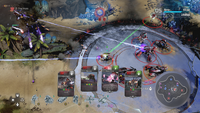 Blitz Firefight.
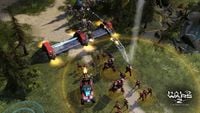 Terminus Firefight.


Halo Infinite[edit]
- Main article: Firefight (Halo Infinite)
Firefight was introduced into Halo Infinite in the game's December 2023 update in the form of Firefight: King of the Hill. Unlike prior Firefight modes, Halo Infinite's Firefight is not an entirely separate experience to the regular multiplayer, but instead built in the game's Forge mode thanks to the new ability to spawn AI in the editing tools. Firefight: King of the Hill combines Firefight gameplay with King of the Hill, with waves of increasingly-difficult Banished enemies attempting to storm and hold a hill located on the map. Players have to capture and hold five hills to win, with boss waves deployed at regular intervals to up the ante. Due to feedback from prior games' Firefight modes, Firefight: King of the Hill does not have a limited pool of lives and players can be revived if downed - however, a full squad wipe is cause for total loss (though the traditional system of limited lives can be enabled in custom games).[9] For special events, such as The Yappening II, Firefight: King of the Hill has been themed around more specific game variants like Gruntpocalypse, in which all enemies are replaced with Grunts.[10][11] In 2024's Great Journey update, a third-person viewmode was added to Firefight: King of the Hill, marking the first time third-person gameplay had been done in any official Halo release. Third-person mode was also added to custom game settings at the same time.[12]
The Blue Team Operation released in early 2025 brought the addition of Firefight Classic to Halo Infinite. Firefight Classic aims to emulate the original ruleset of Halo 3: ODST's Firefight including Waves, Rounds, Sets, the 7 limited lives, the Bonus Round, and the infinite waves. However, one notable change includes the ability to end the game early at the end of a Set. After each Set, a zone spawns on the map that allows players to enter it; if two or more players enter the zone, they are extracted from the game. If the players fail to enter the zone, they are commited in the game until they either run out of lives or finish the next set.[13]
Trivia[edit]
Firefight is similar to wave defense game modes found in many other games, examples including the survival mode from the Xbox LIVE Arcade port of Marathon 2, Zombies from Call of Duty, Invasion from Unreal Tournament 200X, Survival Mode from Left 4 Dead, and Horde from Gears of War 2. In all of these game modes, players attempt to survive against countless numbers of enemies of increasing difficulty over a long period of time.
Gallery[edit]
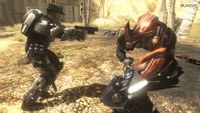 Johnson fighting a Jiralhanae Chieftain on Lost Platoon.
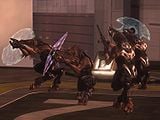 A Jackal lance on Windward.
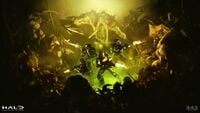 Key art for the "Floodfight" update to Halo 3: ODST in Halo: The Master Chief Collection.
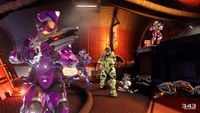 Warzone Firefight in Halo 5: Guardians.
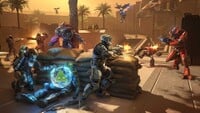 Firefight Classic in Halo Infinite.


Sources[edit]
- ^ Halo: Reach marketing, Halo: Reach Welcome to Firefight 2.0 Trailer
- ^ Bungie.net, Drop Into Firefight (Retrieved on Oct 12, 2014) [archive]
- ^ Bungie.net, Bungie Weekly Update: 08/14/09 (Retrieved on Oct 12, 2014) [archive]
- ^ Bungie.net, Halo 3: ODST : Features - Firefight (Retrieved on Mar 24, 2013) [archive]
- ^ Halo: The Master Chief Collection marketing, Halo 3: ODST Firefight Teaser
- ^ a b Bungie.net, Welcome to Firefight 2.0 (Retrieved on Oct 13, 2014) [archive]
- ^ a b Halo Waypoint, Warzone Firefight (Retrieved on Aug 18, 2016) [archive]
- ^ a b Xbox Wire, First Look at Warzone Firefight in Halo 5: Guardians (Retrieved on May 9, 2025) [archive]
- ^ Halo Waypoint, Firefight: King of the Hill Preview (Retrieved on May 9, 2025) [archive]
- ^ Halo Waypoint, The Yappening II Operation Launch (Retrieved on May 9, 2025) [archive]
- ^ Halo Waypoint, Gruntpocalypse (Retrieved on May 11, 2025) [archive]
- ^ Halo Waypoint, Playlist Overview - Great Journey (Retrieved on Oct 31, 2024) [archive]
- ^ Halo Waypoint, Firefight Classic (Retrieved on May 9, 2025) [archive]
| |||||||||||
| |||||||||||||


