
Halo: Flashpoint
From Halopedia, the Halo wiki
| Halo: Flashpoint | |
|---|---|
 
| |
|
Developer(s): |
|
|
Publisher(s): |
|
|
Release date(s): |
|
|
Genre(s): |
|
Halo: Flashpoint is a tabletop strategy game produced by Mantic Games in conjunction with 343 Industries and Microsoft.[2] The game was released in mid-late November 2024, depending on region.[1]
Unlike the previous Fleet Battles and Ground Command wargames produced by the now-defunct Spartan Games, Flashpoint is focused on Spartan and Elite battles similar in nature to Halo multiplayer.[3][4] The games are predominantly focused on small-team skirmish fighting, though Mantic have expressed interest in producing larger-scale games based on Firefight and including vehicles should Flashpoint be successful.[5]
Official summmary[edit]
- "The year is 2560.
Humanity was forced to the brink of extinction by the alien alliance known as the Covenant, and even in victory many of our worlds were glassed and left in ruins.
From the ashes of the Covenant War a new generation of super-soldiers has been trained in War Games simulations, pitting Spartan Fireteams against an almost infinite combination of potential threats – including other Spartans.[6]"
Overview[edit]

Flashpoint is a skirmish-scale wargame with a focus on small teams and fast, easy to pick-up-and-play gameplay.[4] The game is played on a 61x61cm (2x2ft) board designed to fit on most tables, with a high degree of emphasis on verticality. The terrain is constructed based on a cube grid, meaning that unlike other tabletop wargames, no tape measures are required to play. However, positioning is still a vital component of the game; height and cover play important roles in determining dice rolls and damage output.[7] Terrain is present in the form of pre-printed cardboard punch-out structures including things like barricades, shipping crates, and towers, to allow for a 3D playing field.[4] In the expanded Spartan Edition of the game, the arena board and terrain pieces can be flipped to theme the map around either a UNSC hangar facility or an outdoor training yard.[7][8] When setting up a map, players can scatter the map with a number of item tokens to represent power weapons, grenades, equipment, ammunition, and other game-changing pickups.[5]
Gameplay involves the use of D8 dice alongside some custom D6s.[4] When attacking or defending, the player rolls 3 D8s for the relevant stat, with additional die added depending on other factors such as if the attacker has high ground or if the defender is in cover.[7] The D6s are termed as "command dice", and allow Spartans to perform unique abilities to respond to the changing situation on the battlefield. Each command dice has a custom symbol on each face; the first is a data chip representing a Special Order - a unique ability that is determined by the player's chosen faction/leader. An arrow symbol represents an extra movement, a diamond represents an additional D8 dice roll for more damage, an explosion represents being allowed to fire another shot, and a Spartan helmet represents being allowed to activate another Spartan.[5]
Each character has an individual stats card that list a Spartan's two weapons, a pickup slot, energy shielding value, and other keyword-based specific stats/perks. Like in Halo FPS multiplayer, power weapons can be picked up on the map and equipped for a massive advantage.[7] As per Halo multiplayer, upon death, a given character can be respawned back onto the field at one of a number of respawn points - albeit with reduced abilities.[4]
The game consists of preassembled plastic miniatures that can be manually painted, although the Spartan Edition box includes two teams in red and blue plastic by default to allow for easy play. Each miniature consists of a SPARTAN-IV clad in one of the various multiplayer armours available for use in Halo Infinite, each equipped with one of the weapons useable in Halo Infinite and given a dedicated stats card.[4] In both release editions of the game, the Spartan teams provided are mirrors of one another, with Recon including four-per-team and Spartan including eight-per-team. Each Spartan has a unique weapon and armour suite, which dictate their in-game stats. As such, in Recon Edition, this has the game play with two identical teams of four whereas in Spartan Edition, both players can build a custom fireteam of four based on the eight models they each have available to pick from. However, if the standalone Master Chief mini is picked, he counts as two Spartans by himself - meaning that picking Master Chief will bring the total fireteam size down to three.[5]
Currently, the game features two factions: the UNSC and the Banished. The Banished were first introduced in the Spartan Edition of the game with the Sangheili Mercenaries and were expanded on with the Rise of the Banished Faction Box that added Atriox and a handful of different Jiralhanae units. The UNSC currently consists of both Spartans and ODSTs which were introduced in the Feet First Into Hell Faction Box.
Game modes available in Halo: Flashpoint include takes on a number of classic scenarios from Halo FPS multiplayer including Slayer, Oddball, Capture the Flag, Strongholds, and Stockpile.[8]
Development[edit]
Flashpoint's origins date back to a pitch document produced by game designer Ronnie Renton in 2017 (the same year that Spartan Games and the previous Halo tabletop games were shut down). Mantic spent several years after 2017 attempting to get the Halo IP though were repeatedly denied - a process they credited with allowing them to ensure that their original game Deadzone was highly-refined by the time they were granted the Halo license in 2022. From the beginning, Ronnie envisioned the game working on the same cube-based terrain system as Deadzone due to its ability to allow for quick play rather than multi-hour sessions typical of a larger wargame. The Deadzone rules committee were tasked with designing the first iterations of the game in the five month period between 343 Industries granting permission for Mantic to begin work on the game and formally signing a contract, before Ronnie flew out to Redmond to show the game to 343 Industries in person. As of June 2024, the game has been in development for around eighteen months.[5]
One of Mantic's key priorities during development was the knowledge that Flashpoint would be many peoples' first introduction to tabletop gaming, due to Halo's already preexisting fanbase.[5] The scale of the models was not decided based on a predetermined size (ie 28mm, 32mm, etc), but instead based on a process of printing Spartan models at various size scales and comparing them with Deadzone's terrain pieces until they "felt right" - taking into account the Spartans' enhanced height and bulk as per their augmentations and armour.[5]
Flashpoint was first teased at the start of 2024 in a cryptic announcement,[3] followed by a full title reveal in March of that year.[2] The game was later debuted at GAMA Expo with some prototype units showing off early box art and miniatures,[4] with a full reveal in Adepticon at the end of March. The Adepticon reveal coincided with a dedicated website launch for Flashpoint on March 22, 2024.[2]
As of June 2024, the final model prints are currently in production for the first wave of pre-orders.[5] The official paints included in the Master Chief paint pack were made via a collaboration between Mantic Games and Army Painter. The pack required colours not currently supported by the Army Painter range, resulting in the creation of several new officially-licensed paints including "Master Chief Green".[5] A limited pre-release of the Recon Edition of Flashpoint is planned at GenCon in August 2024, with 150 copies available to purchase on each day of the event.[9][10]
Competitive play[edit]
Halo: Flashpoint tournament play was formally announced in March 2025, around six months after the game's release (and coinciding with the release of Wave 2 of the game, detailed below). To help support tournament play, Mantic released a number of tournament packs for organisers which include new scenarios, special cards, and some unique features for the game's web app. Other tournament releases include a "Paint and Take" pack, which includes a number of miniatures to allow prospective players to try out the game and paint their own model in-store, and a special unique set of Spartan models - Fireteam Wolf - to use as a grand prize for a tournament setting. These models are not available for individual purchase.[11]
Web app[edit]
The Halo: Flashpoint Web App (internally dubbed the Halo: Flashpoint Index[12]) is an online rules reference, army builder, and tournament tracker created by Mantic as a digital resource for Flashpoint players available on both desktop and as a mobile app. It was released as a beta on April 24, 2025, and has since gone into a full release.[13]
The web app includes the ability to increase a player's rank by attending local tournaments, and is set to eventually include leaderboards and titles for best players in various categories.[12]
Appearances[edit]
Editions[edit]
Year One[edit]
Wave 1 (Fall 2024)[edit]
At launch, Halo: Flashpoint released with two editions: Recon Edition and Spartan Edition.[4] Recon Edition is intended for players who may be new to tabletop wargaming, and comes with all of the basics needed to play a game of Halo: Flashpoint including 8 Spartan models (4 red, 4 blue), 10 weapon tokens, and a full suite of terrain and gameplay tokens.[14] The Spartan Edition is intended for more seasoned wargamers and Halo fans, consisting of 16 Spartan models (8 red, 8 blue), 4 Elite models, more terrain, more weapon cards, and more deluxe content.[7][15]
The first batch of pre-orders for the game come bundled with a free miniature of John-117 in his GEN3 Mark VI armour from Halo Infinite. This model can also be purchased separately in an individual painting pack. Pre-orders are set to begin shipping in September 2024.[8][16] The paints included in the painting pack are based on official Pantone colour palettes approved by 343 Industries to represent the Spartans of the Halo universe.[5]
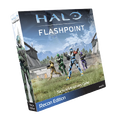 Recon Edition box.
 Recon Edition terrain.
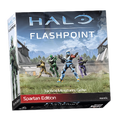 Spartan Edition box.
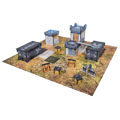 Spartan Edition terrain.
 Spartan Edition alternate terrain.
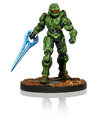 Master Chief pre-order model.


Wave 2 (Q1 2025)[edit]
Wave 2 of Halo: Flashpoint was announced for pre-order in October 2024,[17] with a release date of March 20, 2025 (depending on region).[18] The releases in this wave focused on fleshing out ways to play the Spartans, with several new models released based on the Spartans from Halo: Reach.
The main release of Wave 2 was the War Games Expansion Pack, released and containing four Reach-themed Spartan miniatures clad in Mark V [B] MJOLNIR armor; HAZOP, GUNGNIR, JFO, and CQB. The War Games Spartans include new weapons Concussion Rifle, energy sword, plasma launcher, shotgun), with the box containing additional stat cards for all of the then-released Spartan/Weapon combinations, and new point rules for building fireteams. Released alongside the War Games Expansion Pack was a second Spartan miniature set, Fireteam Cerberus, containing the same set of Spartans as the War Games Expansion, but with alternate weapons and poses (grenade launcher, target locator, gravity hammer, Spiker).[18][19][20] In addition, a set of plastic UNSC-themed terrain including generators, barriers, and crates, was made available for purchase.[21]
Finally, items already made available in the initial Wave 1 releases were made available for purchase separately. These included Fireteam Hydra (consisting of Spartans originally exclusive to Spartan Edition)[22] and two neoprene mats, Field Outpost [23] and Firebase - both neoprene releases of the boards originally exclusive to Spartan Edition.[24] Another unique Spartan fireteam set, Fireteam Phoenix, was also made available for limited-time purchase during the 2025 show season and on Mantic's web store. These Spartans are alternate poses of the ones featured in the Recon Edition of the game.[25]
As a limited time bonus, preorders made on Wave 2 bundles before January 24, 2025, included a "The Weapon" score tracker.[26]. This bonus was available from orders on Mantic's web store and from participating local games stores.
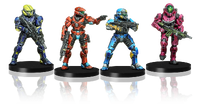 Fireteam Phoenix models.
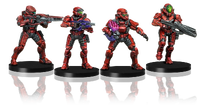 Fireteam Hydra models.
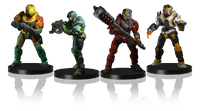 Fireteam Cerberus models.


Wave 3 (Mid 2025)[edit]
Wave 3 of Flashpoint was announced on March 26, 2025, with a focus on introducing the first new faction to the game - the Banished.[27] This Wave focused around a larger expansion box set, Rise of the Banished, which introduced Brutes into the game alongside using the Elite models first introduced in Spartan Edition. The Rise of the Banished expansion also included new Banished-themed cardboard terrain, and pre-orders included a unique limited-edition model of Atriox.[28] Rise of the Banished was released in July 2025, with the rest of Wave 3 set to ship in September.
Alongside Rise of the Banished, a number of additional Banished-themed releases were announced for Wave 3. These included the Defiance Expansion Pack, similar to Wave 2's War Games pack but focused on Jiralhanae,[29] and the Jiralhanae Fireteam - a small pack containing four additional Brute models to flesh out Brute armies.[30] The Sangheili Mercenaries pack was also made available for purchase, containing the four Elites originally released in Wave 1's Spartan Edition.[31]
Other additional releases in Wave 3 included a neoprene play mat themed around a Banished Garrison, a Banished-themed dice set, and a Banished cardboard terrain set - the latter two being items from the Rise of the Banished box but available to purchase individually. An Atriox model, identical in stats to the one featured in the Rise of the Banished preorder but with a different sculpt, was also released.[32]
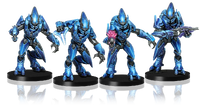 Sangheilie Mercenaries models.

Wave 4 (Fall 2025)[edit]
Wave 4 of Flashpoint was announced on July 31, 2025, focusing on the newly-announced Feet First Into Hell expansion - focusing on introducing the Orbital Drop Shock Troopers into Flashpoint. The Feet First expansion includes 16 ODST models alongside limited edition hero models for Edward Buck and Veronica Dare, a New Mombasa-themed terrain, and new rules for the new models.[33] Preorders for Feet First Into Hell started to ship in October 2025. The contents of the expansion were also released in three separate smaller parts: the Desperate Measures Expansion Pack that includes the ODST models and unit cards[34], the New Mombasa Terrain Set[35], and a separate bundle of Buck and Dare with different poses from the ones in Feet First Into Hell.[36] These were released in February 2026.
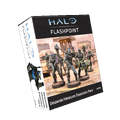 Desperate Measures box.
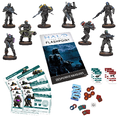 Desperate Measures contents.
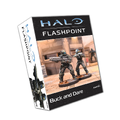 Buck and Dare box.
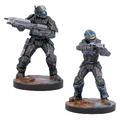 Buck and Dare models.


| Recon Edition[14] | Spartan Edition[15] | Rise of the Banished[28] | Feet First Into Hell[37] |
|---|---|---|---|
 |
  |
 |
 |
|
|
|
|
Year Two[edit]
Wave 5 (2026)[edit]
The first expansion of Year Two was revealed in early 2026 with a release later that year, focusing on Halo: Reach and NOBLE Team.[38] Revealed on February 27, 2026, Wave 5 focuses on Noble Team in the dedicated Noble Team Expansion as well as several bundles that feature the Noble Team Expansion. There will also be a Reach and New Mombasa themed terrain mats, ODST themed scenery objects, and a special version of Fireteam Wolf in new poses.[39]
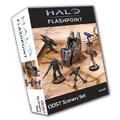 ODST Scenery Box.
 ODST Scenery contents.


Wave 6 (2026)[edit]
Wave 6 for Flashpoint was announced in June 2026, with multiple expansion boxes dubbed the Battle for Zeta Halo. These include "reinforcements" packs adding basic infantry for the UNSC and Banished; UNSC Marines, and Grunts and Jackals, respectively, alongside heroes for Tomas Horvath and an Elite Enforcer. To complement NOBLE Team from the prior wave, a new box of Hand of Atriox miniatures was also made available, including Jega 'Rdomnai, Hyperius, and Tovarus. The Battle for Zeta Halo also has a new Installation 07-themed playmat, all of which could be bought separately or in one bundle.[40]
Wave 6 also included some updates for the existing game. These included the ability to buy a pack of core game rules and tokens without any miniatures (to enable playing with one of the prior army packs), an updated 1.5 rulebook with some rules clarifications and quality-of-life updates, and a new pack containing the Spartan Models originally from the War Games Expansion - now available separately as Fireteam Grizzly.[40]
Wave 7 (2026)[edit]
Wave 7 was announced in October 2026, focused on the Battle of Installation 04.
Gallery[edit]
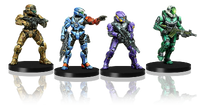 A fireteam of Spartan miniatures.
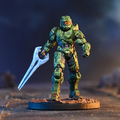 A photo of the Master Chief model.
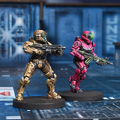 Two Spartans.
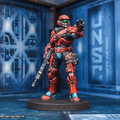 A red Spartan clad in Mark VII.
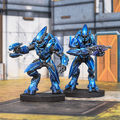 A pair of Sangheili Mercenary miniatures.
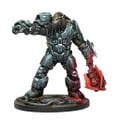 Atriox miniature.
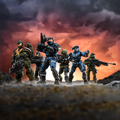 All six Noble Team miniatures.
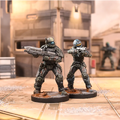 Buck and Dare miniatures.
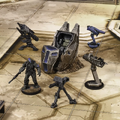 ODST Scenery.


Sources[edit]
- ^ a b c Mantic Games, Halo: Flashpoint – Release Dates (Retrieved on Oct 24, 2024) [archive]
- ^ a b c Mantic Games, Halo: Flashpoint - First Reveals (Retrieved on Mar 3, 2024) [archive]
- ^ a b Mantic Games, On the 12th Day of Christmas: Special Announcement (Retrieved on Mar 3, 2024) [archive]
- ^ a b c d e f g h Bell of Lost Souls, Halo: Flashpoint – Mantic Games Showcase At GAMA (Retrieved on Mar 8, 2024) [archive]
- ^ a b c d e f g h i j YouTube - Mantic Games, Mantic Vs Army Painter - Halo Flashpoint Painting Challenge Day 1 (Retrieved on Jun 12, 2024)
- ^ Mantic Games, What is Halo: Flashpoint? - Video Preview (Retrieved on Mar 21, 2024) [archive]
- ^ a b c d e YouTube - Mantic Games, What Is Halo: Flashpoint? - The Tabletop Miniatures Game from Mantic Games (Retrieved on Mar 21, 2024)
- ^ a b c Halo: Flashpoint, What is Halo: Flashpoint? (Retrieved on Mar 22, 2024) [archive]
- ^ X.com, Mantic Games (@manticgames): "Big Mantic gaming stories in August: 🌌 Halo: Flashpoint Recon Edition limited pre-release at GEN CON booth #1515 (only 150 copies each day)!" (Retrieved on Jul 29, 2024) [archive]
- ^ Mantic Games, Play Games & Meet the Team! 26th Jul 2024 (Retrieved on Jul 29, 2024) [archive]
- ^ Mantic Games, Introducing Organised Play to Halo: Flashpoint (Retrieved on Aug 3, 2025) [archive]
- ^ a b Mantic Games, The Halo App Updated! (Retrieved on Aug 3, 2025) [archive]
- ^ Mantic Games, Halo: Flashpoint Online Rules, List Builder, and Global Rankings (Retrieved on Aug 3, 2025) [archive]
- ^ a b Halo: Flashpoint, Recon Edition (Retrieved on Mar 22, 2024) [archive]
- ^ a b Halo: Flashpoint, Spartan Edition (Retrieved on Mar 22, 2024) [archive]
- ^ Halo: Flashpoint, FAQ (Retrieved on Mar 22, 2024) [archive]
- ^ Mantic Games, Wave 2 Pre-Orders & Wave 1 Second Printing (Retrieved on Jul 11, 2025) [archive]
- ^ a b Mantic Games, Halo: Flashpoint – Get Tactical with Wave 2 (Retrieved on Jul 11, 2025) [archive]
- ^ Mantic Games, War Games Expansion Pack (Retrieved on Jul 12, 2025) [archive]
- ^ Mantic Games, Fireteam Cerberus Pack (Retrieved on Jul 12, 2025) [archive]
- ^ Mantic Games, UNSC Scenery Set (Retrieved on Jul 12, 2025) [archive]
- ^ Mantic Games, Fireteam Hydra Pack (Retrieved on Jul 12, 2025) [archive]
- ^ Mantic Games, Field Outpost Deluxe Gaming Mat (Retrieved on Jul 12, 2025) [archive]
- ^ Mantic Games, UNSC Firebase Deluxe Gaming Mat (Retrieved on Jul 12, 2025) [archive]
- ^ Mantic Games, Halo: Flashpoint Organised play, Show Specials, and the Banished (Retrieved on Aug 3, 2025) [archive]
- ^ Facebook, ***BREAKING NEWS*** Free 'The Weapon' (Retrieved on Jul 11, 2025) [archive]
- ^ Mantic Games, Breaking News - The Banished Are Coming To Halo: Flashpoint (Retrieved on Aug 3, 2025) [archive]
- ^ a b Halo Flashpoint, Rise of the Banished Boxed Set (Retrieved on Dec 29, 2025) [archive]
- ^ Mantic Games, Defiance Expansion Pack (Retrieved on Aug 3, 2025) [archive]
- ^ Mantic Games, Jiralhanae Fireteam (Retrieved on Aug 3, 2025) [archive]
- ^ Mantic Games, Sangheili Mercenaries (Retrieved on Aug 3, 2025) [archive]
- ^ Mantic Games, Atriox, Warmaster of the Banished (Retrieved on Aug 3, 2025) [archive]
- ^ Mantic Games, Feet First Into Hell - The ODST Drop Into Halo: Flashpoint! (Retrieved on Aug 3, 2025) [archive]
- ^ Mantic Games, Desperate Measure Expansion Pack (Retrieved on Dec 22, 2025) [archive]
- ^ Mantic Games, New Mombasa Terrain Set (Retrieved on Dec 22, 2025) [archive]
- ^ Mantic Games, Buck and Dare (Retrieved on Dec 22, 2025) [archive]
- ^ Halo Flashpoint, Feet First Into Hell Boxed Set (Retrieved on Dec 29, 2025) [archive]
- ^ Mantic Games, Halo: Flashpoint - Year One & Beyond (Retrieved on Dec 22, 2025) [archive]
- ^ Mantic Games, Command Noble Team, Heroes of Reach (Retrieved on Feb 27, 2026) [archive]
- ^ a b Mantic Games, Halo: Flashpoint Summer Reveals and Pre-Orders - Join the Battle! (Retrieved on Jun 7, 2026) [archive]
External links[edit]
| ||||||||||||||||||||||||||||||||||||||||||||


