
CQB-class Mjolnir
From Halopedia, the Halo wiki
| CQB | |
|---|---|
GEN1 Mark VI
 GEN1 Mark V
 | |
| Production overview | |
|
Manufacturer(s): |
|
|
Testing site(s): |
Special Warfare Center Essen, Deutschland (developed)[1][2][3][4][5] Special Warfare Center Seongnam, Hanguk (tested)[1][2][3][4][5] |
|
Type: |
MJOLNIR (GEN1) MJOLNIR (GEN2) (Compatible)[6]
|
|
Role(s): |
|

The MJOLNIR Powered Assault Armor/C variant, colloquially known as the Close Quarters Battle (CQB) armor, is a variant of the MJOLNIR Powered Assault Armor manufactured by Beweglichkeitsrüstungsysteme.[1][2][3][4]
GEN1 overview[edit]
Design details[edit]
The CQB variant specializes in the improvement of survivability in close quarters engagements, this was done in the dispersal of kinetic energy, by looking at alternate methods to disperse the kinetic energy versus momentum transferred by a Spartan during combat. In addition the CQB's armor components are designed to optimize joint mobility in close quarters, and have an improved field of view.[1][2][3][8]
Although CQB surpasses CQC in overall integration, the variant's ability to allow ad hoc modifications is limited in comparison.[1][9] The helmet is compatible with the AN/PCK-221 FARNDALE Command Network Module, the AN/PZY-990T STARLIGHT and PZY-955SSA WILLOW remote sensors and the Type C1 UA module.
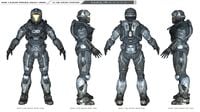 Turnaround reference of the CQB helmet on the Mark V armor.
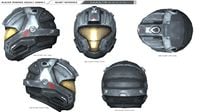 Turnaround reference of the Mark V CQB helmet.
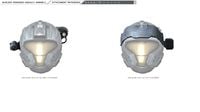 Mark V CQB helmet with HU/RS/CNM and UA/HUL attachments.
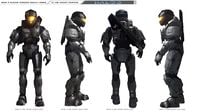 Overview of the Mark VI CQB variant.


