
Cut Halo Wars buildings
From Halopedia, the Halo wiki
| This page discusses elements of deleted material and cut content. Some information on the page is sourced from game files and may not be verifiable through external sources. Where possible, such information should be clearly-marked and replaced with a proper external source as soon as one is available. |

This article is part of a series on
Halo Wars cut content
- Cut content
- Development
Halo Wars development
Concept art
Storyboards
Title Updates
Halo Wars Alpha
E3 2007 demo
E3 2008 demo
Cancelled sequel
Phoenix
To check out cut content for other Halo games, see here!
- "The next (and last) big problem on base building and building size turned out to be the need for the units to exit their buildings. We really wanted to showcase that. It had been received very well in our E3 2007 demo. We had gutted that base scheme during the various un-fun iterations of the “place anywhere” systems, so most of the E3 2007 stuff was gone. But, we were determined to keep the units exiting their buildings. But those tanks are so f’ing big. Each building site had to be big enough to accommodate the Vehicle Depot, which was killing our attempts to reduce the base size."
- — Dave Pottinger on the E3 2007 bases.[2]
Throughout the development of Halo Wars, a large number of buildings were cut from the final release. Over the game's development, the building system went through over six iterations prior to settling on the Firebase system ultimately found in the E3 2008 Demo and final game.[2]
UNSC buildings[edit]
Air pad[edit]
- Main article: UNSC Airpad
While the Air Pad was ultimately included in the final game, it underwent several revisions to reach that stage. An early design of the air pad found in the E3 2007 build consists of a small hangar and runway for several aircraft including a B-65 Shortsword and three Falcons or Sparrowhawks.[1] Icons depicting this design remain in the files of the final release, depicting upgrades which add the aforementioned Shortsword and a missile silo to the structure. These may indicate that early iterations of the air pad were used to deploy leader powers.
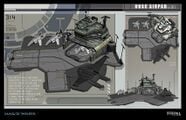 The model for this early air pad.
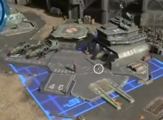 This air pad in-game.
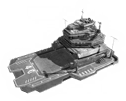 An icon for the early air pad.
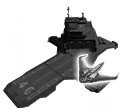 An icon for an upgrade to the air pad, which appears to add a B-65 Shortsword bomber to the runway.
 An icon for an upgrade to the air pad, which appears to add a missile silo to the structure.


Barracks[edit]
- Main article: UNSC Barracks
Another building that survived into the final game, the barracks underwent many design iterations. In the E3 2007 build, the barracks are little more than a fenced-off courtyard, and have Marines doing pushups behind the building.[1] Another iteration of the barracks was intended to be "orbitally deployed", with the building dropping down from orbit and unpacking itself.[3]
A third design of the barracks has also been shown, much more simplified in form and more closely-resembling the direction of the buildings in the final game. Icons depicting this design remain in the files of the final release.
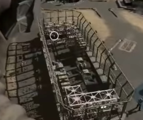 The barracks seen in the E3 2007 build, with marines doing pushups.
 Concept art for the unfolding mechanism of the orbitally-deployed barracks.
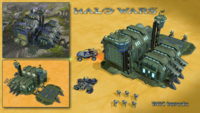 The model for the orbitally-deployed barracks.
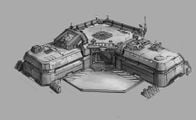 Concept art for the third design.
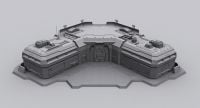 A wireframe render of the barracks, early in Halo Wars' production.
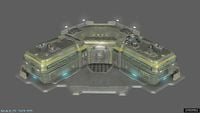 A render of the early barracks design.
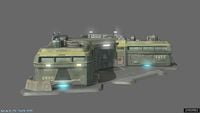 Another early render.
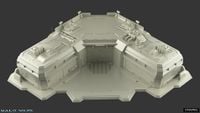 Hi-poly render of the early barracks.
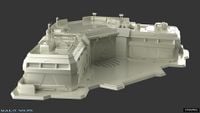 Hi-poly render of the early barracks.
 An icon for this barracks iteration.


Command centre[edit]
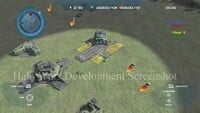 A look at the E3 2007-era bases, with the command centre visible in the bottom-left.
 A look at an iteration of the "orbitally-dropped" bases.


Landing pad[edit]
 This section is a stub. You can help Halopedia by expanding it.
Missile silo[edit]
- "Two missile silos... two guys standing uncomfortably close to the edge."
- — Graeme Devine, referring to the silos in the E3 2007 demo.[1]
Found in the E3 2007 Demo, the missile silo was presumably intended for launching missiles as part of the leader power system. The building is never used in the demo, leaving its full functionality a mystery.[1]
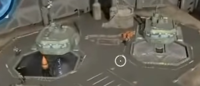 Open and closed missile silos in the E3 2007 demo.

Power extractor[edit]
Found only as a leftover icon in Halo Wars' game files, the bldg_powerextractor's function remains a mystery - though it was presumably an early iteration of what would become the UNSC Reactor in the final game. Its design is notably similar to Halo Wars 2's replacement for the UNSC Reactor, the UNSC Generator.
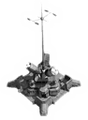 The power extractor's icon.

Repair pad[edit]
This building's existence is only known thanks to a leftover icon in Halo Wars' game files, named bldg_repairpad. As such little of its intended functions are known, though its name suggests it was intended to Heal and Repair friendly units. This may be an indication, similar to the airpad upgrades above, that leader powers were initially intended to be activated by buildings.
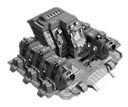 The repair pad icon.

Spec ops building/ field armory[edit]
- Main article: UNSC Field Armory
Another building that was realised in the final release, the field armory went through similar revision as other buildings. A particularly early revision labels the field armory as the "spec ops building", though the building went through at least one other iteration before the final design was chosen; this second iteration's icon is featured in the E3 2007 demo and remains in the files for Halo Wars. Icons additionally remain in the files for yet another "specialops" building design alongside the aforementioned field armory.
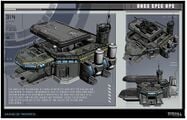 The "spec ops building" 3D asset.
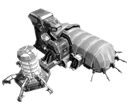 An icon for the spec ops building, remaining in Halo Wars' game files. This design is drastically different to the prior revision.
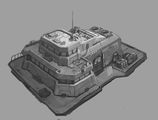 Concept art for a revised field armory.
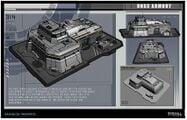 The 3D asset for this revised field armory.
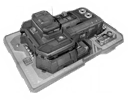 An icon for the revised field armory.
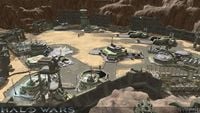 A firebase in the E3 2007 demo; a field armory can be spotted in the back-middle, with two blue jets coming out of the top.


Supply pad[edit]
- Main article: UNSC Supply Pad
The UNSC Supply Pad went through a few iterations throughout Halo Wars' development. One iteration appeared to be a much larger building than in the final game, with a large landing pad set atop hydraulic supports. This version was concepted by Matthew Burke and modelled by Robert Walden.
A second iteration was featured in the E3 2007 demo and in a gallery section on the game's announcement website.[4] By comparison, this Supply Pad is a more squat structure with a single landing pad and a crane. Various icons leftover in Halo Wars' game files indicate this building would have had several upgrades, with one icon depicting a D77 Pelican docked to the structure, and the second icon depicting a general upgrade to the structure's sturdiness.
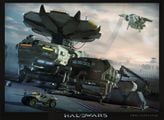 An early concept for the supply pad.
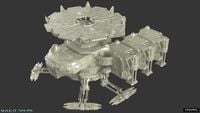 A high-poly render of the early supply pad.
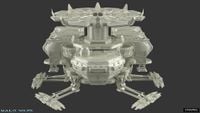 A high-poly render of the early supply pad.
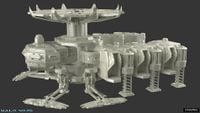 A high-poly render of the early supply pad.
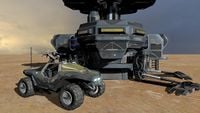 A screenshot of a Warthog next to the supply pad.
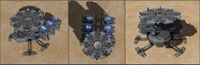 Angled views of the supply pad.
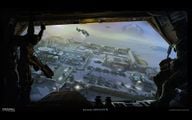 A more developed concept piece for a full firebase, with a supply pad prominently visible towards the left side of the image.
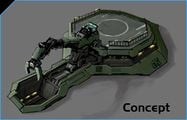 Early concept art for the E3 2007 supply pad design.
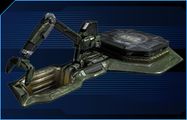 An official render of the E3 2007 supply pad model.
- A screenshot of a firebase in the E3 2007 demo; the supply pads can be seen to the right.
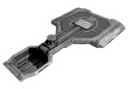 An icon for the supply pad, with no upgrades.
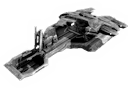 An icon for the supply pad with a D77 Pelican upgrade.
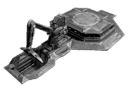 An icon for the supply pad's third and final upgrade, generally beefing up the structure.


Turrets[edit]
Some early designs for the M5 Talos base turrets would have seen the turrets able to be deployed from orbit, similar to abilities later implemented into Halo Wars 2. These designs would have reused turret geometry from existing UNSC vehicles, with a third (unfinished) variation intended to create a crater with a small fortification in the middle.[5]
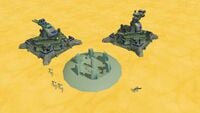 Early turret designs.
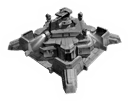 An icon for the turret.
 An icon for the turret with a "cannon" upgrade.
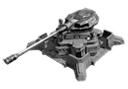 An icon for the turret with a "fort" upgrade, appearing to resemble the Zeus artillery cannon of the M145D Rhino.
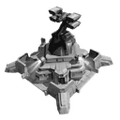 An icon for the turret with a missile upgrade, presumably for anti-aircraft use as in the final game.
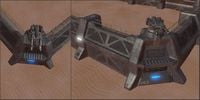 A screenshot of various modular walls seen in the E3 2007 demo, with turrets mounted atop them.
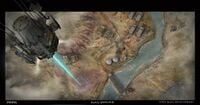 Early concept art depicting an orbitally-deployed structure, seemingly similar in concept to the fortification described by Jennell Jaquays.


Vehicle depot[edit]
The UNSC Vehicle Depot went through a small number of revisions in production. One early iteration, found in the E3 2007 build and as a leftover icon in the final game, appears to be similar in design to the vehicle spawn buildings found aboard UNSC Spirit of Fire in mission 11: Cleansing and mission 12: Repairs, with a ramp leading underground for the vehicles to spawn from. According to Dave Pottinger, the early vehicle depot models were well-received due to their ability to show the vehicle leaving the building. However, their massive size caused issues in base building, which was the catalyst that led to the final game's socket base building system.[2]
A second iteration, shown below as a render, appears to be almost identical to the final game asset, with a slightly longer section in front of the building and some minor altered details.
- A screenshot of a firebase in the E3 2007 build; two vehicle depots can be seen in the back-right of the image.
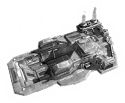 An early icon for the vehicle depot. This iteration appears to have been the basis for the vehicle production buildings used in missions 11/12.
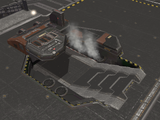 The Vehicle Depot airlock in the final game.
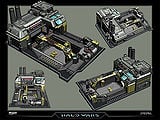 A render of the near-final vehicle depot model.
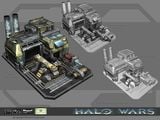 The final vehicle depot model, for comparison.


Miscellaneous[edit]
- This section is a stub. You can help Halopedia by expanding it.
- A more developed concept piece depicting an early iteration of firebase, featuring numerous buildings.
Covenant buildings[edit]
Builder[edit]
The "builder" is a structure seen only in a concept piece by Nathan Stefan, labelled in the original file upload as builder008.jpg. Little is known of its intended function or purpose.
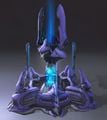 Concept art for the "builder".

Factories[edit]
- Main article: Covenant Factory
Various icons and concepts for Halo Wars point to the idea of the game initially giving the faction "Light" and "Heavy" variants of the Factory. The icon for the Light Factory bears a design almost identical to the final game's Covenant Summit (and aircraft production building), possibly indicating that in this early version of the game, the Covenant did not need specialised buildings for vehicles and aircraft, but instead divided the two into light and heavy categories.
The concept design for the heavy factory was done by Nathan Stefan and is also featured as a leftover icon in the final game, though this design was totally cut from the game and redesigned for the final release.
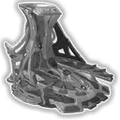 An icon for the light factory, reused in the final game as the Covenant Summit building.
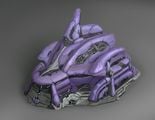 Concept art for the heavy factory, by Nathan Stefan.
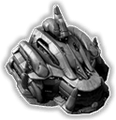 An icon for the heavy factory.


Monument[edit]
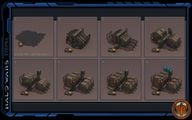
Identified only via filenames cov_bdlg_monument and cov_bdlg_upgradedmonument of icons in the released build of Halo Wars, the Covenant monument building was to have five tiers of upgrade, shown below. The monument's intended function is unknown, though the labelling of the base defense turrets as cov_nodemonumentupgrade suggests the monument was intended to serve as the base headquarters/ command centre in the original free-placement building system.
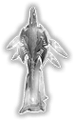 An icon for the monument.
 An icon for the monument's first upgrade.
 An icon for the monument's second upgrade.
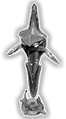 An icon for the monument's third upgrade.
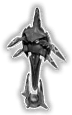 An icon for the monument's fourth upgrade.
 An icon for the monument's fifth upgrade.
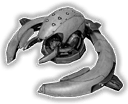 An icon for the "node upgrade", later reused in the final game as the base turret.
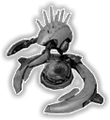 An icon for "node02", seemingly a needle-based upgrade to the standard turret.


Scarab[edit]
- Main article: Cut Halo Wars units § Scarab (Protos-pattern)
While ostensibly a unit like any other, the leftover icon for the Scarab in Halo Wars' E3 2007 build refers to the vehicle as cov_bldg_scarab_01, with "bldg" a standard phrase used for all building icons. It is unclear as such whether in this early game, the Scarab was considered to be a building rather than a vehicle. For more in-depth information about the early Scarab, see here.
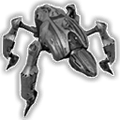 The Scarab "building" icon.

Wall generator[edit]
Found in the earliest builds of Halo Wars, these structures are descended from mechanics intended for the original Phoenix IP developed by Ensemble prior to adopting the Halo themeing. As part of this game, the alien enemies were to have the ability to build "fog-of-war killing barriers".[6] Covenant-themed models for these structures were created by artist Duane Santos, though the mechanic was ultimately cut.[7]
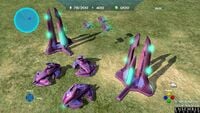 The wall generators alongside some Banshees and Brute Tanks.

Flood buildings[edit]
Flood spawner[edit]
- Main article: Flood Den
- This section is a stub. You can help Halopedia by expanding it.
Sources[edit]
- ^ a b c d e Halo Wars E3 2007 Demo
- ^ a b c Official Halo Wars Community Site, How to Build a Base in the 26th Century (Retrieved on Jan 17, 2010) [archive]
- ^ Facebook, Jennell Jaquays' Halo Wars pre-release overview: "This was an unfolding version of the barracks building. The idea from the art director was that it dropped from orbit, landed on retro thrust rockets and then all the details of the model unfolded or unpacked themselves. This was my first project after shifting over from the recently completed Warchiefs game expansion ... and my first experience at very-high poly modeling for normal mapping. The upper left image was created by a freelance concept artist working with the art director. The AD made a simple folding version of the concept. I developed my model from the AD's prototype." (Retrieved on May 1, 2021) [local archive] [external archive]
- ^ Official Halo Wars Community Site, Features (Retrieved on Dec 15, 2007) [local archive] [external archive]
- ^ Facebook, Jennell Jaquays' Halo Wars pre-release overview: "Drop from space gun emplacements/fortifications. The middle piece (unfinished) would be fired from space to create a crater with a small fortification in the middle. The upper two used weaponry taken off existing UNSC vehicles" (Retrieved on May 1, 2021) [local archive] [external archive]
- ^ Twitter, Graeme Devine (@zaphodgjd): "I think they were wall generators? Left over from Phoenix when non-humans could build fog of war killing barriers." (Retrieved on Sep 21, 2021) [archive]
- ^ ArtStation, Halo Wars: Covenant Wraith (Retrieved on Sep 21, 2021) [archive]


