
SRS99C-S2 AM sniper rifle
From Halopedia, the Halo wiki
| SRS99C-S2 AM sniper rifle | |
|---|---|
|
| |
| Production overview | |
|
Manufacturer: |
|
|
Model series: |
|
|
Type: |
Sniper rifle, anti-materiel[1] |
| Specifications | |
|
Ammunition type: |
|
|
Feed system: |
4-round detachable box magazine[3][4] |
| Service history | |
|
In service: |
|


The Sniper Rifle System 99C-Series 2 Anti-Matériel, abbreviated SRS99C-S2 AM[5] or just S2 AM,[1] is a commonly-utilized sniper rifle in the arsenal of the United Nations Space Command. As evidenced by its designation, it is part of the SRS99 Series.
Overview[edit]
Design details[edit]
- Main article: SRS99 Series
The SRS99C-S2 AM is a gas-operated, magazine-fed sniper rifle chambered in the powerful 14.5×114mm cartridge.[2] Its rate of fire is semi-automatic, and it is typically fed by 4-round detachable box magazines.[3][4] As befits their sniping role, they are issued with optics, such as the Oracle N-variant scope.[6]

A salient attribute of the rifle is its inherent reconfigurability; the optics, stock, barrel and firing mechanism are all designed in modular sections to simplify the tailoring of the weapon to specific needs.[7] Other potential components of the weapon include gyro compensators and adaptive texture barrel sheaths.[8][Note 1] One configuration of the weapon, which was deployed during the Battle of Installation 04, featured a noticeably longer barrel and different optic than the configuration observed later during the Battle of Mombasa and the Battle of Installation 05.[3][4] The former version mounted an optic capable of x2 and x8 magnification,[3] and the latter an optic capable of x5 magnification, though both optics were smart-linked and capable of x10 magnification, and both weapons were employed firing APFSDS (armor-piercing fin-stabilized discarding-sabot) ammunition.[2][1]

During Operation: TALON, Linda-058 deployed her SRS99C-S2 AM with an alternate barrel designed to suppress firing report and muzzle-flash and, in order to compensate for the reduced muzzle velocity that came with this, re-chambered it to fire .450-caliber ammunition. Additionally, she removed any sight or scope, instead deeming to rely on an integrated link between the weapon and her HUD for the close-quarters environment. She also brought a supply of extended magazines to last her the engagement.[7] She later employed the weapon in a different configuration during the Battle of Sigma Octanus IV, this time with an Oracle scope.[9]
The appearance of the SRS99C-S2 AM is characteristic of Series 2 iterations of the SRS99 family. While bulky, its body is streamlined and smooth, somewhat simple in design, and possesses a matte-black or grey finish. The charging handle is positioned on the left side of the weapon, a tube-shaped protrusion with a metallic finish, and the ejection port is situated on the right.[Note 2] A square-shaped carry-handle is positioned above and in front of the scope. The configuration used on Installation 04 featured a solid stock joined to the base of the pistol grip, while the later version lacked this, and its stock had a prominent cutout. The barrel is locked into the upper receiver of the weapon by a prominent, rounded collar.[3][4]
Functionality[edit]
As with most human weapons, to fire the SRS99C-S2 AM, the index finger is used to depress a trigger positioned towards the top of the grip. After firing, no additional action is required to chamber another round, with the weapon’s gas systems serving to cycle the bolt, ejecting the spent casing and loading a new round automatically. Holding the trigger down, however, will not result in continuous firing, making it semi-automatic, as opposed to fully-automatic. When the weapon fires, a hot cloud of fiery gas is expelled from the barrel exit and the ports of the muzzle brake, and as the projectile travels through the air, it leaves a lingering trail of smoky vapor. The expended cartridge case is ejected out of the right side of the weapon as the charging handle reciprocates, before moving forward again as the next round is chambered. This process can be repeated continuously until all available rounds are expended.[3][4]

In the case of the configuration used on Installation 04, when the magazine is empty, the charging handle locks back, indicating the functionality of a bolt catch. Once the magazine is exchanged, the charging handle must be nudged to release the bolt into its closed position, stripping a round from the magazine on its path and chambering it.[3] In the case of the configuration employed later, the charging handle travels forward when the magazine is emptied, but the weapon can still be immediately fired after a fresh magazine is inserted, indicating that the bolt does not close despite the movement of the charging handle, and only does so with the insertion of a fresh ammo supply. If magazines are exchanged while ammunition remains in the weapon, this process is not necessary as the cycle of the bolt is uninterrupted.[4]
The smart-linked optics commonly employed with the SRS99C-S2 AM, when initiated, will project the view of the weapon's optic on the heads-up display of the user's visor, should they possess one. This targeting display indicates projected firing point of impact via a targeting reticle, remaining ammunition quantity in the weapon and loaded magazine, and level of zoom, which can be cycled between the lesser and greater magnification (generally x2 to x8 for the first configuration, though it is capable of x10 zoom,[1] and x5 to x10 for the second). The display features notches to indicate elevation, and can be toggled with a night vision filter for functionality in the dark.[3][4]
Performance[edit]
While notably bulky and of limited use in close-quarters, the SRS99C-S2 AM is considered devastating when employed strategically, firing from a secured position.[2] The 14.5x114mm APFSDS ammunition it is most frequently utilized with has extremely vicious penetration capability, being able to pass through several armored soldiers in a row. While this is of benefit when engaging resilient armored targets, it is also cause for great caution in hectic firefights.[1] The Covenant begrudgingly considered this weapon to be both accurate and powerful, noting that headshots could result in immediate incapacitation for even energy-shielded infantry.[10]
History[edit]

SRS99C-S2 AM rifles were prominently employed by UNSC forces during the Battle of Installation 04,[3] with John-117 notably deploying with one during the mission to board the Truth and Reconciliation to retrieve Captain Jacob Keyes.[11] They were also employed in the early stages of the Battle of Earth, and the Battle of Installation 05.[4] Spartan Linda-058 is particularly notable for her use of this weapon, specifically during Operation: TALON,[7] the Battle of Sigma Octanus IV,[9] Operation: FIRST STRIKE,[8] and the Onyx Conflict.[12]
In-game information[edit]
- Main article: Sniper Rifle
The Sniper Rifle is a precision power weapon, which fires highly damaging projectiles at near instantaneous speeds. It features two levels of zoom, and a magazine of 4 rounds. This makes it a powerhouse at long ranges, capable of killing most enemies, including enemy players in multiplayer, with one headshot, and outranging other weapons like the Battle Rifle significantly. To compensate for its power, it is a relatively rare weapon, and ammo for it is difficult to find.
Trivia[edit]


- During an interview, William O'Brien, an animator for Halo 2, said, "Robert McLees is definitely the go-to guy for the gun stuff. I wanted to come up with an animation for the sniper scope, an 'idle cycle'. If you activate the scope, and then sit too long without doing anything, the animation would kick in periodically, just to keep things interesting... Simple, right...? He replied, 'No way. If you adjust your scope in the field, you're dead. Snipers don't do that.' That's how detailed his weapon designs are -- not just guns, but how they work, and how a sniper would fire them. Amazing."[13]
- In Halo: Combat Evolved, enemy NPCs do not acknowledge the sniper rifle's shot if they do not see the sniper, despite its loud crack in close-medium quarters. If the player downs an enemy with the sniper rifle, some will note the fallen AI, but will not search for the player as they would if the player fired with any other weapon. This can be most easily seen (and thoroughly used to the player's advantage) during the opening sections of Truth and Reconciliation, and is essential to getting the achievement All According to Plan in Halo: Anniversary.
- In the original Xbox 360 version of Halo: Combat Evolved Anniversary the sniper rifle's reticule is far larger than it is in the original Halo: Combat Evolved on Xbox and PC. In the Halo: The Master Chief Collection version of Halo: Anniversary, the reticule returns once again to its original size.
- A trend started on Halo 2 was the inclusion of a Trinity symbol on the weapon's stock. It was originally going to come back for the Halo 3 Sniper Rifle, but it was cut from the final game.[14]
Gallery[edit]
Halo: Combat Evolved[edit]
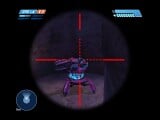 The scope of the SRS99C-S2AM in an early build of Halo: Combat Evolved.
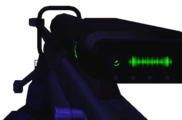 A first person view of the SRS99C-S2AM in Halo: Combat Evolved.
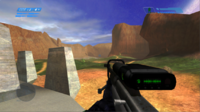 First-person view of the SRS99C on Blood Gulch.
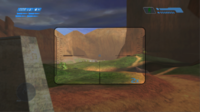 The 2× zoom
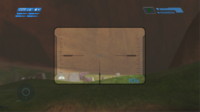 The 10× zoom.
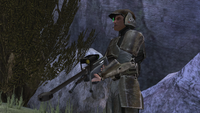 A marine with the SRS99C.
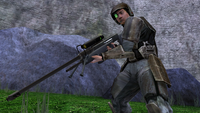 A marine wielding the SRS99C.
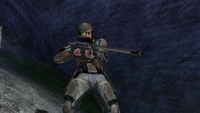 A marine takes aim with the SRS99C.
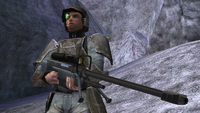 A marine with the SRS99C.
 John-117 using the SRS99C in combat.
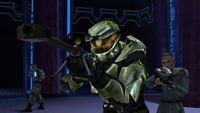 Front view of the SRS99C.
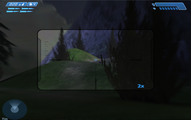 The 2× scope of the SRS99C-S2AM in Halo PC.
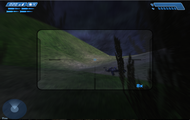 The 8× scope of the SRS99C-S2AM in Halo PC.
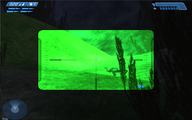 The night-vision function of the scope of the SRS99C-S2AM in Halo PC.
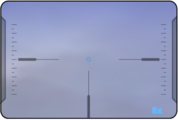 The SRS99C-S2 AM's targeting reticule in Halo PC.
 Two Spartans using the SRS99C on Timberland.


Halo 2[edit]
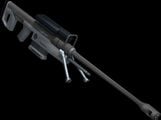 Side view of the SRS99C-S2.
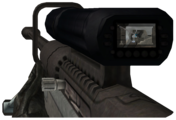 A first person view of the SRS99C-S2.
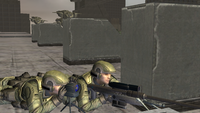 A marine using the SRS99C-S2.
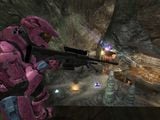 A Spartan with the SRS99C-S2 on Waterworks.


Halo Legends[edit]
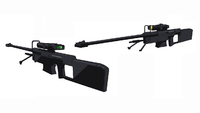 Concept art of the SRS99C-S2 in Homecoming.
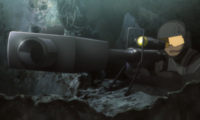 Hauser with the SRS99C-S2 in Homecoming.
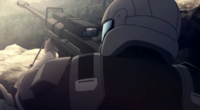 O'Brien with the SRS99C-S2 in The Babysitter.


Halo Infinite[edit]
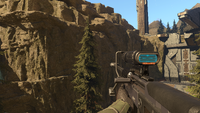 First-person view of the Veteran SRS99.
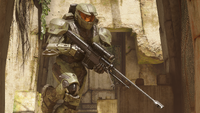 A Spartan sprinting with the Veteran SRS99.
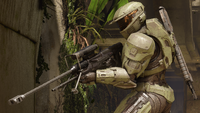 A Spartan carrying the Veteran SRS99.
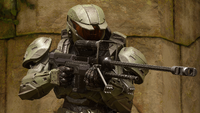 A Spartan takes aim with the Veteran SRS99.


Halo: Campaign Evolved[edit]
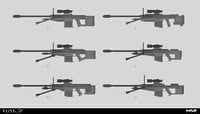 Early concept revisions for the weapon.
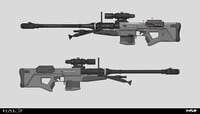 Orthographic concept art.
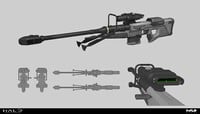 Finalised concept art.
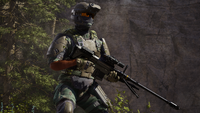 A marine with the SRS99C.
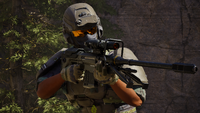 A marine with his SRS99C raised.
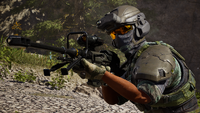 A marine wielding an SRS99C in combat.
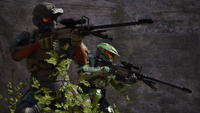 John-117 and a marine wielding SRS99Cs in combat.
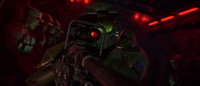 John-117 wielding an SRS99C-S2 sniper rifle in Echo 419's troop bay.
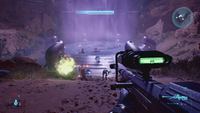 John-117 preparing to fire the SRS99C-S2 on a Kig-Yar.
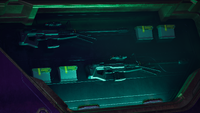 Two SRS99Cs on display aboard the Triumph of Tolerance.


List of appearances[edit]
Notes[edit]
- ^ In the reference given for this information, the weapon in question is only described as an "SRS99C", and not by the full SRS99C-S2 AM designation. Given what has been observed of the naming schemes of the SRS99 family, it is possible that this weapon is of a different series to the SRS99C-S2 AM. However, there exists insufficient evidence to justify the creation of a new page, and in light of the real-world context that other series of SRS99 were not depicted at the time of Ghosts of Onyx's release in 2006 (the first depicted non-S2 variant of the SRS99 family was in Halo: Reach, released in 2010), this information has been assumed by this article to pertain to the SRS99C-S2 AM.
- ^ The model of the sniper rifle as seen in Halo: Combat Evolved does not feature a visible ejection port, but as the weapon still produces spent casings, this article assumes that this was an oversight and does not represent in-universe fact.
Sources[edit]
- ^ a b c d e f g Halo: Combat Evolved Manual, page 18
- ^ a b c d e Halo 2 Manual, page 11
- ^ a b c d e f g h i j Halo: Combat Evolved, Sniper Rifle in-game weapon
- ^ a b c d e f g h i Halo 2, Sniper Rifle in-game weapon
- ^ The Art of Halo, page 100
- ^ Halo: Ghosts of Onyx, chapter 23
- ^ a b c Halo: The Fall of Reach, chapter 9
- ^ a b Halo: First Strike, chapter 29
- ^ a b Halo: The Fall of Reach, chapter 20
- ^ Halo 2 Limited Collector's Edition Manual, page 14
- ^ Halo: The Flood, chapter 4
- ^ Halo: Ghosts of Onyx, chapter 29
- ^ The Art of Halo: Creating a Virtual World, page 100
- ^ YouTube - The Vengeful 'Vadam , Full Analysis of the Halo 3 "Pimps At Sea" Alpha
| ||||||||||||||||||||||||||||||||||||||||||||||||||||||||||||||||


