

Project CHRYSANTHEMUM
From Halopedia, the Halo wiki

- "Read. New training protocols have been outlined as well as an improved augmentation regime. We've learned much from the unfortunate medical processes Dr. Halsey had at her disposal."
- — Colonel James Ackerson introducing the CHRYSANTHEMUM augmentations to Kurt Ambrose[1]
Project CHRYSANTHEMUM was the codename given to the surgical and chemical augmentation procedures performed on the Spartan-III supersoldiers. They represented a significant improvement over the augmentations used in the previous SPARTAN-II program,[1] retaining the procedures' effectiveness but being safer and less invasive to perform.[2]
Background[edit]

The CHRYSANTHEMUM augmentation set improved upon the augmentations of the SPARTAN-II program,[1] pioneered by Dr. Catherine Halsey. With advances in technology, the casualty rate for Spartan-III candidates was usually 0%, as opposed to the 56% casualty rate of the Spartan-IIs.
The genetic requirements for the Spartan-III candidates were loosened from the exceedingly strict criteria of the SPARTAN-II program,[1] although the range of compatible individuals still remained incredibly narrow, and any aberrations from the required genetic set geometrically increased the failure rate.[3][4] Colonel James Ackerson, the mastermind of the SPARTAN-III program, requested to have mandatory genetic screening put in place in the Outer Colonies in order to find more genetic matches for his program, but the Office of Naval Intelligence leadership felt this would only provoke the colonists for further aggression against the UNSC.[3] As a result of the more lenient selection criteria, the Spartan-III candidate pool was less physically and psychologically consistent, with a higher likelihood of behavioral problems;[1] many of the Spartan-III candidates were more lively and predisposed for aggression than their forebears.[4]
While the CHRYSANTHEMUM augmentations still had to be administered at the onset of puberty as the bodies of either prepubescents or adults would reject the chemicals, Colonel Ackerson's age restriction protocol for the SPARTAN-III program was considerably looser than that of the Spartan-IIs.[3][2] The Spartan-III candidates' ages upon induction typically ranged from four to six years old,[5][6] with the nominal ages of some of them (such as Carter-A259) exhibiting more extreme deviation from the standard age range.[7]
Augmentations[edit]
All Spartan-IIIs[edit]
The schedule of the SPARTAN-III program was accelerated from that of the Spartan-IIs: because the Office of Naval Intelligence wanted to have the Spartans deployed in the field as rapidly as possible, by the time of Gamma Company the Spartan-IIIs were augmented at an average age of twelve, whereas the Spartan-IIs were fourteen during their augmentations. As puberty had not yet started for the majority of candidates at this time, they were given human growth hormone as well as cartilage, muscle and bone supplements added into their food over several months to artificially induce the onset of puberty. As a result, the candidates had the bodies of near-adult Olympic athletes at an average of only twelve years of age, and it took some time for them to acclimatize to their larger physiques.[2][Note 1]
| Drug | Description | Effect |
|---|---|---|
| 8942-LQ99 | "carbide ceramic ossification catalyst" drug.[2] | Skeletons become virtually unbreakable, allowing survival in harder impacts. |
| 88005-MX77 | "fibroid muscular protein complex" drug.[2] | Increased density of individual's muscles, greatly enhancing physical strength. |
| 88947-OP24 | "retina-inversion stabilizer" drug.[2] | Color sharpness is significantly improved upon, and night vision is heightened. |
| 87556-UD61 | "improved colloidal neural disunification solution" drug.[2] | Greatly improves the individual's reaction time, decreasing the time taken to react by 300%; "Spartan time". |
In addition to their chemically-administered augmentations, Spartan-IIIs were subjected to a number of surgical alterations to enhance their capabilities.[2] Their circulatory systems were also augmented from the human baseline.[8] All Spartan-IIIs are implanted with a neural interface, as all UNSC Armed Forces personnel are.[9] The augmentations also involved some degree of genetic modification. In 2548, Owen-B096 was immune to the negative genetic effects of a Forerunner artifact he encountered on Meridian, with said immunity being explicitly attributed to his augmentations. [10] Additionally, like their Spartan-II predecessors, a common genetic side-effect of their bioaugmentations was the suppression of their libido, which Olivia-G291 experienced.[11]
Gamma Company[edit]
In addition to the standard set of chemicals, Kurt Ambrose covertly had a set of three additional drugs added to the augmentations of Gamma Company in hopes of increasing their survivability in the field. All of the three had been outlawed by the UNSC Medical Corps in 2513.[2]
| Drug | Description | Effect |
|---|---|---|
| 009762-OO | Neural-altering non-carcinogenic mutagen. | Alters key regions in the individual's frontal lobe to enhance aggressive response, making the animal part of the brain more accessible in times of stress. This allows the subject access to enormous reserves of strength and endurance and enables them to remain fighting even under the influence of a wide systemic shock that would be instantly fatal to a normal human.[2] Depresses higher reason centers of the brain over time; requires regular doses of 009127-PX and 009927-DG to be taken to avoid uncontrollable aggression.[2] |
| 009127-PX | cyclodexione-4, bipolar integration drug | Counters the effects of 009762-OO.[2] |
| 009927-DG | miso-olanzapine | Counters the psychological effects of 009762-OO.[2] |
Procedure[edit]
The CHRYSANTHEMUM procedures took place aboard the mobile hospital ship UNSC Hopeful. Because of the SPARTAN-III program's secrecy, the Hopeful was stationed in interstellar space at Vice Admiral Parangosky's order for the duration of the procedures. The ship's docking cluster Bravo and the eight decks surrounding it were entirely cleared of personnel to allow ONI to move in their personnel and equipment.[2]
The augmentations were administered over the course of a week; the subject was kept in a mostly sedated state throughout the process, which was conducted in a large, open operations room housing 400 sections separated by semi-opaque plastic curtains. Each compartment was filled with medical equipment, including a sterile field generator overhead as well as vital signs monitors and a chemotherapeutic infuser. The infuser contained vials for the various chemicals, which were administered to the subject via IV and osmotic patches. The Spartans were given a number of drugs to allow them to withstand the procedures themselves and counter their potential negative effects; these included shock reducers, analgesics, anti-inflammatories, anticoagulants, and pH buffers.[2]
Performance[edit]
- "Even for a Spartan, the attack had been a masterwork, and it made Fred wonder just how deeply Mark-G313 had devoted himself to the fine art of killing."
- — Frederic-104 pondering the prowess of a Spartan-III.[12]

Despite the Spartan-IIIs' expendable nature and lower-grade equipment than the Spartan-IIs, their enhancements represented a "quantum leap" over the previous program's bioaugmentation set.[1]
The muscular augmentations administered gave a Spartan-III the strength of "three normal soldiers".[2] During Operation: TORPEDO, Spartan-IIIs ran at a speed of nearly 30 KPH (around 18 MPH).[6][Note 2] Spartan-IIIs were also described to have been moving with "speed and reflexes that no Covenant could follow". "They dodged, snapped necks and limbs, and with captured energy swords, they cut through the enemy until the field ran with rivers of gore and blue blood". The Spartans of Team Foxtrot engaged six Kig-Yar in close quarters and left the aliens' bodies "snapped like rag dolls". Tom-B292, 12 years old at the time and equipped with SPI armor, engaged a Sangheili armed with a plasma pistol and an energy sword in hand-to-hand combat. The Spartan's enhanced reflexes allowed him to dodge a plasma pistol bolt and sword swing at point blank range. He then proceeded to throw the Sangheili warrior to the ground and finish it off with his assault rifle. During the battle, the Sangheili and Kig-Yar forces moved out of cover because they realized that it was suicidal to face Spartans in close quarters.[6]
Approximately 300 Spartan-IIIs faced thousands upon thousands of Covenant, including Covenant air support, and were described to have been winning the battle until 7 Covenant cruisers emerged as reinforcements.[6] During the battle on Pegasi Delta, most of Beta Company were roughly twelve years old. The physical abilities of any Spartan-IIIs who lived long enough to mature would supposedly have improved significantly as CPO Mendez stated that Spartans only grew stronger and faster as their bodies grew accustomed to their augmentations.[13][Note 3] Although the carbide ceramic ossification rendered the Spartan-IIIs' bones "virtually unbreakable",[2] they can still be broken by extreme physical trauma. This was demonstrated when Olivia-G291's legs were broken in several places[14] by a three-meter-long slab of rock falling on them.[15]
During the Onyx Conflict, one of the Spartan-IIIs briefly fought the Mjolnir-armored Kelly-087. The Spartan-III in question was able to momentarily hold their own against Kelly, being strong enough to twist Kelly's wrist and escape from her arm lock as well, despite wearing only SPI armor, which does not significantly increase the wearers speed and strength, unlike MJOLNIR. While Kelly was able to quickly defeat the Spartan-III afterward with a palm strike, she took note that she would have easily torn her opponent's arm off if he or she were unaugmented; it should be noted that the Spartan III was on the move mere moments later.[16][17] Additionally, Mark-G313 was able to support and haul the weight of Frederic-104, who was equipped with Mark VI MJOLNIR armor and barely conscious.[18]

Mark-G313 was noted as being the best sharpshooter of his detail, which at the time consisted of Team Saber and Frederic-104,[19] who was the second-best sniper among the Spartan-IIs.[20] Moreover, during Operation: JOVIAN WHISTLE, Mark eliminated a Jiralhanae warrior by paralyzing it with a precise blade strike to its spine, leading Fred-104 to deem Mark's skills exceptional, even by Spartan standards.[12] Soon after, Mark eliminated numerous Jiralhanae warriors in close-quarters combat, with nothing but his combat knife.[21] Mark then continued his attack on the enemy by killing three Jiralhanae warriors before any of them even realized what was happening. He also killed a dozen enemies in six seconds with the help of Ash-G099.[22] In 2558, SPARTAN-G059 engaged Avu Med 'Telcam and two other Commanders in close quarters combat. She eliminated the two Sangheili with minimal effort and proceeded to finish off 'Telcam with three kicks, a punch, and a shot from an M6H Magnum.[23]
While Veta Lopis and her Ferret Team were on Neos Atlantis, Mark-G313 dodged a knife strike from the corner of his eye and proceeded to pick up Spencer Hume, who weighed 309 pounds (140 kg), and use him as a human shield to block knife strikes from Ota Gallo. When Hume began to resist, Mark accidentally killed him by dealing a soft punch to his chest, although Mark suggested that Hume must've had a weak heart for the hit to have killed him since Mark was deliberately holding back his strength with the blow. Later on, Mark moved so quickly that a Dark Moon Enterprises agent shot himself in the feet when Mark "abruptly" forced his rifle downwards. Additionally, Ash-G099 killed a Dark Moon Enterprises operative with three "rabbit" punches to the man's skull.[11]
The Spartan-IIIs' augmentations allow them to remain conscious and even function effectively while exposed to the vacuum of space for up to a minute. However, the Spartans still suffer from the negative effects of exposure to space and require medical treatment directly after to recover.[8] While on board a spacecraft, Kevin-A282 walked through the forces of rapid decompression while carrying Captain Darren Leone to safety. Later on, Kevin shot the rifle out of the hands of Ryan Larsson from a quarter mile away and successfully jogged to his location before Ryan could recover.[24]
While most Spartan-IIIs were issued Semi-Powered Infiltration armor as opposed to Mjolnir for budgetary reasons, a small number of Spartan-III candidates—called "cat 2s" by Kurt Ambrose—were set apart from the general population of the program by Ambrose and Franklin Mendez on the basis of possessing exceptional skill and performance either in general or in specific fields.[25][26][27] These Spartans were removed from the program's mainline companies, given Mjolnir armor and assigned to separate special forces units.[28] Kurt regarded the "cat 2" Spartan-IIIs as being on par with the Spartan-IIs in regard to sheer natural ability, though he would also later assess Gamma Company on the whole as being comprised of the "finest Spartans ever".[2][Note 4] Additionally, Dr. Catherine Halsey noted how SPARTAN-B312's "hyper-lethal" rating was shared by only one other Spartan,[Note 5] and remarked that Jun-A266's skills as a sniper were "unmatched".[29] Spartan-B312 was also noted to have singlehandedly broken Insurrectionist organizations and made entire militia groups disappear.[29][30] After the success of Operation: UPPER CUT, Noble Six survived landing on surface of Reach after he was thrown from the launch bay of the Ardent Prayer by Jorge-052 in high orbit above Reach, though he was equipped with an M-Spec reentry pack.[31][32][Note 6] On August 29th, Halsey acknowledged that decryption of data from a Forerunner artifact was only possible because of the efforts of Kat-B320.[Note 7] On the same day, Halsey states that Noble Six was chosen by the Cortana fragment to deliver her to the UNSC Pillar of Autumn, whose capacity to judge a Spartan's capabilities were acknowledged by Halsey to potentially be better than that of herself.[33][Note 8] On August 30th, while airborne in a moving pelican, Emile-A239 shot down two Banshees by clipping the lead Banshee's wing with a well placed grenade from a grenade launcher.[34]
While making his last stand on Reach, SPARTAN-B312, wearing Mjolnir armor, knocked out a Sangheili General with a single elbow strike and shot him twice in the head as he was struggling to get up. He then continued to make his final effort by dealing single strikes to multiple Sangheili Ultras and Sangheili Zealots causing them to forcefully stagger backwards, before being subdued himself.[35] During the Battle of Meridian in 2548, Owen-B096 took the hit of a Mgalekgolo full force which sent him flying through the wall of a warehouse. Thereafter, he beat the Hunter in CQC only suffering a minor limp from the encounter.[36]
Gamma Company[edit]
- Veta Lopis: "And if you don't get your injections, you... what? Start hearing voices? Go berserk?"
- Ash-G099: "Something like that. Except we don't always hear voices."
- Mark-G313: "Or see flying dinosaurs. That only happens sometimes."
- Olivia-G291: "But we can usually... read thoughts. I kind of like that, especially when there are civilians around, thinking about sex and stuff."
- — Exchange between Special Inspector Veta Lopis and the three Gamma Company Spartans of Blue Team regarding the latter's augmentations in a joking manner[37]
The mutagen 009762-OO, administered only to the Spartans of Gamma Company, makes the Spartans more resistant to pain and injury, with stress or pain only increasing their physical prowess. The Gammas are almost completely immune to shock, allowing them to endure injuries and physical pain beyond Spartans of any other generation; for example, Dante-G188 was able to function for some time after a number of Needler rounds had blown his chest open, initially not even realizing his grave injuries.[18] As a side effect, the drug suppresses higher brain functions over time; without the regularly administered counteragents, cyclodexione-4 and miso-olanzapine (the cocktails containing which are colloquially known among the Gamma Company Spartans as "Smoothers"),[38] the Spartan will lose their strategic judgment and become more prone to impulsive, instinct-driven behavior.[39] This may also occur in combat under extreme pain and stress; after both of her legs were broken, Olivia-G291 engaged and destroyed an Aggressor Sentinel with her bare hands by forcing it to the ground and smashing it repeatedly with a "rock as large as her torso" in an uncontrolled berserk rage.[14][Note 9] Frederic-104 noted that she could easily have indiscriminately attacked both allies and enemies in this state, and in order to immediately return her to normal, Fred was forced to strike her in the head with the butt of his rifle. The blow had enough force to knock off her helmet and was just enough to snap her out of this state.[40] It should be noted that life-threatening—or, indeed, even fatal—injuries do not invariably result in uncontrollable aggression, as demonstrated by the example of Dante-G188, who calmly limped into safety before saluting Lieutenant Commander Ambrose and informing the commander that he had been "nicked".[18] Rather, Olivia's case is suggested to have been the result of her using her immense pain to compound her strength and rage to the point she could no longer control herself.[14] Despite being severely wounded, having suffered a severe stomach wound and a crushed leg from a Warthog-sized boulder bouncing off of it, Mark-G313 was able to keep going thanks to his Gamma enhancements until Prelate Dhas Bhasvod snapped his neck. Although Ash in a Smoother-deprived state insisted that Mark wasn't dead as Gammas were augmented against cardiogenic, hypovolemic and neurogenic shock, Alice-130 informed him that Mark's neck was broken, he bled out and then he drowned, meaning that no matter his augmentations, Mark was dead three times over.[41]
There are several different types of "Smoother". The most common type used during combat operations is administered via a hypodermic injection and lasts approximately twelve hours, after which its effectiveness begins to steadily decrease. Several factors such as stress and fatigue can precipitate the mental unraveling process.[42] Ash referred to the Smoother-deprived state as "Gamma-mode fury."[41] The first symptoms, appearing within several hours after the Smoothers' effect wears off, include nervousness and irritability,[43][44] eventually followed by paranoia, fits of temper and physical outbursts.[42] After well over a day without a Smoother injection,[44] Mark-G313 began having difficulties distinguishing friend from foe in the middle of a firefight, holding a combat knife to a Marine sergeant's throat before being successfully convinced by Fred-104 that the Marine was an ally rather than an enemy infiltrator.[45] Another, significantly more expensive type of Smoother is a subcutaneous insert with a longer-lasting effect. While they can only be changed out in a medical facility, they also cannot be lost or destroyed during a mission like the more commonly used kind.[46] While in a Smoother-deprived state, Ash-G099 had to be dangled out of a Pelican by Alice-130 in order to be brought back to his senses. Once Alice assured him that Mark-G313 really was dead and allowed Ash to check, he calmed down completely. Seeing that Olivia was going to put everyone onboard in danger in her "Gamma-mode fury," Ash warned Alice not to use polly-sue or sedatives on either of them as they wouldn't work and would only serve to make Ash and Olivia crazy.[41] The crew of the UNSC Spirit of Fire had trouble tuning the Ferrets' Smoothers because they didn't have quite the same pharmaceuticals available. However, they were enough to restore Ash and Olivia's sanity.[47]
Trivia[edit]
The Birth of a Spartan live-action commercial for Halo: Reach depicts Carter-A259's eyes changing color from hazel to deep blue as a byproduct of his retinal augmentations, a side effect not described in any other media. Several augmented Spartan-IIIs have been shown to have different eye colors,[48][2] implying that the effect was not universal. The effect may have stemmed from Carter being much older than his peers when undergoing the augmentations.
Gallery[edit]
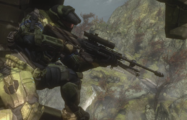 Jun-A266 sniping from a UH-144 Falcon.
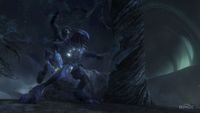 SPARTAN-B312 assassinates a Sangheili.
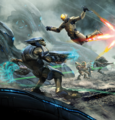 A Spartan-III engaging a Sangheili Minor in Halo Mythos.
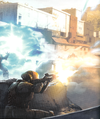 A Spartan-III of Blue Team during the Operation: JOVIAN WHISTLE.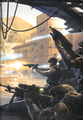
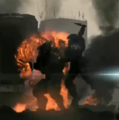 Carter assassinates a Sangheili Ultra during the Battle of Fumirole.
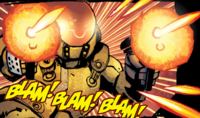 G059 fires a pair of M6H magnums.


List of appearances[edit]
- Halo: Ghosts of Onyx (First appearance)
- Remember Reach
- Halo: Glasslands (Mentioned only)
- Halo: Last Light (Mentioned only)
- Halo Mythos (Mentioned only)
- Halo: Fractures
- Lessons Learned (Mentioned only)
- Halo: Official Spartan Field Manual
- Halo: Meridian Divide (Mentioned only)
- Halo: Divine Wind (Mentioned only)
Notes[edit]
- ^ These hormonal treatments supposedly replaced the catalytic thyroid implants received by the Spartan-IIs as part of their augmentation procedures. When describing the CHRYSANTHEMUM augmentations, Halo: Ghosts of Onyx does not mention the Spartan-IIIs receiving the growth hormone catalyst in the form of a thyroid implant like the Spartan-IIs. Since the Spartan-IIIs received human growth hormone months prior to receiving their augmentations, it can be inferred that the catalytic thyroid implant was rendered redundant since both serve the same purpose.
- ^ Sprinting is the act of running at one's top speed for a short period of time. Given how this is a sprint speed obtainable by normal un-augmented humans, it seems unlikely that this is truly the Spartan IIIs' top speed. It is possible that "sprinting" in the context of this particular instance could mean covering a long distance with a relatively fast pace rather than actually sprinting. This is reinforced by page 14 of Halo: Ghosts of Onyx, which mentions the Spartan IIIs having to cross a terrain of over five kilometers on foot, which would imply maintaining the fastest pace possible while not losing any stamina. This would also indicate that the Spartan IIIs in this context were not running at their top speed, but rather a slower pace to conserve stamina.
- ^ While Mendez's statement was in reference to the Spartan-IIs, it can be assumed to hold true to their successors due to the similar nature of the augmentations.
- ^ Though Gamma company being the "finest Spartans ever" is only Kurt's opinion. Kurt's capacity to form that opinion would be the greatest of any human, since he would have access to all prior Spartan II and Spartan III boot camp performance measurements and service records.
- ^ The notion that the label "hyper-lethal" applies only to two Spartans is somewhat questionable, given that the information sheet for Spartans in Halo: Ground Command also states that "each Spartan is a hyper-lethal special forces operative".
- ^ Even though Noble Six had an M-Spec reentry pack on his back, the opening cutscene of Exodus may imply that the pack failed upon re-entry, with Noble Six's apparent injury possibly implying a fall from a great height without assistance, potentially even reaching terminal velocity. However, Noble Six could reasonably sustain injury during re-entry with a functional pack due to a variety of factors including angle of descent, landing surface, user error, etc. Further possible evidence is that the Sabre pilots were seen in Long Night of Solace to have M-Spec reentry packs as well, but they did not make it back to the surface with Noble Six. However, it is also possible that the other Sabre pilots canonically died during the boarding action or that they landed separately from Noble Six.
- ^ Halo: Reach never specifies if Kat's meddling with the data module saved time on the Cortana fragment's part or if it made the decryption of the data possible at all, with Cortana's capabilities as a smart AI pointing towards the latter rather than the former, especially since Halsey gave the Cortana fragment almost an entire month between August 5th-29th to decrypt the Forerunner artifact's data.
- ^ During the level The Package, Halsey states that the data that the Cortana fragment possesses is humanity's "best chance for survival". Though Halsey herself would never admit that a Spartan was better than John 117, seeing as how on August 25th, Halsey told the main Cortana that John was "the best" Spartan in her opinion. Regardless, on August 29th, Halsey set aside her opinion and let the fragment of Cortana claim another Spartan as "the best" Spartan since "the stakes" demanded it. Within the span of a month, the fragment determined that Noble Six was the best Spartan suited to carry her to the Pillar of Autumn. The fragment herself was so important that the Pillar of Autumn had to go groundside in order for Six to deliver her at all, in spite of the rigid planning of Operation Red Flag. Though it's never explicitly stated, the context of the Fall of Reach timeline and the stakes as they are explained in the level would suggest that Noble Six was the best Spartan to have ever been present on the planet Reach, considering the fragment would have to have chosen Six over all Spartan III and Spartan II teams to have ever been present on Reach during the month of August.
- ^ Assuming the rock was made from limestone, which was mentioned to be present in the cave on page 114 of Halo: Last Light, the rock potentially could have weighed anywhere from 1,400lbs to 11,200lbs (approx. 630 to 5000 kilograms) depending on the relative size of Olivia's torso and the gravity on Gao. Link to boulder weight scale.
Sources[edit]
- ^ a b c d e f Halo: Ghosts of Onyx, chapter 5
- ^ a b c d e f g h i j k l m n o p q r s Halo: Ghosts of Onyx, chapter 10
- ^ a b c Halo: Ghosts of Onyx, chapter 8
- ^ a b Halo: Ghosts of Onyx, chapter 6
- ^ Halo: Ghosts of Onyx, chapter 39
- ^ a b c d Halo: Ghosts of Onyx, Prologue
- ^ Bungie.net: Carter-A259 Personnel Profile
- ^ a b Halo: Fractures - Lessons Learned
- ^ Halo: Glasslands, chapter 8
- ^ Halo: Meridian Divide, chapter 21
- ^ a b Halo: Fractures - A Necessary Truth
- ^ a b Halo: Last Light, pages 152-154(Google Play edition) page 173(Print Edition)
- ^ Halo: The Fall of Reach, page 73
- ^ a b c Halo: Last Light, page 114
- ^ Halo: Last Light, page 118 (Google Play edition)
- ^ Halo: Ghosts of Onyx, chapter 18
- ^ Halo Mythos, page 77
- ^ a b c Halo: Ghosts of Onyx, chapter 33
- ^ Halo: Last Light, page 108
- ^ Halo: First Strike - The Definitive Edition, page 194
- ^ Halo: Last Light, pages 180, 193
- ^ Halo: Last Light, page 213, 216
- ^ Halo: Tales from Slipspace - Knight Takes Bishop
- ^ Halo: Fractures - Breaking Strain
- ^ Halo Waypoint, Kat-B320 (Retrieved on Jul 28, 2021) [archive]
- ^ Halo Waypoint, Carter-A259 (Retrieved on Sep 14, 2016) [archive]
- ^ Halo Waypoint, Emile-A239 (Retrieved on Oct 16, 2021) [archive]
- ^ halo.bungie.net, Communique from Kurt to Mendez (Retrieved on Oct 12, 2014) [archive]
- ^ a b Halo: Reach marketing, Halo: Reach ViDoc: A Spartan Will Rise
- ^ halo.bungie.net, Spartan-B312 Personnel Profile (Retrieved on Apr 28, 2013) [archive]
- ^ Halo: Reach, campaign level Long Night of Solace
- ^ Halo: Reach, campaign level Exodus
- ^ Halo: Reach, campaign level The Package
- ^ Halo: Reach, campaign level The Pillar of Autumn
- ^ Halo: Reach, campaign level Lone Wolf
- ^ Halo: Battle Born, chapter 10
- ^ Halo: Last Light, page 136
- ^ Halo: Last Light, page 123
- ^ Halo: Ghosts of Onyx, chapter 36
- ^ Halo: Last Light, page 102-104
- ^ a b c Halo: Divine Wind, chapter 17
- ^ a b Halo: Last Light, page 145-146
- ^ Halo: Last Light, page 182
- ^ a b Halo: Last Light, page 214-215
- ^ Halo: Last Light, page 247
- ^ Halo: Last Light, page 249
- ^ Halo: Divine Wind, Epilogue
- ^ Halo: Last Light, cover art & pages 104, 106 (Google Play edition)
See also[edit]
| |||||||||||||||||


