
D96 Albatross
From Halopedia, the Halo wiki
| D96-TCE Albatross | |
|---|---|

| |
| Production information | |
|
Manufacturer: |
|
|
Class: |
|
|
Role: |
|
| Technical specifications | |
|
Length: |
36.9 meters (121 ft)[1] |
|
Width: |
19.3 meters (63 ft)[1] |
|
Height: |
13.5 meters (44.2 ft)[2] |
|
Mass: |
151 metric tons (149 LT; 166 ST)[2] |
|
Slipspace drive: |
None[4] |
|
Hull: |
Heavily armored[3] |
|
Armament: |
|
|
Complement: |
|
|
Crew: |
|
| Chronological and affiliation | |
|
Era: |
|
|
Affiliation: |
|

The D96-TCE Albatross, formally designated as the D96 Troop Carrier, Equipment[1][2], is a heavy-lift dropship in service with the United Nations Space Command.[3] Manufactured by Ushuaia Armory, the Albatross is one of the UNSC's primary modes of long-range matériel deployment, transporting troops, vehicles, and equipment across long distances.[1]
Overview[edit]
Design details[edit]
A heavy-lift dropship manufactured by Ushuaia Armory, the D96-TCE Albatross is capable of deploying equipment behind enemy lines from both atmospheric and exoatmospheric locations. Although Albatrosses possess no offensive capabilities[3] as they are not typically armed, its nimble maneuverability and heavily protected, expansive cargo bay allow it to transport troops, vehicles, and equipment safely.[1] However, this agility only applies while the vehicle is unloaded - once the cargo bay is full, the ship is notoriously sluggish in the air.[2]
The Albatross lacks any form of slipspace drive.[4] The dropship's propulsion system consists of four engines, two on each side, attached to the Albatross' body.[1] The dropships are also equipped with an autopilot feature that allow them to be operated remotely by a dumb AI.[8]
The cockpit, located at the front of the Albatross, allows for a single pilot and one or two crewmen. The Albatross' large cargo bay can carry between forty-five to fifty passengers, or vehicles and weapons for battlefield deployment.[1] Once the dropship has landed, the Albatross lowers three metal ramps holding the bay, allowing troops and cargo to roll on/roll off (RO/RO), before the hatches are closed and the ship departs back to friendly lines.[2] Heavily armored, the Albatross is able to serve as a makeshift base or command center.[3]
Usage[edit]
The Albatross is unarmed, and thus typically reserved for usage well away from the front lines.[2] Despite this, it is an indispensable part of the UNSC's fleet of dropships,[1] remaining behind the Pelican in terms of importance.[9] The Albatross is similar in operation to the D82 Darter, which specializes in the transportation of base supplies.[1] The functionality of the D81 Condor overlaps with both the Albatross and Darter, though the Condor is equipped with a slipspace drive.[4]
Operational history[edit]

The Albatross has been a part of the United Nations Space Command's fleet of dropships for many decades. In 2517, during a training mission for the young Spartan-II candidates, an Albatross deployed the seventy-five children to the Military Wilderness Training Preserve in Reach's Highland Mountains.[1] An Albatross was later commandeered by the children to return back to the Reach Naval Officers Academy, autopiloted by the dumb AI Déjà.[8]
The Albatross was also used throughout the Human-Covenant War. During the Battle of Installation 05 in 2552, UNSC In Amber Clad deployed the surveillance team RECON 127 to Installation 05 to investigate a Forerunner structure on an island, but the team met heavy Covenant opposition and their Albatross was shot down over the island.[5][10] UNSC Aegis Fate deployed the Albatross 03 to an abandoned Jiralhanae base, where the dropship ultimately crash-landed by.[11] Following the Covenant War, the Venezian Militia had acquired an assortment of Albatrosses, among other UNSC aircraft, hidden in a hanger under Mount Longdon Road in New Tyne.[12] After the Rookie's death in the rebellion on Draco III in 2554, an old Albatross was used by Alpha-Nine to bring his body out to one of Draco III's oceans.[13]
Albatrosses were later employed by the ground force complement of the UNSC Infinity during Operation: WOLFE, intended to follow a drop pod deployment of Spartan-IVs onto Reach with Marine reinforcements.[14] Eight such craft were deployed in the invasion supported by a wing of Broadswords.[7] At the end of the campaign, the Infinity was forced to evacuate before all the craft were able to return to dock, resulting in at least one Albatross being marooned on Reach.[15]
Known Albatrosses[edit]
- 03: Attached to UNSC Aegis Fate, 03 crash-landed near an abandoned Jiralhanae base.[11]
Production notes[edit]
- Main article: Cut Halo Wars units
In early builds of Halo Wars, the Albatross was set to appear as the logistical dropship delivering supplies to the UNSC Firebases. While the vehicle was modelled and implemented (see below for images), for reasons unknown in the final game it was replaced with the D82 Darter dropship. Despite this, Darters are still referred to in the game files as Albatrosses.
Trivia[edit]
- An albatross is a seabird, in keeping with the UNSC's tradition of naming most of their dropships (IE the Pelican, Condor, Darter, and Heron) after seabirds.
- Some Albatrosses have words inscribed on their hulls by their crews, similar to those pilots painted on the exterior of their bombers in World War II. 03 bears the words "Covenant Killer Mk C" and "Humanity-1 Flood-0".
Gallery[edit]

Developmental images[edit]
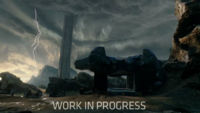 An Albatross on the Halo 2: Anniversary map Remnant.
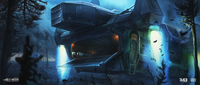 Concept art of an Albatross dropping off Spartan-II trainees in Halo: The Fall of Reach - The Animated Series.
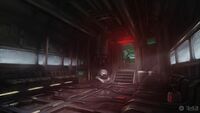 Concept art of the Albatross's interior for Halo: The Fall of Reach - The Animated Series.
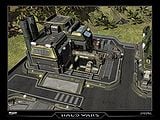 An early screenshot of the Halo Wars UNSC Vehicle Depot; the Albatross can be seen on the Supply Pad just out-of-frame on the right.
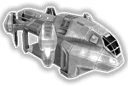 The icon for the Halo Wars Albatross. Note the presence of the cockpit windows, in contrast to the Halo 2 and Halo 3 designs.


Screenshots[edit]
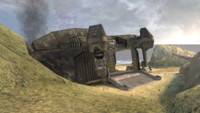 Front view of the Albatross on Relic.
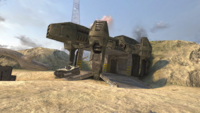 Rear view of the Albatross on Relic.
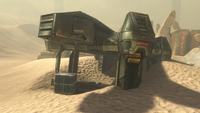 The cargo bay of an Albatross when fully opened in Halo 3.
 The sillhouette of an Albatross from Halo 3.
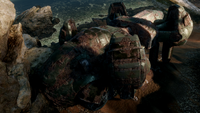 Front view of the Albatross on the Halo 2: Anniversary map Remnant.
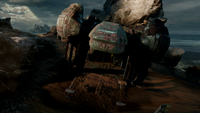 Rear view of the Albatross on Remnant.
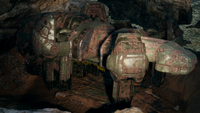 Profile view of the Albatross on Remnant.


List of appearances[edit]
- Halo: The Fall of Reach (2010 edition)
- Halo 2 (First appearance)
- Halo 3
- Halo: Fall of Reach
- Halo: Mortal Dictata (Mentioned only)
- Halo 2: Anniversary
- Halo: New Blood
- Halo: The Fall of Reach - The Animated Series
- Halo Mythos (Mentioned only)
- Halo: Shadows of Reach
Sources[edit]
- ^ a b c d e f g h i j k l m n o p q Halo: The Essential Visual Guide, page 5
- ^ a b c d e f g h i j Halo Encyclopedia (2022 edition), page 151
- ^ a b c d e Halo Encyclopedia (2011 edition), page 259
- ^ a b c Halo Waypoint, Condor (Retrieved on Jun 30, 2021) [archive]
- ^ a b Halo 2, multiplayer map Relic
- ^ Halo 2: Anniversary, multiplayer map Remnant
- ^ a b Halo: Shadows of Reach, chapter 17
- ^ a b Halo: The Fall of Reach, page 71 (2010)
- ^ Halo 4: The Essential Visual Guide, page 112
- ^ Halo Waypoint, Delta Halo (Retrieved on Jun 30, 2021) [archive]
- ^ a b Halo 3, multiplayer map Sandtrap
- ^ Halo: Mortal Dictata, page 103
- ^ Halo: New Blood, page 97
- ^ Halo: Shadows of Reach, chapter 13
- ^ Halo: Shadows of Reach, Epilogue


