
Bungie ViDoc: O Brave New World
From Halopedia, the Halo wiki
| “ | To cap off Bungie's 20th Anniversary festivities, the team has assembled a near hour long documentary covering the studio's past, present, and future. Featuring insight from the team -- including their ever illusive Creative Director, Jason Jones -- and interviews from key industry veterans and luminaries, "O Brave New World" is both a celebration of Bungie's legacy and a love letter to the community of gamers who have embraced Bungie's games for two incredible decades. | ” |
The Bungie ViDoc: O Brave New World is the last Halo-related and longest ViDoc made by Bungie. It was released on YouTube on August 3, 2011.[1] It runs for 55:08, and summarizes Bungie's history and future, as well as Halo's creation. Though mostly new footage, it also contains parts from other ViDocs, as well as videos recorded during the early days of Bungie.
Transcript[edit]
The Bungie logo is presented.
- Luke Timmins: "In many ways, it's one of the best things that ever happened to Bungie, right?"
- Adam Sessler: "What I really like about this whole Bungie relationship with Activision is that I never saw it coming."
- Jerry Holkins: "The idea that Bungie would make Halo for a million years was inconceivable."
- Eric Osborne: "In a lot of ways, we're starting over."
- Geoff Keighley: "I can't wait to see where Bungie is going to take us next. I know it's going to be ambitious, I know it's going to be something exciting. I just want find some details on it."
- Luke Timmins: Being an underdog, and having something to prove and remembering we're not the top dog any more is a great thing to happen to us.
- Curtis Creamer: "We're out on our own in the wilderness again and we have to fight to bring every customer along with us."
- Joseph Staten: "We've gone from a totally as sure as a thing can get with Halo, to tackling a challenge which is even bigger than Halo with no real guarantee of success."
- Martin O'Donnell: "There has to be some scare dangling over the edge of the cliff and hope that the world we are weaving will hold us."
- "I love being the underdog."
- Jason Jones: "It does bring back the early days. We have this great idea and we don't really understand it. Its going to be fun to figure it out."
A group of pixels form together in a similar way to Gnop! which later transfigure into a timeline which moves between 1991, 1992, 1993, 1994, 1995, 1995, 1997/1998, 2001, 2001, 2004, 2007, 2009 and 2010 simultaneously while showing brief snippets of games Bungie developed in those specific years.
Bungie 20th Anniversary
O Brave New World
- Alexander Seropian: "My senior in college was taking an artifical intelligence class, and Jason was in that class. He had a way cooler computer than I had, which really pissed me off. So... you know, so we just got to talking and tried partnering up."
- Martin O'Donnell: It was clear, right from the get-go that Alex was the business guy, Jason was the creative guy."
- Jason Jones: "I was working on a game and Alex was trying to start a company."
Alexander Seropian is seen in a car, which is driving down the streets of Chicago.
- Alexander Seropian: "So here we are in down town Chicago. This is the classy part of town. The original Bungie was not here. For that, we've got to go south."
- "We occupied the second floor, so we got broken into a couple of times."
- "There was that crack house behind the building."
- Robert McLees: "I was employee number five. We were in one room... Well, a room and a half. Everybody did everything."
- Jason Jones: "We ended up with Pathways."
- "Pathways into Darkness was our first successful game. It had made a profit."
Gameplay of Pathways is presented.
- Alexander Seropian: "Then came Marathon, which was a real big hit for us."
Marathon gameplay is presented.
- Claude Errera: "Marathon was the first shooter which had verticality to it."
- Geoff Keighley: "It had that Sci-Fi sensibility. Mac gaming didn't really exist for me before Marathon."
- Lorraine McLees: "Marathon made me dizzy!"
- "I remember being amazed at this world that Bungie had created."
- Alexander Seropian: "We were bound by this comradery. It was our lives; 24/7. It was kind of like being in a band."
- Martin O'Donnell: "But the project that we were working on which was called Myth, which I though was really interesting."
- Alexander Seropian: One of the most significant things that we had done with Myth was we developed it for both the Mac and the PC at the same time."
- Geoff Keighley: "It was interesting how Bungie was able to nail both first-person shooters for the Mac and move to the other big genre which was strategy games for the PC, and then nail that with Myth."
- Claude Errera: "Myth's the first time that Real-time strategy didn't have micro managing built into it."
Myth gameplay is presented.
- Mike Krahulik: "Myth was a revolution. It was an RTS which got rid of all of the RTS bullshit."
- Lorraine McLees: "You use the terrain to your advantage. Which isn't something that a lot of games did at the time."
- Martin O'Donnell: "I definitely did not think Bungie was going to last. It didn't seem like they had a real plan for the future."
- Jason Jones: "We had the advantage twenty years ago of being really stupid. I mean young, but young is stupid. In that mind set, like, anything is possible. So you just get started and figure out what is hard on the way."
- Dave Dunn: "The first time I meet Jason, he said 'Why are you okay with building environments the way you're building environments?', and I said 'Why would I not be okay? Like I have some choice?' and he said 'Yeah, absolutely!'. That sorta gave me a hint that is to 'Ah okay, so that is what our culture is about'."
- Alexander Seropian: I think it all starts with the idea that we were our own customer and that anyone else who going to play our games, we were in their shoes."
- Dave Dunn: "A big moment in Bungie, I think one that stands out to me, more than anything elses, is the Myth II installer bug."
- Jerry Holkins: "That installer bug that would remove your computer. You try to uninstall the game, it was just a scorched earth policy, like...'"
- Mike Krahulik: "'Well, you don't like Myth?'
- Jerry Holkins: "'Fuck you!'"
- Mike Krahulik: "'We're taking your machine!'"
- Martin O'Donnell: "There was five hundred thousands units that were boxed, shrink wrapped and everything else."
- Dave Dunn: "Alex decided to do the right thing and recalled all of the copies."
- Martin O'Donnell: "It was just horrible. They had to reprint all the discs."
- Dave Dunn: "Everyone in the office was just stuffing new CDs into boxes of Myth II."
- Shi Kai Wang: "That caused the company a good chunk of money."
- Martin O'Donnell: "It was at least a million-dollar mistake."
- Dave Dunn: "A mistep like that is going to put you in some serious jeopardy."
So Our Game Is Called Halo...[edit]

The timeline appears at 2000, with an image of John-117 beside it. It is followed by footage of Halo: Combat Evolved. The footage stops as the Halo logo appears.
- Marcus R. Lehto: "It started off with just three of us. We were at that time making what we thought was gonna turn out to be a Myth-type clone, with a Sci-Fi skin on it."
- Martin O'Donnell: "They were doing "Blam!", which was the codename for this other game they were working on."
- Jason Jones: "We had a huge map for a continuous RPG and before that we had an RTS."
- Shi Kai Wang: "We had no idea what the game was going to be, I had no idea. I was just there to do concepts."
- Marcus Lehto: "It was pretty generic Sci-Fi. You had your typical military forces, tanks, jeeps, that kind of things and some armored guys."
- Jason Jones: "We did a lot of thinking about what it meant to be an action game. And could an action game be a Real-time strategy game? And the answer was no."
- Shi Kai Wang: *We want a Sci-Fi character, a guy in a suit who can go from Earth to space and we don't have to worry about him changing clothes. And we just needed him to look like a Space marine."
- Marcus Lehto: "Oh god, what do we call him? Something like the super soldier."
- Shi Kai Wang: "And then, you know, we started moving the camera closer and closer to the character."
- Marcus Lehto: "What if we put ourselves in this character, what if we became that character?"
- Eric Osborne: "Those are the moments where things start to come together. It's Marcus saying 'No, no, we're going first-person because this is more fun'."
- Shi Kai Wang: "I don't think we could have captured as much of the audience had we stayed in Third-person."
- Eric Osborne: "Those are the ideas and decisions which really change the course of the game and the company."
- Martin O'Donnell: "Suddenly we had this opportunity to tell a little piece of a story. I remember Joe coming to me and saying 'Ancient, epic, alien'. So he just gave me those three words and I though okay, well I'll just try combining something that does that. I came up with the pounding drums, Cellos, monks, alien voice and showed it to the guys on Monday morning and then they got on a plane to go to New York and show it at Mac World the next day.."
- Alexander Seropian: "Which really went over, big."
Footage of the Pre-Xbox Halo from the Mac World is present.
- Geoff Keighley: "They were making games for the Mac which you know was still a small and stall-based at the time. But you know, Bungie was into pretty ambitious games and to fund games of that calibre is not easy to do."
- Ed Fries: "One day, my phone rings; telling me that Bungie is in financial trouble and that their talking to some people about potentially being acquired."
- Alexander Seropian: "It was going to be really important for Microsoft to have games for the Xbox. That is what would make or break it. So you know, we call up at Fries and said 'Maybe we should talk'."
- Ed Fries: "That was a great call to get, it was definitely a time were I was open to that kind of a conversation and had money to spend and desperately needed content for this new platform that was going to be showing up in less than two years."
- Marcus R. Lehto: "We knew that there were some financial struggles at that time. There was some strange dudes in black suits walking around the office, weeks prior to that and so we knew something was going on."
- Chris Barrett: "I had been there for something like a couple of months and then I get called into Alex's office and he's like 'So, we might be moving to Seattle' and I was like 'Oh god, you know I just signed a lease!'.
- Ed Fries: "This was a group that while I respected their talent because I had seen their previous games. I mean, I probably would have been interested in them just for the team. But that fact that they had this Halo thing that they were trying to figure out was a plus."
- Jordan Weisman: "Ed came into me one day and said that 'I want you to go talk to Jason and Alex and tell them its all going to be okay once we buy them."
- Joseph Staten: "Greed, fair and simple. Cashed it in, sold our souls, came out here. I mean if you're going to sell your souls, Seattle's a pretty nice place to do it."
- Adam Sessler: "Back in the 90s, Microsoft had an evil empire like quality to them, and the idea that they were going to Microsoft was 'Oh no! They're selling out!'."
- Shi Kai Wang: "That turning point of us going from PC games to Console was gigantic and it was a giant gamble."
- Geoff Keighley: "Bungie, I think presented a great opportunity for them, but I think it was incredibly risk worthy too."
- Harold Ryan: "One of the main polls for the team to move into Microsoft was to be a part of creating the Xbox and a game that really used it."
- Chris Butcher: "Jason said it best, I think; he said that 'Microsoft has built the biggest cannon in the world and they're pointing it right at Sony and that we can be a bullet in that canon, and we can make a really big impact on the course of the game history'."
- Alexander Seropian: "We got very excited about the opportunity to define and a platform and to define a franchise would be important to the platform."
- Shi Kai Wang: "Everybody in the office was pissed off because we like being independent and, you know kind of like a 'Fuck the man!' sort of thing and now we got to the console and now we're like 'Hey there, man'! and we're like shaking his hands, *laughs*. Instead of raising our fists up."
- Chris Butcher: "It was exciting, as well as terrifying."
- Ed Fries: "I had this nice spot in this building picked out for them in this building and thought they would love it and they hated it. You know, it was a typical Microsoft office which the Microsoft people think are great. The Bungie guys looked at me and said 'This looks awful! This is the exact opposite of what we want. You know, we want a big open space' and just mow down all of these walls of this section."
- "People just couldn't fathom being at Microsoft."
- Jordan Weisman: "I remember Ed complaining that even he didn't have a key to get into the Bungie area."
- Geoff Keighley: "The challenge that I think Halo faces is that it was trying to do a first-person shooter on a console platform."
- Ed Fries: "One of the biggest challenges was making a shooter that felt right and worked right on a controller."
- Mike Krahulik: "Yeah, I mean originally, you had to struggle with it really being the first FPS that we were trying to get into on a console...
- Jerry Holkins: "On a controller..."
- Mike Krahulik: "...With the duke. It was huge. Coming from PC First-person shooters, it just really felt... er..."
- Jerry Holkins: "Different."
- Mike Krahulik: "Different!"
- Marcus R. Lehto: "The reality of actually shipping on a console, it was a lot of pressure there. And we didn't have anything running on that console, at all."
- Chris Butcher: "When I joined, the AI for Halo was about three source files and the big block comments at the top that were just Jason's log of him frantically trying to get something, anything, up and running. Jaime Griesemer and myself, we just sat and worked on two signature encounters, one was the beach on The Silent Cartographer, which was the classic kind of wave advancing encounter and the other one was the classic defensive encounter. We really only had one shot at it because we weren't going to have time to go back and scrap the AI system. So we just knew we had to get it right."
- Marcus R. Lehto: "We had a lot of content to build, gameplay experience to create. So all of these grand ideas we had of this huge open world experience quickly dissipated."
- Claude Errera: "Bungie has always had a way of figuring out what is important in a particular game style and throwing away the extreme stuff."
- Pete Parsons: "I think there were a small group of people who felt like Halo would be the defining game of the Xbox."
- Curtis Creamer: "There were a lot of other games which were getting a lot more attention than Halo. Malice, Munch's Oddysee, racing game."
- Shi Kai Wang: "I think they put a lot of bets on this game called Azurik. I'm not sure if anybody remembers that."
- Curtis Creamer: "Master Chief was certainly a part of it, but he wasn't 'the guy'."
- Jordan Weisman: "It wasn't pre-ordained that it was going to be Halo. Halo earned that right, you know, by being one of the best titles in development at the time."
- Dave Dunn: "On Halo, one of the moments that always sticks out in my mind was once we actually got B30[Note 1] up and running and you could play it."
- Curtis Creamer: "There's something simple as driving the Warthog on B30, which was fun. That was a defining game experience that brought me in."
- Luke Timmins: "They brought me in. So here's a proto-type Xbox, here's a proto-type controller and here's this game called Halo. And he said 'You know Bungie?', and I'm like 'Who, Mac gaming are you fucking joking?'. He gives it to me and I'm like 'Oh wow, this is fucking amazing!' and all it was, was the B30, running around on the beach and just shoot stuff. I was like 'This is fantastic!'."
- Chris Butcher: "There was such an energising moment. I was like 'Oh, this is what we're actually making!' and all of a sudden, the team just got attraction and it kicked in and started going at high-gear."
- Dave Dunn: "At that time, there was three teams. The Halo team, still the Phoenix team and then there was the Oni team."
- Shi Kai Wang: "They owe it all to the Oni team because before we came up from San Jose, they had no multiplayer, so the multiplayer designer and multiplayer programmer came from the Oni team."
Oni gameplay is presented.
- Curtis Creamer: "Getting closer and closer to the deadline for Halo, each one of those teams started getting absorbed into the Halo team because there was just no way we were going to make it."
- Harold Ryan: "We almost cut multiplayer out of it a few days before we had to ship the build because it wasn't really working that well. You know, we were having arguments about how many people can actually connect a box together. Maybe people in college dorms can do it, but who's really going to carry a TV to their friend's house?"
- Pete Parsons: "Everyone was pushing to keep multiplayer in but none of us knew just what it would mean."
- Chris Butcher: "That was the first time I had a team which was moving inexorably towards something."
- Luke Timmins: "The awesome thing was watching the game being built."
- Shi Kai Wang: "I probably wouldn't have made the Covenant guys so colorful. But that was a request from Jason. Shinier, brighter, more color and i'm like 'Dude, you're fucking nuts, man!'. This things like a rainbow, it's horrible. Obviously, it worked. He knows it from gameplay perspective what makes games tick."
- Jen Taylor: "I think I auditioned with a British dialect and then I auditioned with just a vaguely Spanishy, Frenchy, German sounds *laughs*. And I can't remember if it was Marty who said 'Just do your own voice, get in your lower register and give that to us.'"
- Geoff Keighley: "Halo was incredibly unique because there wasn't anything like it. It was sort of a perfect storm of music and art and universe design."
- Chris Anderson: "You could see that someone had created a really thought through a world. The greatest stories and especially in the Sci-Fi realm are coherent visions. Continuity comes from an underlying vision that shines through."
- Jason Jones: "Halo was an action game which put you in this world were you could be the most powerful actor in this rich physical simulation. It gave you this ability to become competent and show your competence to your friends competitively or cooperatively."
- Luke Timmins: "I never forget this, I get like this headshot on Zack and I'm like 'Sit the fuck down!' and there's like applause and I turn around and there's a group of people who were watching and before I know it, we had this fucking line. And people were, like, coming in and playing there ten minutes of Slayer and just getting back in line."
- Adam Sessler: "Multiplayer and Halo just go hand-in-hand."
- Luke Timmins: "Now they get it, the Multiplayer was the thing."
What Does Not Kill Me[edit]

The timeline appears at 2004, with a clip from the Halo 2 announcement trailer. It is followed by the rest of the announcement trailer. The Halo 2 logo is then presented.
- Chris Butcher: "The story of Halo 2 is kind of like a three act tragedy."
- Jordan Weisman: "In Halo 2, they really wanted take a step up in terms of depth of the universe. That Joe and Jason had created this really rich universe that you could get across purely in even the tools that they had at their disposal."
- Chris Butcher: "The first act, we are all optimistic and naive and saying 'This game is going to be 72 times more fun than Halo 1!' because we've got all of these great weapons and vehicles and environments. We're just going to jam as much stuff as we can."
- Curtis Creamer: "There was a lot of new technology that was being researched."
- Pete Parsons: "And we had to throw out a lot of stuff that we had wanted to do."
- Chris Butcher: "We had wrote this graphics engine that was totally unsuited for the Xbox. We had these ideas for levels that just really didn't make sense for the Halo engine or any other kind of shooter engine."
- Dave Dunn: "We really wanted to do a game where we felt every mission, every environment is going to feel totally unique."
- Chris Butcher: We let our ambition lead us into some very, very scary places."
- Curtis Butcher: "Multiplayer for Halo 2 was really a gigantic thrust for what we wanted to give Halo, that we couldn't in Halo 1."
- Harold Ryan: "Our goal was to create the virtual couch."
- Chris Butcher: "Halo 1's multiplayer was done by three or four people tops in six months. Halo 2's multiplayer was a massive advancement. That kind of resource crunch really caused a lot of tensions on the single player side of things because now all of a sudden, we're trying to create multiplayer environments which have to look as good as the singleplayer side of the game."
- Zach Russell: "I remember that time we got sixteen boxes all working together and understand that there wasn't a bunch of maps to go and play now. We just got sixteen boxes and we kind of ran around and they didn't crash."
- Curtis Creamer: "We absolutely loved playing multiplayer. I mean, everybody in the studio is play testing these maps everyday."
- Luke Timmins: "'Holy shit, I'm totally shooting you in the head right now' and it's amazing."
- Chris Butcher: "In many ways, Halo 2 was the title that was the breakout title for Xbox LIVE.
- Harold Ryan: "The Xbox team, we co-developed with them. We helped them design and develop what they called the tsunami feature set which was a lot of the new LIVE matchmaking multiplayer features. We built our own friends list; which you can now do friends and friends parties over on Xbox LIVE dash. But we built it in Halo 2 first.
- Ed Fries: "The console world kind of pushed back, and said, 'Those aren't console-y things to do. You guys don't get it.' But, we really did get it, because we have already seen that these successful on the PC. You know, we had seen the multiplayer plays features.
- Zach Russel: "That first time he jumps on, the crowd just, you know, goes into this really loud cheering."
- Jason Jones: "I mean, just wow. It will give you chills. Sitting there."
- Geoff Keighly: "It's something you really don't see very often in E3 in the middle of the demo, you will just like, 'Fuck yea, that's awesome'."
- Chris Butcher: "And then, on Halo 2, Alex had left the company and go back to Chicago. And Jason has left the project to work on Pheonix. So without Alex and Jason, the Halo 2 team was led by a committee, who kind of went through the second act, where we were really trying to deliver something that was just impossible. We kind of found ourselves standing there, after E3 2003, kind of looking around and saying, 'Well okay, we can't possible build this game'."
- Martin O'Donnell: "We were showing something at E3 that was going to be in the game. It's not in the game."
- Jason Jones: "It was very clear at the time the future of the studio was with Halo 2. And if Halo 2 failed, then the studio was going to be a very different, less fun place to be in."
- Ed Fries: "They were going to go back and rework things. Jason was getting more involved. And, uh, then they came back and told me it was basically going to be a year slip.
- Jason Jones: "The fucking devil himself and stood up and told us we will never ship it and 'fuck you', and rammed us pitfall up our asses."
- Pete Parsons: "Halo 2 is, y'know, not what we want it to be right now."
- Martin O'Donnell: "How do we topple what we did before, and even if we'd say, too tired to topple what we did before, but the pressure's there, I think we put it on each other."
- Pete Parsons: "The disaster's flaming turd of failure would be uh, probably the right way to say it."
- Jason Jones: "We have the whole climax of the game planned on Earth, and we're not doing it. And that... and that sucks."
- Joseph Staten: "Before Halo 2, we could fail in silence and in misery, but no one really knew when we were failing, and that's something like in Halo 2 where everybody knew we cut the missions in the end. We walked off our third act. We failed spectacularly in public as far as the story is concerned."
- Geoff Keighley: "Yeah, they literally did have to cut off sort of the end of the game."
- Domenic Koeplin: "There's the big knife and we were just chopping sometimes."
- Geoff Keighley: "And they must have been heartbreaking, I'm sure the guys at Bungie."
- Domenic Koeplin: "It's a trade-off. We can't develop forever, or else there would never be a game."
- Jason Jones: "Our nuts, like, fell in the fire and, like, they weren't totally burnt when we picked them up. Like, we kind of made it in the end, you know. I, uh, still work."
- CJ Cowan: "As much as a death mark Halo 2 was, we got to the end of it, and... there's a bunch of scenes there that are exciting and.. and really fed the rest of the trilogy."
- Jason Jones: "The difference between entertainment that's successful and entertainment that's forgotten is only how people react to it. So no matter how successful we were in Halo 2, doesn't matter how hard we worked, and... and they don't give a shit if it took you two seconds or six years and twenty gallons of blood."
- Pete Parsons: "I looked at the bug count and realized we were going to make it. We were actually going to ship this game. And, uh, I think that was probably one of the proudest moments for me, because it had been so hard.
I Wish I Knew How To Quit You[edit]
- Eric Osborne: "The biggest legacy Bungie has had is in the community."
Footage of people playing Halo together in LAN parties are shown.
- Pete Parsons: "All of us were caught by surprise just to see that how it became a cultural phenomenon in its own way. We see people gathering in basements and having LAN games."
- David "DHalo" Moore: "We have competitive people. We have people who like to play for fun. We have campaign people. Multiplayer people. Firefight people. Doesn't matter how far, how hard is the game, we do it, 'cause we love it."
- "We have people here from Sweden, we have people from every corner from the country, and that's not a hardship that's part of it."
- John "Nof" Farrell: "I pick people up I have never met before, and I drive them here from the airport. It's crazy! I mean, I never met them, but somehow we share this bond. We've been friends, and they only existed as characters on that chatroom screen."
- Cameron Pinard: "You have people here who didn't ever start with Halo. They started with Myth or Marathon and you know, they've carried through this whole time and it's incredible."
- Kieth "Kete" Hernandez: "Bungie's always showed a love for its community; they're here right now."
- Claude Errera: "They're not just a gaming company, there's an interpersonal relationship between the millions of fans that Bungie has and employees."
- David Candland: "Any time we get together and have a LAN party like this, you see that interaction, you see people joking around together and it's fantastic."
- Claude Errera: "To me, it's become more about the community than the games. A huge chunk of my life has been this game, and this company, and... and the fans of this game. Twenty years from now, when I'm not playing games at all anymore, maybe, this is the stuff I'll remember."
- Miguel "Mig" Chavez: "We were kinda in-on the ground floor, seeing this group of guys from Chicago, seeing them slowly working their way up, and not forget us."
- Daniel "Finn" Barbour: "I've been spending that much time invested into the game, it is nice to hear people listen and responses to it."
- Dan Miller: "I remember hearing feedback from people when I start working at Bungie, and I was like 'Are you kidding me? Like, you guys actually listen to your community?' and they're like, 'That's how we've always kind of done things'."
- Jen Taylor: "I went to E3, and signed autographs. That blew my mind. There were so many people in line and excited about... this game."
- Geoff Keighley: "Bungie has done an amazing job, I think, y'know, speaking to its community on an ongoing basis."
- Chris Anderson: "I think that, because they are obsessive in what is this world, who are these people, that you could get a community forming that would do derivative fanbase work. And my favorite of this are, umm, Red vs. Blue series."
Clips of Red vs. Blue is present.
- Burnie Burns: "The fact that Red vs. Blue even exist, is a testament to what Bungie does for their community."
- Geoff Ramsey: "Absolutely."
- Burnie Burns: "Is there anyone else that'd, you know, bam! Cease & desist. Hey look, Geoff, I've got the mail!"
- Geoff Ramsey: "'Let's move to Mexico'!"
Fan-made material, screenshots and videos, are shown.
- 'Chris Butcher: "Where we are today with the community, you could capture it all, and bumble it up, and say, 'This is what we are all experiencing together.' Developers and players."
- Curtis Creamer: "They do things with Halo that we've never expected. There were all kinds of people, y'know, having contest about how high you can blow the Warthog up, if you've gotten enough plasma grenades."
Video of Warthog jumping is shown.
- Eric Osborne: "Randall Glass' Warthog Jump video really resonate with the community because he was doing something really cool inside the game with the physics engine, and the Warthog. And people were inspired by that."
- Curtis Creamer: "Getting places in the map we've never seen before. Creating art in Forge."
- Joseph Staten: "And when you realize the impact our work have on people, and such a broad group of people, it's really surprising."
More fan-made material is shown.
- Jordan Weisman: "Because of the community nature of the storytelling, right? They find the pieces and tell it to each other. And so they're the story tellers rather than just consuming a story."
- Eric Osborne: "People live it and brief it. And that breeds real community. Not just inside of the game, but people that create lifelong friendships. People get married in Bungie games, and I think that's pretty incredible.
Third Time's the Charm[edit]

The timeline appears at 2007, with a clip of the Halo 3 Announcement Trailer. The Halo 3 logo is then presented.
- Shi Kai Wang: "All I've got to say is that we're on Halo 3, right now. That's all."
- Marcus R. Lehto: "We wanted to create something that stood out from the crowd a little bit.
- CJ Cowan: "It was really important to us to end with a high note with Halo 3."
- Curtis Creamer: "Halo 3 was gonna be the end of the trilogy. We knew we had to do it better than we did in Halo 2. So it was gonna be a focus conservative effort throughout to make sure that Halo 3 was the jewel on the crown."
- Geoff Keighley: "I still remember the first Halo 3 reveal trailer, Master Chief kind of walking through that smoke, I think what really dazzled people in that trailer was the engine. A really powerful moment, I think, is to realize that, er, this world of Halo was going to be taken to the next level."
- CJ Cowan: "We are shipping on a new box, we've got all this new tech, kind of rewriting the engine, we've got higher def... Everybody was fighting over all this new memory, all the new process and power, where was it gonna go, for the graphics or for the AI."
- Luke Timmins: "I remember that it was one of my most nervous, like, 'Are we gonna able to do it? Are we actually going to finish it?'"
- Curtis Creamer: "It was one of the top risk on Halo 3 that we are gonna cut co-op again because we cannot get it to work."
Footage of Bungie employees having trouble during Halo 3's development is shown.
- Dave Dunn: "We had a lot of influences of new people. They were super excited to work on a Halo game. So that actually carries you."
- Hao Chen: "If we do something cool, then the artists would go out of their way to try to use it. Seeing all this water popping up and down, y'know, in every level, that really makes me, uh, very happy. So that's gotta be one of my favorites moments."
- Chris Barrett: "The way that the lighting came together, seeing the skies on the 360 for the first time, sketching out those ideas and watching it step-by-step coming out of vision, and then finally seeing it on TV for the first time. I was going through that process which was amazing."
- CJ Cowan: "We went through a full year of pre-production on this project. So when we moved to Halo 3, when we moved to the new Xbox, we can do close-ups, we can do solid facial animations. What is gonna happen to the Chief. What is gonna happen to Cortana."
- Paul Bertone: "Cortana plays a huge role in the fiction of this game. We didn't want people to forget about her, we actually see her fighting for her existence. It was just a really powerful idea for us."
- Joseph Staten: "If it was just a straight 'Now go find her, here's a map.' People wouldn't care. The characters to their environment, their story in every level. People really do believe we are a community of story tellers. That's extremely exciting we've made that evolution."
- Luke Timmins': "Halo 3 seem to me is the next step for Halo 2 in my point of view. We added Forge, File Share, Saved Films and co-op."
- Steve Scott: "We added Saved Films in Halo 3, and the gamers out there can pause and stop really study the explosion and rotate at the camera, and really look at the work. "
- Chris Butcher: "That was a real time direct connection to our community."
Clips of Halo 3 launch are present.
- Pete Parsons: "It was probably the moment in Halo 3 launch where I realized that 'Well, this is as big as anything can get'."
Shows footage of fans during Halo 3 launch, ranging from fans reaction during the event to Spike TV interview.
- Adam Sessler: "I remember being in Manhattan, where the big launch was occurring. It was absolute Candemonium! Bungie turned it into this seminal, world-wide, cultural event! You might not see people playing games because they are practicing at their own home, but everybody is doing it."
It's Not You It's Me[edit]
- Chris Butcher: "Back when Bungie was founded. You know, Jason, Alex and their friends. The culture of Bungie was pretty simple. It was just a bunch of college kids who wanted drink beer and eat pizza and do amazing cool stuff in their basements."
- Eric Osborne: "It's such an important cultural ideal here that the studio owns what it creates."
- Pete Parsons: "Independence was going to be the only thing that was going to be able to allow us to do what we what to do."
- Harold Ryan: "In the end, I think, the transition was good for Bungie. The journey through Microsoft, being able to integrate on the Xbox..."
- Jason Jones: "We're a different studio, and a more potent studio, and we're going to do things that we never could have done."
- Harold Ryan: "The deal was essentially we make a couple more Halo games, we leave Halo with Microsoft and we can split amicably. So, I mean ultimately the price of our freedom was to... to leave our baby behind. To move from being Halo developers to Halo fans."
- Curtis Creamer: "Having to leave Halo behind because we left Microsoft, it's kind of a high price, but that's the price of the next thing you're going to give birth to."
- David Candland: "That's going to be a seminal moment in this studio."
- CJ Cowan: "Harold had promised Microsoft we had two more Halo games, and Reach was only one of them. What can we do in one year with the engine we've already built, not a whole lot of engineers, just a handful of artists. What can we do in a year to get a game out the door? Harold looked at us and said, 'Make it happen.'"

- Curtis Creamer: "ODST was a lot of fun, because it was a smaller team. It got back to, you know feeling a little bit like what that Halo 1 experience was."
- Paul Bertrone: "We wanted to try something we'd never done before, breaking the mold of what people expect from Halo."
- CJ Cowan: "Even faced with making a game in a year, we couldn't just kick something out. We wanted to make it different, we wanted to tell an interesting story in a new way. Early on, film noire was mentioned, detective story was mentioned. Putting that twist and telling a small story inside the universe just coalesced super quick."
- Paul Bertrone: "Very early on we latched onto the concept of the nighttime city. It was always more about the silence and the mood and the ambiance."
- Martin O'Donnell: "I did brand new music for ODST, 'cause it was such a different mood. It was not at all the big space opera, it was the one-day, one-night story, film noire, rainy, wet, wonderful atmosphere. For me it meant, this should all be new music. I was kind of hoping it wouldn't end up being six hours of new music, but it ended up being about six hours of new composed music."
- Mike Krahulik: "ODST is the best single-player."
- Jerry Holkins: "ODST is beyond a shadow of a doubt the best Halo campaign in existence.
- Mike Krahulik: "It's the only one worth playing."
- Jerry Holkins: "I have told Joe Staten this. I have taken Joe Staten by the shoulders, and shaken him in this fashion. It was the best one Bungie has kicked out, in my opinion, in terms of single-player campaign."
- Joseph Staten: "Everyone will agree, that not only should games have stories, have great stories, but that we're all in charge of telling it."
- Nathan Fillion (as Edward Buck): "The FNG. The Rookie. Not exactly green. No ODST is. If I didn't think he could do the job I wouldn't have him on my six. He doesn't say much but I don't care, I just need him to listen."
- Lars Bakken: "With Firefight we knew we could take these intense experiences and kind of expand them out into a co-op flavored game type. Firefight really came from the idea of the gravity room in Halo 1. It's where you go up in Truth and Reconciliation into the ship. That room has multiple entrances in, and these Elites start coming to attack you and they come out of different doors. What's it like to be trapped in a place and have to defend it from never-ending enemies that continually get harder? We knew it was going to be big but we didn't know that fans would react to it the way they did, but it was, those were definitely good times."
- Martin O'Donnell: "ODST was the beginning, it was the first one that we did that was not as Microsoft employees, we were Bungie employees at that moment, and that was really exciting."
- Nathan Fillion (as Edward Buck): The Covenant have found Earth. They own New Mombasa. Anyone that could've driven them off is dead, or gone. I'd say that makes for desperate times. Me and my team... guess we're the desperate measures."
Once More, With Feeling[edit]

The timeline appears at 2010, with a clip of various gamplay snippets and cutscenes from Halo: Reach's campaign. The Halo: Reach logo is then presented.
- Joseph Tung: "Reach was just perfect, it was the perfect fit for all of the ideas we were talking about in the early days. Doing something with a little bit of a harder edge than Halo 3. You know, bringing back the scariness and the alien-ness of the Covenant. All of those sort of dovetailed perfectly with Reach."
- Zach Russell: "I think Halo: Reach was the game we were trying to make from the beginning."
- Geoff Keighly: "Reach is... having so much to it. The campaign, and the co-op and the DLC, and the Firefight, I mean there's just so many elements to these games now."
- Marcus Lehto: "We have this opportunity to look at the entire franchise, and we were like 'Okay, it's now our time, to close out Bungie's contribution to the Halo universe. How are we going to do that in a way that does justice to this big thing that we created?'"
- Lars Bakken: "We were able to pick up the notepad and say, 'Oh man, look at these fifteen things we crossed out, we just couldn't do. Let's start there, and let's see what else we can do as well on top of that.'"
- Zach Russell: "Having a rich online experience, a rich set of services that we'd written ourselves, bringing deeper immersion to our campaign or our cinematics."
- Marcus Lehto: "Mo-cap became integral into all of our gameplay animation systems. If you look back on the whole series, our animation system actually had pretty much been the same. We hit this point where we just said to ourselves, 'I think it's time now to take animation into that next generational leap.'"
- Rajeev Nattam: "We had to figure out how to create high-res models. Approaching the art from a whole different point of view. Like with Reach it was, 'Let's make it much grungier and dirtier, like these guys have been in the shit."
- Marcus Lehto: "We wanted to pull the helmets off all the Spartans, and we wanted to get to know each one of those Spartans up close and personal. It needed to be human."
- Rajeev Nattam: "Really make sure they conveyed that emotion, you see that literally on their faces."
- Geoff Keighly: "Reach was the ultimate Halo game."
- Joseph Tung: "The biggest Halo game we had ever made, the most exciting Halo game we had ever made. It was absolutely liberating to no longer be tied to the story lines from Halo 1, 2 and 3, to sort of know that we were making a stand-alone."
- Tyson Green: "I don't think you can make a good game these days without taking into account all elements of it."
- Chris Carney: "What else can we do with Halo that we haven't done yet? Firefight, Invasion, armor abilities, even the ability to sprint in a map started changing really fundamentally how the game played. And then with Firefight and Invasion really seeing what could we do with this game that we loved so much, what direction could we push it in where we were excited to play it."
- Marcus Lehto: "God bless Steve Cotton for Forge World, he's like given the task, 'Hey let's build the ultimate Forge experience.' Which at that time was much smaller. Before you knew it we had this incredible space. Steve was like, he believed in it, and he was so excited about it, and you couldn't help it to like look at it and go 'God, I believe in that too.'"
- Geoff Keighly: "I think anyone that played Reach and was a fan of Halo, I think felt a sense of completion. I look at that final sequence with you know the helmet sitting there shattered and the world around it. It reminded of that first moment when I saw Halo at E3."
- Bill O' Brien: "I was more proud of Reach than I was of any game I've ever worked on."
- Joseph Staten: "With ODST, with Reach, in ways that we haven't revealed yet, we absolutely learned important things from all of those games."
Varios clips from the launch of Halo: Reach as well as Reach gameplay are shown.
- Marcus Lehto: "The last ten years have been a whirlwind of creative construction of an amazing universe, building huge teams, nearly burning out a couple times, and ultimately leading to something like Halo: Reach that to me was all of the right things put together, like that was a great way to end the Halo series, that was the perfect way to do it."
My God, It's Full of Stars[edit]
- Ed Fries: "There was always a culture of reflection in not being satisfied with something just being okay with feeling like it has to be great."
- Eric Osborne: "In the end of each production, they've drawn on the white board a plane that's on fire, and then the analogy was you've gotta land, right? Like, this sucker gotta land sooner or later, but you've also got to think about what's most vital to the experience. If you hold on to everything in the back of the plane, all your dreams, all your hopes, all your aspirations, you're gonna blow up. So you've gotta eventually get light and land that sucker."
- Pete Parsons: "There's a lot of great stuff that was almost cut. The shotgun was almost cut. But... y'know, good is never good enough for Bungie."
- Mike Zak: "Everybody cares. Everybody sits in the same... big pit, we're all in it together, it's good to know."
- Zach Russell: "When people here are really critical and it's hard to impress them. Yet, the best part is how much fun is it to work with them."
- Roger Wolfson: "We've joked about it like a three ring circus; sometimes the spotlight shifts around. Everything is really active at all times."
- Chris Butcher: "As we get better at doing things, we also keep biting off more, more, and more, meaning we are always on the verge of tackling something too big and falling on our faces."
- Eric Osborne: "There's always this moment where everything just comes together, just coalesces. The effects guys goes like 'Here's what I've been working for 18 months:' and bam! It just all self-assembles as if it's a sentient being."
- Nathan Fillion: "There's a reason I'm loyal. I didn't know I was a first-person-shooter until I player Halo. I put my faith in Bungie."
- Martin O'Donnell: "No matter what, that's who Bungie is. We always make what we want to make. We're gonna make it a game we want to play."
- Nathan Fillion: "I've been there. I've seen the noses on the grindstones. I know what's going on. I know that they're working hard. I know that they are passionate."
- Martin O'Donnell: "I wanted to make sure that fans know that we did Halo because we wanted to do Halo. We did ODST because we wanted to do ODST. We did Reach because we wanted to do Reach. But now we want to do something brand new, now we want to do something different."
- Zach Russell: "I can't wait to share with the fans what we're working on."
- Eric Osborne: "We are moving on. We're building something new, something totally different."
- CJ Cowan: "Looking forward, everything needs to be invented, everything is created from scratch. There are no characters that are returning because all the characters are new. It's... really exciting to be part of such a big team working on something brand new."
- Geoff Keighley: "Bungie's next project is obviously incredible ambitious and incredibly exciting. You know, a new world, a new universe, there's a scale to what Bungie wants to do, which people have not seen before."
- Joseph Staten: "If you're responsible for not just telling an isolated story, but for building a universe that at some point, is gonna become more the fans than ours, it's gonna take a life of its own."
- Eric Osborne: "We don't know what the future holds. We need to push past that self-doubt and that fear."
- Martin O'Donnell:"If it's not scary, then it's not gonna be good."

- Shi Kai Wang: "We have other ideas. We have other, y'know, worlds we want to create."
- Chris Barrett: "We want to build a universe where any crazy shit could happen."
- Curtis Creamer: "We've got all that experience making really big games, so we know what we're aiming for, it's just not gonna be that much bigger."
- Jason Jones: "One reason why the new people studio is to reaching players ways we haven't before."
- Luke Timmins: "That's it. That's gonna be fun. Clear the fucking table."
- Joseph Tung: "I believe that it absolutely will be a game changer in the way that Halo was a game changer."
- CJ Cowan: "We didn't even know how big Halo was gonna get. How could anything be bigger than Halo. We'll find out."
The sun sets on a snowy landscape, and it changes into a symbol. A space aura fades in, and a message from Bungie appears:
Bungie would like to thank everyone
who has ever been a part of the game we make.
We could not have done it without you.
We would also like to thank the following people for the really nice things
they said and did for us during the production of this ViDoc.
Everyone at Bungie past and present
Daniel Barbour Bruce Chianese Laura Karpman |
Geoff Levin Susan Lusty Burnie Burns Geoff Ramsey |
Nico Andy-Rowland Jordan Weisman |
Over the past twenty years, Bungie games have been built
by a talented group of extraordinary people who refused to
kill and each each other in the process, even when times were tough.
Out studio continues to thrive due in large part to the
wealth of generosity, support, and understanding provided by
our friends and family, and our success is owed completely
to our uncompromising community of fans.
Thank you for the past twenty years.
We can't wait to show you what's next.
Video ends with the shining logo of Bungie's next game, Destiny, and the phrase "Per Audacia Ad Astra" fades in.
Gallery[edit]
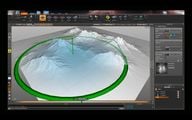 A brief look at the development of Bungie's next project.
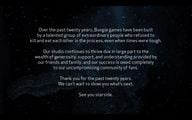 The closing caption of the vidoc.


Sources[edit]
Notes[edit]
- ^ B30 is the code for the level The Silent Cartographer, which was the first Halo map shown in public.


