
Planetary warfare
From Halopedia, the Halo wiki
 |
This article does not have enough inline citations and/or does not adhere to the proper citation format. You can help Halopedia by adding citations. |

Planetary warfare is conflict conducted between armed belligerents on the surface of a planet, using land, air and sea-based forces for invading, defending and controlling important strategic areas. Ground warfare varies widely in scale and type, ranging from small skirmishes, to asymmetric combat against non-conventional forces, to large-scale engagements between two or more large forces.
Theaters of combat[edit]
Land[edit]

While air power is important strategically, and orbital superiority is ultimately the crux upon which battles between space-faring powers are won or lost, land warfare has been, and continues in the 26th century to be, the most prominent aspect of warfare.
Infantry are an integral part of any army, no matter how technologically sophisticated. During the Forerunners' wars with humanity, both sides continued to use soldiers equipped with a range of handheld armaments and protective armor.[1] Initially, Forerunner ground forces consisted of infantry wearing combat skins and operating war sphinxes,[2] supplemented by artificial intelligence-operated Sentinels[3] and armigers,[4] though as the war with the Flood wore on the Forerunners increasingly relied on automated forces to sterilize or destroy Flood forces, eventually producing the Prometheans from composed Warrior-Servants and unwilling humans.[1] In the modern era, both the Covenant and the United Nations Space Command, as well as other human military and paramilitary groups, also use infantry, equipped with a range of weapons designed to occupy different niches. Both sides primarily use infantry to take and hold strategically and tactically important areas, particularly military bases and population centers. Infantry are also useful during counter-insurgency operations, which the UNSC conducted during the Insurrection, to sweep populated areas and clear out buildings of hostile occupants. Infantry are also much easier to transport and supply than larger and heavier vehicles, which can be awkward to operate in narrow urban environments and can cause significant collateral damage. the UNSC primarily relied on Army troopers and Marines, though the Air Force and Navy also maintained infantry units for garrison and security duties.

The UNSC and Covenant use a range of light transports and scout craft - the M12 Warthog and the Karo'etba-pattern Ghost are ubiquitous in the UNSC Armed Forces and the Covenant respectively, used primarily for force reconnaissance and engaging light enemy forces. The Warthog is a versatile UNSC light vehicle, and comes in a number of variants for different niches - the standard model is equipped with a crew-served light machinegun, though this can be replaced with missile pods, a tri-barrelled rocket launcher, a gauss turret, or replaced with a troop compartment. The UNSC also uses variants of the Mongoose ULATV, usually operated by a single operator for message or materiel delivery on a battlefield where communications uplinks are compromised or where airborne or slower ground transports are impractical. The Covenant Ghost is a fairly standard vehicle, lightly armed and armored but extremely fast and agile, though several post-war variants of the Karo'wark-pattern Ghost have been used by both the Covenant and the Swords of Sanghelios. The Covenant have at times supplemented the Ghost with the Wuzum-pattern Spectre, though it was not adopted in large numbers, and the Rizvum-pattern Revenant. When the Jiralhanae assumed command of the Covenant, they supplemented their Ghosts with Barukaza Workshop Choppers and Qavardu Workshop Prowlers. For improved ground mobility, both sides also used a number of armored fighting vehicles. The UNSC used the M831 Warthog for troop transport, while the Covenant used the larger, more heavily armored Ruwaa-pattern Shadow for transport in urban environments, though both sides tend to use dropship airlift more frequently. Transport was less of a concern to the Forerunners, who used sophisticated battlefield translocation to move across the battlefield, a technique continued into the 26th century by Promethean forces.

For heavier firepower, both the UNSC and Covenant utilize a number of heavy weapons platforms, including tanks, artillery and anti-air units. The M808 Scorpion was the UNSC's main battle tank of choice, particularly among the Marine Corps, due to its ability to be airlifted across the battlefield by dropship, and small crew size. It was replaced in 2557 by the M820 Scorpion, which featured similar design elements but featured a heavier main cannon and lighter chassis. Many UNSC Army and Marine Corps also operated the M850 Grizzly tank, which featured better armor and two 120mm cannons, as well as co-axial and pintle-mounted machine guns, but was considered expensive to maintain and difficult to transport. The Covenant filled the same niche with their own tank, the Zurdo-pattern Wraith mortar tank, later replaced by the Kemu-pattern Wraith which had similar capabilities but was smaller and lighter.

In support of both infantry and armored units, both sides also deployed a number of artillery units. Though the Wraith could be, and frequently was, used as a main battle tank, it excelled as long-range artillery, bombarding positions with plasma mortars. It was supplemented in the role by the Shua'ee-pattern Locust, which used a powerful directed energy weapon to destroy stationary targets but was vulnerable to enemy armor. The UNSC employed a number of artillery vehicles, such as the SP42 Cobra and the experimental M145D Rhino, though the role was usually filled by aerial or orbital missile or MAC support. The M9 Wolverine served as a dedicated anti-air missile launcher, but was able to use its missiles as a volley to hit ground targets, particularly useful against structures. The Covenant used a dedicated Wraith variant for anti-air defense, equipping them with powerful fuel rod cannons that served as effective flak.
For theaters that offer the most difficult and violent of ground combat, both the UNSC and the Covenant utilize extremely powerful, 'line breaker' assets to overwhelm and punch through heavily fortified defenses. The UNSC is known to utilize the M510 Mammoth as both a mobile command center, a siege breaker and a formidable anti-air/anti-ship areal denial weapon, whilst the smaller M313 Elephant acts as an important support and recovery vehicle as well as another mode of mobile command and control. The Covenant use civilian mining vehicles such as the Scarabs as a dual-use asset that can both excavate Forerunner artefacts and drill through the most heavily fortified walls. Moreover, the Covenant is also known to utilize absurdly large ground vehicles - akin to warships on land - for campaigns so large and well defended that not even the Covenant armada could pacify conventionally. Landcrafts such as the Zashk-pattern Draugr and Shuul'se-pattern Kraken behave like mobile fortresses and command centers meant to punch through the most violent battles, whilst the Za'zayara-pattern Harvester can excavate the most stubborn of earth or armour with ease.
The Flood deploy a range of ground forces, though initially the bulk of them are infected and repurposed corpses that are turned into Combat Forms, able to use its enemies' weapons against them. Corpses that are unsuited to becoming Combat Forms are turned into Carrier Forms, which gestate and release Infection Forms which continue the cycle. As the Flood spreads, and accumulated biomass, it constructs Proto-Graveminds which can coordinate large numbers of Flood forms to act in concert, and begins sculpting biomass as Pure Forms, which are tougher and use organic weapons.
Air[edit]

Most military forces deploy a range of aerial combat units to establish aerial supremacy and close air support. Establishing aerial supremacy can be critical to winning a battle, defending land and sea-based forces from aerial attack, improving one's own ability to attack enemy land and sea-based forces, and even repelling orbital attacks - the UNSC Air Force was able to hold off Covenant invasion for three years when the Covenant attacked Meridian, before the colony finally fell. UNSC military branches deploy a number of different craft for the role - the SkyHawk jump-jet, the GA-TL1 Longsword and the F41 Broadsword. The Covenant rely on the small, fast and nimble Type-26 and post-war D'nomlhe-pattern Banshee flyer, supported by smaller numbers of the larger, more powerful and better protected Type-31 Seraph, as well as Bkowe'nei-pattern Vampire craft for anti-air capability. Forerunner forces established air superiority through the use of small weapon-ships, such as the Phaeton, with a single operator able to control at least a million craft remotely, or directly operated by onboard pilots. Even the Flood deployed aerial forces to deter enemy air units and attack ground-based units - Flood swarms were able to attack both air and ground units, and although were individually weak, were deployed in large numbers.

Close air support is another important aspect of air combat. Ordnance can be delivered by fighters and bombers, but their speed and method of flight gives them small loiter times before they leave the area and need to refuel. To this end, the UNSC and Covenant utilize a range of craft for the purpose. The key strategic advantage of the Banshee is that it is able to operate at sub-sonic speeds and even hover, allowing them to attack enemy ground forces with plasma cannons and fuel rod guns. Spirit and Phantom dropships are also equipped with plasma cannons to cover the deployment of their troops and provide air support for them once they have been deployed. The original Covenant used the Dextro Xur-pattern Spirit, which was replaced after the war by the Nuro'k Xur-pattern Spirit, while the Phantom has seen a number of variants including the Type-44 and Type-52, which were replaced in the post-war period by the Type-57. The UNSC prefer to separate those roles into dedicated transports, usually with at least rudimentary armament, and dedicated gunship variants with more firepower. Both the D77 and D79 Pelicans had a number of variants, but most were equipped with a chin-mounted cannon, a troop-bay mounted machine gun, and some variants equipped with wing-mounted missile or rocket pods. The G79H Pelican gunship was a Pelican airframe equipped with a diverse range of armaments, including an M8 Spartan Laser, side-mounted machine gun turrets, and chin-mounted autocannons, but also featured limited troop transport and resupply capabilities. The AV-22 Sparrowhawk was dedicated to the role, and featured wing-mounted autocannons and a nose-mounted M6 Spartan Laser, and lacked the troop transport abilities of the Pelican, but was lighter, faster and more agile. The UNSC also utilized the smaller AV-14 Hornet, a tiltjet which used missile pods and wing-mounted machine guns to attack ground units and transport up to two passengers.

The air is also important to control because it enables fast tactical and strategic deployments. The UNSC maintains a range of air cavalry units, operating a mixture of Pelican dropships, and planetary-based UH-144 Falcon utility helicopters, to rapidly transport infantry and vehicles across the battlefield, which is one reason why the UNSC Marine Corps favor lighter Warthogs and Scorpions over heavier, better-armed and armored vehicles. Many of these craft, particularly Pelicans and the larger D96 Albatross, are rated for space operations, allowing them to transport personnel and material to and from orbit. The Covenant generally rely on the slow, cumbersome Spirit dropship, which features a light armament and awkward deployment bppms, but has superior armor to its smaller, faster and better armed companion, the Phantom, which features a nose-mounted plasma cannon and side-mounted plasma turrets that cover troop deployment.
Sea[edit]

While ocean combat has been eclipsed by air and space assets, it has not fallen out of use entirely. The UNSC Navy maintains planetary-based naval forces, particularly Crassus-class supercarriers, to support land forces. The Covenant attempted to excavate the seabed off the Yucatan peninsula during the Battle of Earth, but their efforts were halted by Blue Team. The UNSC maintains a range of equipment for Army combat divers, and has introduced several MJOLNIR variants specifically designed to allow Spartans to operate underwater, such as the OCEANIC and MAKO-class Mjolnir.
Orbital support[edit]

Given the importance of orbital supremacy, there are a number of ways orbital forces can support planetary campaigns. Spacecraft often serve as troop transports and staging points for assaults - UNSC and Covenant carriers carry large numbers of fighter craft, able to operate in both space and in atmosphere, to escort atmosphere-capable dropships to deploy troops and vehicles to ground-based combat theaters. Spacecraft are also able to directly engage in planetary combat, delivering ordnance from high or low orbit - UNSC ships used a range of nuclear and conventional missiles with varying warhead yields and the standard Magnetic Accelerator Cannon to strike targets from orbit, and the Covenant frequently bombard population centres with devastating plasma torpedoes or energy projectors. In addition, both UNSC and Covenant space warships are capable of operating as air-based artillery - the UNSC uses frigates in this role, while the Covenant can deploy virtually any warship in a planet's airspace.

The battle of an entire planet can be waged across its surface, but it is more often than not won or lost in orbit by whoever can establish orbital superiority. During the Human-Covenant War, the UNSC had enormous difficulty overcoming the Covenant's sheer technological advantage in orbit, but were able to win several key battles to support ground troops: the Harvest campaign was waged for five years because the UNSC space forces outnumbered the Covenant occupiers by a significant margin; UNSC air power on Meridian held off Covenant invasion for three years before it finally fell; a joint Army, Air Force and Navy operation brought down the Sh'wada-pattern supercarrier Long Night of Solace using Saber fighters; and while the Solemn Penance blew past Earth's orbital defense grid, the rest of the Fleet of Sacred Consecration was destroyed by the UNSC Home Fleet in the early hours of the Battle of Earth, forcing the assault carrier to make an emergency slipspace jump over New Mombasa to retreat.
Both sides also utilize insertion pods that can deploy individual troops or small squads from orbit to the surface, with both the UNSC and the Covenant using a range of drop pods of their own. Insertion pods present smaller targets than a dropship, are more maneuverable, and carry a smaller number of occupants if hit, ensuring a higher number of troops make it to the landing zone at the expense of individual safety. Even the Flood had their own version, the dispersal pod. which it used to scatter its combat forms across the Ark and Installation 08 to prevent the Halo Array from being fired.
Battle doctrines[edit]
Forerunners[edit]

The Forerunners primarily fought their wars using powerful starships, but did deploy forces in planetary environments when they had to, consisting of infantry who used Combat Skins of various tiers.[5] They were equipped with a variety of handheld firearms, automated support in the form of Sentinels and armigers, and powerful and agile air support provided by weapon-ships controlled by remote operators. Forerunner forces were at least on par with ancient human forces, and were able to engage them on a roughly equal footing,[1] but had considerably more trouble facing the Flood since their own troops would fill its ranks, using their own technology and equipment against them. The Forerunners responded by creating the Prometheans that were immune to organic infection, using composed Warrior-Servants and unwilling humans to provide them with sophisticated artificial intelligence.
Forerunner weapons used by Promethean units tend to use various forms of hard light, solid-phased photons, in both offensive and defensive roles. Hard light can form protective shields,[6] is part of the structure of most Promethean bodies,[6] and are emitted by Forerunner firearms, including the Z-110 Boltshot, Z-130 Suppressor and the Z-250 lightrifle.[6] The Z-180 Scattershot, Z-390 incineration cannon and Z-750 binary rifle use exotic matter, and were specifically designed to fight the Flood, destroying all organic matter on contact.[6] While Warrior-Servants preferred to use armigers for security, Builder Security used Sentinels which use more conventional lasers.
Flood[edit]

The Flood is primarily dependent on the capabilities of its enemies to supplement its own. Any living combatant it infects provides with intel and whatever equipment and expertise it possessed when it was assimilated, which is then shared by the Flood hivemind. The physical remnants of its victims become combat forms, serving as basic infantry, until the infection process allows the Flood to begin crafting them into more specialized forms. Infection forms are the primary agent of infection, though in later stages the Flood begins converting local atmosphere to be more hospitable, and releases spores into the air. More advanced forms, such as Proto-Graveminds, are capable of using sophisticated technology and directing Flood forces with more precision and control, with massive numbers moving in concert, united in purpose. The largest forms, Key Minds, are capable of directing Flood-infected forces across vast areas of space in real time, and directed powerful and arcane Precursor technology against the Forerunners toward the end of their war.
Covenant[edit]

The Covenant have a very simply policy when it comes to ground warfare: total victory, at any cost. While they possess superior numbers and technology to the UNSC, Covenant commanders tend to be wasteful of their troops. Unggoy infantry are particularly considered expendable, and often sent against suicidal odds to overwhelm human defenders, or at the least distract them from Sangheili flanking. Kig-Yar mercenaries are employed, often serving as scouts equipped with wrist-mounted shields, or as sharpshooters. While Yanme'e were only introduced into combat roles late into the war, and were lightly armed and rarely armored, they provided effective air support for allies, harassing human forces from the air while dodging incoming fire. While technically considered infantry, Mgalekgolo are equipped with devastating fuel rod cannons, deployed in pairs to support infantry in areas where larger vehicles would be impractical.

Sangheili officers tend not to be original thinkers, tactically or strategically speaking, but they are rarely stupid. Many commanders are capable of using effective strategy and tactics, although most are raised by traditional military doctrine to observe their own honor codes, which demand Sangheili officers to be present in battle to serve with their troops, needlessly endangering the chain of command. Furthermore, the Covenant denote their ranks using a very clear and observable color-coded system that makes officers highly visible. When the Jiralhanae replaced the Sangheili, they began using more brutal tactics in battle, partially to demoralize human forces and partially to satisfy their own more unrestrained violent nature, including eating captives taken in battle, and continued the use of a color-coded tiered rank system. Both Sangheili and Jiralhanae troops use powered armor that features energy shields, providing limited protection against firearms, and provide leadership for squads of Unggoy and Kig-Yar.
While the Covenant typically rely on massed infantry, they also deploy a range of other military forces, including long-range Wraith mortar tanks, and fast, nimble Banshee fighters to provide air superiority and close air support. Troop transport is provided by well-armed and protected dropships, particularly the Spirit and Phantom models, as well as the large, powerful Kmiro'sish-pattern Lich, or by armored vehicles like the Ruwaa-pattern Shadow, and heavy firepower is provided by a range of massive walkers, ranging from light units like the Locust, to larger units like the infamous Scarab, to rare but extremely large units like the Harvester and Kraken. While these walkers were originally designed for excavation work, using plasma weapons or lasers as drills to uncover Forerunner structures and artifacts, their size, armor and power made them ideal for conversion into powerful engines of destruction during the war with humanity. During planetary conquest, the Covenant often bombard positions with plasma from the air or from orbit, devastating large areas and reducing them to molten lechatelierite with the extreme heat. This process is extremely difficult, though not impossible, to survive.
Humanity[edit]

The UNSC features four major military branches, tasked with different duties: the Army, Air Force, Navy and Marine Corps. The Army and Air Force are primarily deployed in defensive roles, garrisoning colonies and holding recaptured territory, while the Marine Corps is the UNSC's primary expeditionary branch, supported by the Navy. Since the end of the Human-Covenant War, these four have been joined by a fifth branch: the Spartans, staffed by surgically and cybernetically augmented supersoldiers equipped with powered armor, who have become the UNSC's elite special operations unit.

While humans use technologically inferior equipment to the Covenant or the Forerunner forces they’ve fought, they have relied on superior tactical and strategic ability to make their forces effective. While the average UNSC Marine or Army trooper is generally better armed and trained than the most common Covenant infantry, Unggoy or Kig-Yar, they are less effective against Mgalekgolo, Sangheili or Jiralhanae unless supported by UNSC special forces, particularly Orbital Drop Shock Troopers and Spartans. While Spartans were rarely seen during the Human-Covenant War, they have become far more common since the creation of the SPARTAN-IV Program, to the point of establishing themselves as their own military branch, on an equal footing with the others. UNSC forces often utilize integrated air support and artillery to reinforce infantry or armored units. While the UNSC is capable of fielding extremely powerful armored vehicles, such as the M850 Grizzly, it prefers the tactical flexibility of lighter, highly mobile units such as the M12 Warthog and the M808 and M820 Scorpion tanks which can be transported more easily by dropship. Air support is provided by a variety of VTOLs, evolutions of old human helicopters and jet aircraft. Many craft, such as Pelicans, Albatross dropships, as well as Broadsword and Longsword fighters, are at home in both atmospheric and vacuum environments, allowing effective orbital support by the UNSC Navy and Air Force.
The UNSC is not the only military force humanity has by any means. Before its dissolution, the Colonial Military Authority served to enforce Earth’s authority over the Outer Colonies, and was the first military to face the Insurrection before it was subsumed within the UNSC. Many colonies also maintained their own self-defense forces or militias for internal security and disaster relief, often equipped with UNSC surplus military equipment and trained by UNSC advisors. The Insurrection also raised a number of paramilitary forces, using black market or captured weapons, vehicles and ships, though most Insurrection units preferred to operate as guerrilla forces.
History[edit]
Forerunner era[edit]

Despite possessing powerful spacecraft, the Forerunners and ancient humans continued to deploy ground and air forces in their wars with each other during planetary engagements, the earliest known wars humanity engaged in.[1] The defense of Charum Hakkor by combined human and San'Shyuum forces lasted fifty-three years, even after the San'Shyuum leadership surrendered, and included both an orbital defense using advanced Precursor technology and then a brutal ground campaign against Forerunner invaders after those defenses fell. Many human and San'Shyuum soldiers chose to commit suicide rather than be captured by the enemy.
After defeating humanity, Forerunner ground forces would face a long, desperate war against the Flood, which depended on planetary engagements to infect and assimilate more victims and increase its capabilities. These engagements invariably ended in a total Flood victory - Forerunner forces eventually resorted to destroying entire star systems, rather than engage them on the ground. While organic Forerunner soldiers proved far too susceptible to infection, towards the end of the war the Forerunners developed sapient machine soldiers to conduct their ground campaigns. However, it was too late to have an effect, and depended on composing too many of the depleted Forerunner Warrior-Servant rate to create their Promethean forces, and the Didact eventually turned to composing humans to try and buy more time, an action that saw the Librarian seal him in a Cryptum on Requiem for his betrayal. Promethean forces would guard Requiem and a number of other Warrior-Servant locations well into the 26th century C.E., long after the activation of the Halo Array.
Post-activation[edit]

After the Halo Array was activated, the galaxy's species were reintroduced and returned to their homeworlds. Independent of each other, they developed at different rates and formed unique cultures. The Sangheili developed an intensely martial culture, and their history has been dominated by a competing system of allied keeps in a constant state of war with each other over resources and old grudges. The species was unified only by their war against the San’Shyuum, where they held the advantage in planetary combat, but the war ended with a stalemate and alliance between the two for mutually beneficial goals, creating the Covenant. The Covenant would encounter many other species during its expansion and exploration of the galaxy, including the Lekgolo and Yanme’e, who would stubbornly resist Covenant intrusion until their assimilation. After their assimilation into the Covenant, the Unggoy’s tensions with the Kig-Yar would boil over into the Unggoy Rebellion, which was fought on numerous fronts across Covenant space, forcing the creation of an Arbiter who threatened to glass Balaho if the Unggoy didn’t lay down arms immediately. Nevertheless, the Sangheili were impressed by the Unggoy’s tenacity, and began conscripting them as soldiers. The Jiralhanae reduced themselves to a pre-industrial state through massive, planetary warfare almost as soon as they had achieved spaceflight, devastating their planet through the use of nuclear weapons, and were ripe for assimilation when they were discovered by the Covenant. The Covenant would have to respond to numerous brushfire rebellions and uprisings during its long history, including the Sixteenth Unggoy Disobedience, and the “heretical” pirate-prince Krith, long before it discovered humanity, which they responded to with military force, often spearheaded by Arbiters created specifically for the task.

Humanity achieved spaceflight much later than most Covenant races, and their history is marked by numerous wars which were exclusively fought on the land, in the air, and on the sea until the development of spacecraft and early colonization of the solar system. The industrial revolution made the production of highly effective firearms in large numbers cheaper, and marked the end of horse-mounted cavalry and archer volleys. The Interplanetary Wars of the 22nd century were fought in a number of theaters across the solar system: the Jovian Moons campaign on the moons of Jupiter; the Rainforest Wars on Earth; and the Argyre Planitia campaign on Mars. The end of the war would see the unification of Earth’s nations into a single planetary body, the Unified Earth Government, and the creation of the United Nations Space Command. Humanity would subsequently experience a period of peace until the late 25th century, as colonial resentment at exploitation by wealthy Inner Colonies bubbled over into massive and widespread planetary uprisings against Earth rule. While occasionally fought in space, the Insurrection would largely be fought on the surface of the worlds involved, involving prolonged counter-insurgency operations and military occupations in areas recaptured from Insurrection control, with strong air and orbital support.
The Human-Covenant War[edit]

The Human-Covenant War brought a screeching halt to most Insurrection activity, though small, stubborn cells would continue to cause the UNSC headaches through the conflict.[7][8] On the whole, though, humanity as a whole had to contend with the military juggernaut of a technologically advanced, numerically superior, previously unknown alien hegemony that embarked, in 2525, on a war of total extermination against the human species for esoteric religious reasons. While the UNSC was heavily outmatched in space, human forces tended to fare much better on the ground against Covenant infantry, armored fighting vehicles and aircraft, though the Covenant's sheer numbers still tended to overwhelm human planetary forces.[9] Even when the UNSC could score decisive victories on a planet's surface, the overwhelming technological advantage the Covenant had in space meant that these were usually short-lived, buying time for the UNSC Navy to evacuate as many civilians as they could before the plasma bombardment.[10]
The Fall of Reach marked the second-largest campaign of the conflict, and the most costly victory for the Covenant, which lost a considerable portion of the forces it deployed to conquer the planet through heavy human resistance, including widespread Spartan deployments across the planet.[11][12]
The largest campaign would be the Battle for Earth, which saw humanity's space forces smashed early in the conflict,[13] and the invasion of several locations across the planet before the Covenant withdrew to occupy East Africa.[14][15] Battles would also be fought on the surface of several artificial planets: UNSC forces from the Spirit of Fire would fight the Covenant on Trove in 2531;[9] the Covenant would fight resistance forces from the UNSC Pillar of Autumn in September, 2552 on the surface of Alpha Halo, and later escaped Flood forces;[16] the UNSC In Amber Clad would follow a Covenant assault carrier from Earth to Delta Halo, deploying its forces on its surface to secure the Activation Index and assassinate the Prophet of Regret;[17] and after a tentative alliance, UNSC and Sangheili forces would pursue the Prophet of Truth’s forces through a Forerunner portal in East Africa to the Ark, where UNSC ground forces secured a Cartographer facility to locate the Installation’s Clarion, and a combined human-Sangheili strike killed the Prophet of Truth, ending the war.[18]
Post-Covenant War[edit]

Though the Covenant would fall apart in the absence of a coherent leadership, numerous factions would continue fighting against humanity and other former Covenant factions. Sanghelios fell into civil war in 2553 with a massive and prolonged uprising against the Arbiter by Sangheili traditionalists across the planet, supported by orbital forces, and the UNSC would fight planetary campaigns against this resurgent Covenant on Draethus V, Requiem, and a number of smaller engagements on small Outer Colonies. These conflicts would see the return of Forerunner Prometheans to galactic prominence, deployed by the Didact on Requiem and subsequently allied to the Covenant after his defeat over Earth, engaging Spartan forces on Requiem’s inner surface during the UNSC’s campaign to secure the artificial planet for the UNSC. The Covenant would face a major setback during the Battle of Kamchatka when Spartan Fireteam Osiris assassinated their leader, Jul ‘Mdama, and the Sangheili civil war would end with the Arbiter’s victory, with the assistance of Osiris, during the Battle of Nuusra and the Battle of Sunaion.
Gallery[edit]
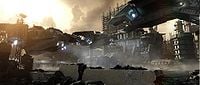 The initial assault to retake Harvest in 2526 went well, with a crushing military victory.
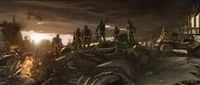 After "five years of hell," UNSC forces finally succeeded in regaining control of Harvest.
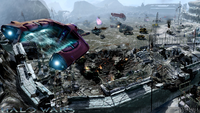 UNSC and Covenant forces fight over control of Alpha Base on Harvest.
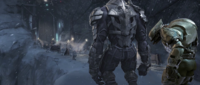 Though the battle for Harvest's surface was won by the UNSC, the Covenant would return in 2531 to follow clues from a Forerunner relic to another UNSC colony, Arcadia.
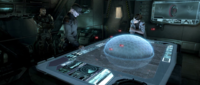 A holographic display of a Covenant base protected by energy shields.
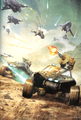 UNSC and Covenant forces clash on a human outer colony.
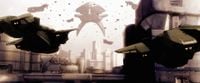 The Covenant frequently brought in devastating starship support during their ground campaigns.
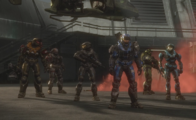 Spartan-II and Spartan-III special forces were some of the most effective units ever fielded by humanity during the Human-Covenant War, but few of either survived the conflict.
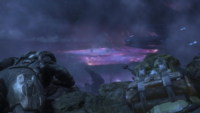 A Spartan force recon scouting Szurdok Ridge.
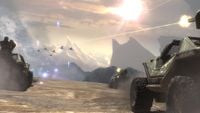 UNSC ground forces charge a Covenant formation in the Battle at Szurdok Ridge
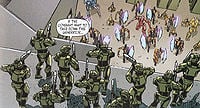 Many Spartans gave their lives defending the generators for the powerful Orbital Defense Platforms in orbit against Covenant attack.
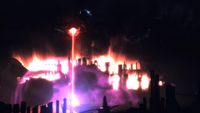 Covenant ships glassing New Alexandria.
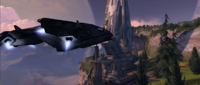 UNSC forces fleeing the Fall of Reach and stranded on Halo waged an effective resistance until the installation was destroyed to stop the Flood.
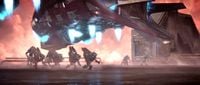 Sangheili-led Covenant troops deploy from a Type-52 Phantom.
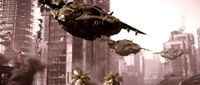 UNSC forces rapidly deployed when the Solemn Penance attacked New Mombasa.
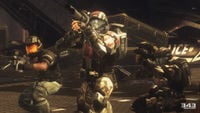 ODST troops were invaluable during the defense and evacuation of New Mombasa.
 ODST troopers dropping to secure a landing zone in Delta Halo.
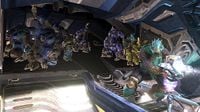 The Jiralhanae replaced the Sangheili wholesale after the assassination of the Prophet of Regret.
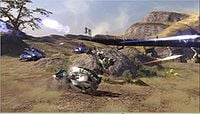 UNSC forces fought through Covenant armor on their way to Voi.
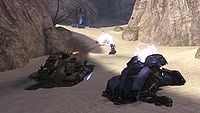 During the Battle on the Ark, UNSC armor was vital in locating the Cartographer to locate Truth
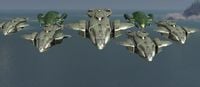 D77H-TCI Pelicans fly in formation with Sangheili T-52 Phantoms during the final assault to defeat the Covenant.
 A simulation of the Flood infection of Earth, seen from orbit.
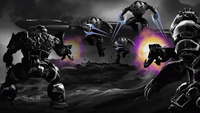 Sangheili and Jiralhanae forces would continue their war long after the collapse of the Covenant.
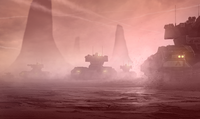 A column of M850 Grizzly tanks during the Draethus V campaign.
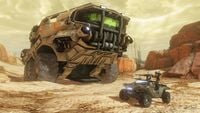 A UNSC Mammoth, serving as a mobile command center, during the Battle of Requiem.
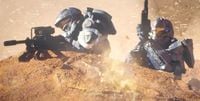 Fireteam Majestic early in the Requiem Campaign.
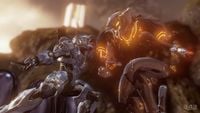 Spartan-IVs engaged Promethean and Covenant forces on Requiem during the ill-fated attempt to take control of the shield world.
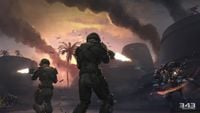 UNSC forces engaging Promethean forces during a brief incursion in New Phoenix.
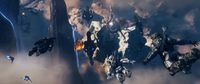 The Battle of Kamchatka was a crucial battle, resulting in the death of Jul 'Mdama and recapture of Catherine Halsey.
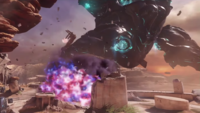 A Covenant Shuul'se-pattern Kraken protecting Covenant forces in Nuusra, brought down by Fireteam Osiris.
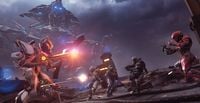 The Battle of Sunaion turned into a three-way battle between the Swords of Sanghelios, the Covenant, and the Created, with Osiris aiding the Arbiter's forces.


List of appearances[edit]
Sources[edit]
- ^ a b c d Halo 4, Terminals
- ^ Halo: Cryptum, chapter 2
- ^ Halo: Combat Evolved, campaign level 343 Guilty Spark
- ^ Halo: Hunters in the Dark, pages 222-226 (Google Play edition)
- ^ Halo: Combat Evolved, campaign level The Library
- ^ a b c d Halo 4
- ^ Dr. Halsey's personal journal: ???
- ^ Halo: Ghosts of Onyx, chapter 1
- ^ a b Halo Wars
- ^ Halo: The Fall of Reach, Prologue
- ^ Halo 4: The Essential Visual Guide, page 177
- ^ Game Reactor: First Look: Halo Reach
- ^ Halo 3, campaign level Crow's Nest
- ^ Halo: Uprising
- ^ Halo: Ghosts of Onyx, chapter 23
- ^ Halo: Combat Evolved
- ^ Halo 2
- ^ Halo 3


