
HRUNTING Mark III (B) Cyclops
From Halopedia, the Halo wiki
| HRUNTING Mark III [B] Exoskeleton | |
|---|---|

| |
| Production information | |
|
Manufacturer: |
|
|
Product line: |
HRUNTING |
|
Model: |
Mark III [B] |
| Technical specifications | |
|
Width: |
3.7 meters (11.7 feet)[1] |
|
Height: |
4.3 meters (14.2 feet)[1] |
|
Maximum speed: |
48 kilometers per hour (30 mph)[2] |
|
Armament: |
1 Anti-structure titanium-enriched jackhammer and piledriver; manipulator units (standard) |
|
Crew: |
One operator[1] |
| Usage | |
|
Year introduced: |
|
|
Role(s): |
Military engineering vehicle, logistical support, structure demolition |
|
Affiliation: |
|
- "You sending a vehicle after me? Suckers."
- — A Cyclops pilot during the Second Ark Conflict.[3]
The HRUNTING Mark III [B] Exoskeleton, also known as the Cyclops, is a bipedal powered exoskeleton used by the United Nations Space Command.[2] It was produced after Project: HRUNTING evaluated the then-defunct Mark III exoskeleton and made several of their own breakthroughs, which culminated in an entirely new variant of the exoskeleton, known as the HRUNTING Mark III [B].[1]
Overview[edit]
Development history[edit]
The original Mark III exoskeleton line was launched in 2510 but quickly became defunct, with the Office of Naval Intelligence scrapping their plans for the armour and focussing their efforts on the fledgling Project: MJOLNIR instead.[1]
However, in 2513, a Project: HRUNTING research team working at Weapons Research Facility T12A on Algolis[2] began an evaluation of the defunct Mark III sets and made many of their own development breakthroughs. These led to the creation of a revised variant, the HRUNTING Mark III [B], which was nicknamed the Cyclops. The Mark III [B] was intended to perform non-combat military roles such as construction, matériel transportation, terraforming, and dock work. The Cyclops eventually saw limited deployment as a logistical support unit with the Marine Corps. Operators were forced into combat on rare occasions, during which the Cyclops proved very effective as an ad hoc anti-matériel and anti-fortification platform.[1]
Numerous variants of the Cyclops have been designed since the introduction of the Mark III [B], including some versions that are armed and up-armored; others are marketed toward civilian agencies.[2] Following the development of the Cyclops the HRUNTING project was merged with the similarly oriented YGGDRASIL project, resulting in the creation of several exoskeletons and armor defense systems beginning with the Mark I Armor Defense System.[4]
Design[edit]
The Cyclops is a very large platform, standing 4.3 meters (14.1 feet) tall and 3.7 meters (12.1 feet) wide.[1] The operator is harnessed within a sealed cockpit that features a transparent canopy and a roll cage. In order to make controlling the Cyclops feel more natural the operator is encased in an internal active-impedance haptic interface exoskeleton that controls the movement of the vehicle itself and provides force feedback. As a result the Cyclops feels like an extension of the operator's body despite not being "worn" in the same sense as smaller powered exoskeletons such as MJOLNIR.[2]
The most prominent feature of the Cyclops is its two large arms, which feature powerful hand-like torque-amplification gauntlets. These manipulators can effortlessly crush a Sangheili's body and, with the assistance of a wrist-mounted pile driver, can shear large pieces from Wraith tanks and even citadels, the latter of which possess starship-grade armor plating. In keeping with its intended role as a support unit the Cyclops can use its manipulators and various arm-mounted tools to repair vehicles and structures. Due to the Cyclops' nimble design these repairs can be completed very quickly, even in the field.[5]
The Cyclops is surprisingly lightweight for its size thanks to the advanced materials created by the engineers and scientists on Algolis.[2] It is also quite agile, capable of outpacing even SPARTAN-IIs at a speed of just over 48 kilometers per hour (30 mph).[2] Hydraulic-buffered shocks in the exoskeleton's feet ensure that rough terrain does not hinder the mobility of the Cyclops and allow it to jump short distances.[5] Like the original Mark III exoskeleton the Cyclops features an externally mounted fusion reactor as its power supply,[5] though the unofficial Mark III [B-II] variant often replaces the standard reactor with an alternate power source.[2]
Models[edit]
The Cyclops' ease of use and load carrying capacity have led to the creation of numerous iterations of it as of 2558:
Major variants[edit]
- Mark III [B]: This is the initial, unarmed production variant used for structural demolition[2] and logistical support.[1]
- Mark III [B-II]: An unofficially designed variant of the [B] model, this exoskeleton features redesigned feet and a more robust, sealed cockpit. Many are equipped with alternate power-packs that replace the expensive fusion generator with hydrogen-burning turbines or high-density power cells.[2]
- Mark III [B1]: An upgrade to the [B] model, this variant is produced by Hannibal Weapon Systems. It features composite armor plating and hardpoints for weapon installation. This model is popular with paramilitary security forces on the cities of Earth.[2] It can be equipped with a missile pod.[6]
![Mark III [B1] with arm mounted missile pod.](https://halo.wiki.gallery/images/thumb/0/06/Heavy_Assault_Cyclops.png/138px-Heavy_Assault_Cyclops.png) Mark III [B1] with arm mounted missile pod.
Mark III [B1] with arm mounted missile pod.
![Mark III [B1] with arm mounted missile pod.](/File:Heavy_Assault_Cyclops.png)
- Mark III [M1]: Produced by Lethbridge Industrial, this variant is armed and are used as multi-purpose assault platforms with heavy weapon hardpoints installed on the "shoulders". They are protected by Titanium-A armor plating. This variant is currently undergoing field trials with the UNSC Army.[2] It can be equipped with dual M12 machine guns.[7]
![Mark III [M1] with shoulder mounted "M12"s.](https://halo.wiki.gallery/images/thumb/b/b3/Attack_Cyclops.png/119px-Attack_Cyclops.png) Mark III [M1] with shoulder mounted "M12"s.
Mark III [M1] with shoulder mounted "M12"s.
![Mark III [M1] with shoulder mounted "M12"s.](/File:Attack_Cyclops.png)
- Mark III [S]: A custom variant designed by Serina based on Lethbridge Industrial design files.
Minor Variants[edit]
There are several minor Cyclops variants with no official categorizations. Most of these variants follow common themes in terms of their loadout and the scope of their modification. Some alterations are made to enhance their suitability in specific climates. The following are variants in service as of 2559:
- Protector: Usually derived from older B-II units, Protectors are deployed in high-threat civil rescue missions. They are often operated by firefighters and medical response teams for deployment in situations where larger vehicles cannot fit, and protect workers from high-risk environments. They are usually configured with a large tank of fire-retardant foam, a high-pressure projector, and a high-torque gripping arm for ripping apart damaged vehicles to reach occupants trapped inside or to break the reinforced walls that are generally found in arcologies.[2]
- Damage Control Cyclops: This variant is equipped to handle on-ship emergencies and comes outfitted with buildable claws and fire-suppression tanks.[8]
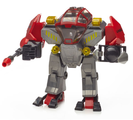 Damage Control Cyclops.

- Breaker: These units are used for ship-breaking and construction. They are equipped with specialized tools such as high-power plasma-cutters, hydraulic rams, or an assortment of cutting blades that allow them to complete their tasks. The Breaker allows individuals to safely take apart shattered ship hulks and stations that remain in orbit around a planet. They are also used for excavating half-melted buildings on the surface of glassed colonies.[2]
- Offworld Cyclops: In order to recover valuable assets and technology from UNSC and Covenant vessels that were destroyed and left hanging in orbit high above the surfaces of human colonies, the UNSC deploys the Offworld Cyclops into the harsh conditions of space, giving the operator access to these harrowing debris fields. These Cyclopes utilize a high-tension energy blow torch in order to bore through or break apart rubble in order to acquire whatever their operators seek.[9]
 Offworld Cyclops.

- Hazops: This variant features a biological laboratory-grade environmental sealing and a heavy flamethrower. Hazops units are occasionally assigned as support vehicles to Spartan assessment and containment teams at Forerunner sites which are believed to house Flood samples. When Flood spores are found by these units, it is often necessary to destroy the entire exoskeleton, as cleaning the whole suit for traces of the Flood supercell is extremely challenging. Although only explored in simulations, some believe it is possible for the Flood to take control of the suit and its operator and further augment the exoskeleton.[2]
- Zombie Containment Cyclops: This variant has an arm mounted energy cannon.[10]
 Zombie Containment Cyclops.

- Arctic Cyclops: This variant is outfitted with arctic insulation and camo for military manoeuvres in sub-zero climates. It has a wrist mounted flamethrower, and can easily smash ice and snow.[11]
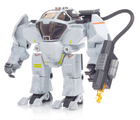 Arctic Cyclops.

- Desert Cyclops: This variant is equipped for maneuvers in desert climates.[12]
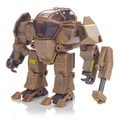 Desert Cyclops.

- Jungle Cyclops: This variant is equipped for maneuvers in tropical climates.[13]
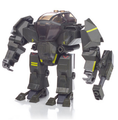 Jungle Cyclops.

Operational history[edit]
The HRUNTING Mark III (B) Cyclops entered its initial trial on February 4, 2531, where according to Captain James Cutter in TAC-EVAL UPDATE IV, despite Spartans being a technically superior unit, lower costs to build and train the Cyclops tips the scale in their favour, and that troops felt more comfortable round them.[14]
Cyclopes were used during the Battle of Trove to repair the UNSC Spirit of Fire's power core after it was damaged during a collision with the Covenant Sinaris-pattern heavy destroyer Proclamation's Tithe.[15] The UNSC Pillar of Autumn also had its own complement, which were used on Installation 04 after it landed on the ring in 2552.
During the Battle of Boundary, while investigating human activity in a nearby barn, Banished War Chief Severan's forces were attacked by Cyclopses from the local militia, killing two Jiralhanae before the Cyclopses were taken down.[16]
Gameplay[edit]
Halo Wars[edit]
The Mark III [B] Cyclops is a playable unit in Halo Wars. In the campaign, the Cyclops appears only in the level Repairs, but can be built by a second player in some missions in Co-op. In skirmish and multiplayer, the Cyclops is available only if Sergeant Forge is the player's selected hero unit. The Cyclops is designed to be an anti-structure unit with only melee attacks, and cannot attack aircraft.
The Cyclops requires 125 resource units, a tech level of one, one population slot, and can be built at the Firebase. It has the following upgrades:
- Repair Kit - Allows the Cyclops to repair buildings and ground vehicles. The upgrade costs 400 resource units and requires a tech level of two.
- High-Torque Joint - Improves the Cyclops' movement speed. The upgrade costs 900 resource units and requires a tech level of three.[17]
Production notes[edit]

- The Cyclopes are a race of one-eyed giants in Greek mythology. This Cyclops resembles them by its huge stature and visor in the center of its "head" resembling a single eye. Hrunting is a magical sword given to Beowulf in the Anglo-Saxon poem of the same name. It had never failed in battle until Beowulf's fight with Grendel's mother.
- From a gameplay perspective the Cyclops exoskeleton is based on the Cyclops unit from Ensemble Studios' game Age of Mythology. It is similarly a large unit that deals heavy melee damage. Their alternate attacks are also similar; when secondary ability bar has charged, the Cyclops will lift a nearby infantry unit and hurl it at the enemy forces for additional damage. In Halo Wars, the Cyclops' secondary ability allows it to tear a vehicle apart and hurl the chunks at enemy forces in a similar manner.[18]
Trivia[edit]
- Though the standard plural form of the mythological Cyclops is Cyclopes, UNSC personnel in Halo Wars consistently say "Cyclopses" instead. In Halo Wars 2, "Cyclops" is treated as both singular and plural.
- The Cyclops and the Gremlin are the only known UNSC vehicles named after mythological creatures. Most UNSC ground vehicles are named after real animals.
- During the development of Halo Wars, concept art and early in-game models of the Cyclops had a yellow polarized canopy rather than the transparent canopy used in the final game. This design feature was brought back in Halo Wars 2.
- The Cyclops' width of 11.7 feet refers to John-117's Spartan tag.
Non-canon background[edit]
Graeme Devine, the lead writer of Halo Wars, created a backstory for the Cyclops that is rife with continuity errors. This was made to provide narrative context for the game development team. However, Devine states on his blog that the background stories he created are "essentially fan fiction" and should not be regarded as canon.[19]
The essay states that the Marine Corps designed the Cyclops as a shock infantry platform to combat the Insurrectionists, and that the program competed with the "fledgling" Orbital Drop Shock Troopers. The Cyclops is said to have been removed from service after the initiation of the SPARTAN-III program. Canonically the Cyclops was originally produced as a support platform and the ODST had been in service for centuries. The SPARTAN-III program was top-secret, activated decades after the Cyclops first saw service, and served an entirely different role from that of the Cyclops, so the activation of the Spartans would have no bearing on the platform's deployment.
Gallery[edit]
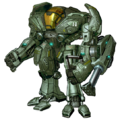 Concept art for the Cyclops, which was later reused as the design for the original Mark III exoskeleton.
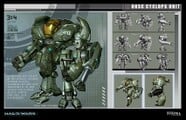 Cyclops unit info sheet for Halo Wars
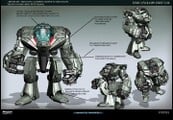 A development image of the Cyclops
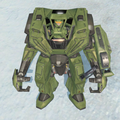 A Cyclops on Harvest.
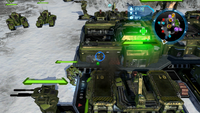 A Cyclops repairing a heavy supply pad on Harvest.
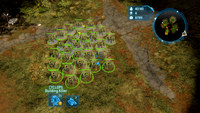 An army of Cyclops on Arcadia.
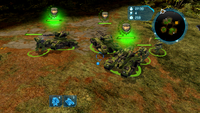 Cyclops repairing Grizzlies.
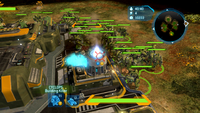 Cyclops attack a Firebase.
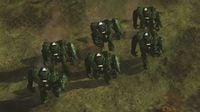 Six Cyclops deployed onto Trove.
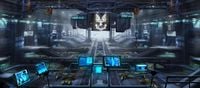 Halo Online concept art depicting what appear to be Cyclops-like mechs tending to and loading cargo.


List of appearances[edit]
- Halo: The Flood (First appearance) (Identified in 2010 edition)
- Halo Wars (First identified as Cyclops)
- Halo: The Thursday War (Mentioned only)
- Know Your Enemy
- Halo Wars 2
- Halo: Official Spartan Field Manual
- Halo: Saturn Devouring His Son
- Halo: Empty Throne
- Halo: Ascension on Atropos (Mentioned only)
Sources[edit]
- ^ a b c d e f g h i Halo: The Essential Visual Guide, page 44
- ^ a b c d e f g h i j k l m n o p q r Halo Waypoint: Cyclops
- ^ Halo Wars 2
- ^ Halo 4: The Essential Visual Guide, page 111
- ^ a b c Halo Wars
- ^ Megabloks - HEAVY ASSAULT CYCLOPS
- ^ Megabloks - UNSC ATTACK CYCLOPS
- ^ Megabloks - DAMAGE CONTROL CYCLOPS
- ^ Megabloks - UNSC OFFWORLD CYCLOPS
- ^ Megabloks - CONTAINMENT OUTPOST PATROL
- ^ Megabloks - UNSC ARCTIC CYCLOPS
- ^ Megabloks - UNSC CYCLOPS DESERT STRIKE
- ^ Megabloks - UNSC CYCLOPS JUNGLE STRIKE
- ^ halo.xbox.com, Halo Wars Launch Site: (Defunct) (Retrieved on Aug 12, 2010) [archive]
- ^ Halo Wars, campaign level Repairs
- ^ Halo: Empty Throne, chapter 28
- ^ Halo Wars manual
- ^ List of units in the Age of Mythology series
- ^ Graeme Devine's blog: Cyclops (Archive)


