
Jovokada Workshop spike grenade
From Halopedia, the Halo wiki
| Jovokada Workshop Spike Bomb | |
|---|---|

| |
| Production overview | |
|
Manufacturer: |
|
|
Type: |
Anti-personnel, fragmentation grenade |
| Specifications | |
|
Length: |
|
|
Weight: |
|
|
Filling: |
Shrapnel and a pyrophoric sulfur-nitrate/potassium compound (shaped charge)[1][2][3] |
|
Blast Range: |
|
| Service history | |
|
In service: |
|

| “ | Banished anti-infantry grenade which is crude and deadly in a particularly brutish combination. The blades on the grenade case allow it to embed itself on a target before detonating, blurring the distinction between grenade and limpet mine. Embedded spike grenades bypass shields.[6] | ” |
The Jovokada Workshop Spike Bomb (UNSC Type classification: Type-2 Antipersonnel Fragmentation Grenade, T-2 AFG),[5] more commonly known as the spike grenade, is a Jiralhanae-employed grenade developed by the Jovokada workshop.[3][1] It was manufactured by the Sacred Promissory in the Covenant,[3] and, following the Great Schism, the variants used by the Banished were manufactured by Jovokada Foundry.[1] It is nicknamed key,[4] table leg, and nail bomb.[5]
Overview[edit]
Design details[edit]
- "When you decide to throw one of these things make sure to tell everyone around you, 'cause they are dangerous all the way there."
- — Anonymous UNSC E2-BAG/1/7 serviceman[5]
The spike grenade is one of two grenade types designed and used by Jiralhanae forces in the Covenant military. Unlike the more common plasma grenade, which adheres only to living targets using a layer of plasma, the spike grenade uses numerous razor-like quills to seemingly be able to embed into any surface including rock, glass and energy shielding.[5] Notably, the power armor employed by Jiralhanae Chieftains is capable of repelling a spike grenade's adherent mechanisms.[7]
Shortly after adherence, the grenade detonates, sending a cluster of super-heated metal spikes flying at a perpendicular trajectory to the surface the grenade has stuck to. The mechanism operates similarly to the UNSC M383C Linear Shaped Charge Demolition Kit. Upon detonation, the shrapnel emitted by the spike grenade reaches a temperature of approximately 270 to 315 °C and retains that heat for upwards of seven seconds.[5] These spikes will ricochet off of hard surfaces, making the grenade a deadly weapon against enemies in confined spaces. The focused direction of the spikes renders the grenade slightly less effective in open areas.[5]

Even being hit by a thrown spike grenade can cause serious injuries akin to being "run through by a mini-baseball bat with nails sticking out of it". However, the device arms on impact, and invariably detonates before it can be extracted from a body. Some UNSC personnel believe that the spike grenade's injuries are designed to be fatal—not to force the enemy to spend time and resources treating casualties, but to make a victim die screaming.[5]
Ergonomics[edit]
- "It’s like a table leg with machetes bolted to it. Who the hell makes a weapon like that? Did those guys actually get up into space on their own?"
- — Anonymous UNSC E2-BAG/1/7 serviceman[5]
The spike grenade is similar in appearance to the Model 24 Stielhandgranate grenade used in the 20th century.[5] However, it derives its namesake from the spikes on the grenade (four curved spikes on top and twelve smaller ones around the shaft) as well as the shrapnel it expels. The outer casing is constructed of an unusual porous metallic compound, though some UNSC personnel have commented that the weapon's look is deceptive and—while still heavy—the grenade is lighter than it appears to be.[5] The spike grenade bears a heavy visual resemblance to the jumpmine.
Operational history[edit]
- "I've heard guys say that there's nothing as scary as seeing one of these slam into a wall—or a man—you're standing next to. Well, those guys have never seen a whole squad of baby kongs huckin' 'em in their direction at the same time—'cause that is some scary ****."
- — Anonymous UNSC E2-BAG/1/7 serviceman[5]
Spike grenades were first encountered by UNSC forces during the First Battle of Harvest in 2525.[8] Like most Jiralhanae weaponry, they became much more prominent during the onset of the Great Schism in 2552, and were widely employed by loyalist forces of the Prophet of Truth during the Battle for Earth and Battle of Installation 00.[7][9][10] The UNSC would eventually capture some samples of spike grenade weaponry and test them at Outpost C9 and the Covenant "Snowbound" facility, leading it to become one of many weapons and vehicles featured in the report Machines, Materiel and Munitions from the Human-Covenant Conflict, 2525 - Present.[5] Spike grenades continue to be used after the Human-Covenant War, most noticeably by the Banished.[1][11]
UNSC remarks[edit]
- "It’s like a table leg with machetes bolted to it. Who the hell makes a weapon like that? Did those guys actually get up into space on their own?"[5]
- "It's not as heavy as it looks, but it’s still like trying to throw a softball bat."[5]
- "When you decide to throw one of these things make sure to tell everyone around you, 'cause they are dangerous all the way there."[5]
- "Those things ain't made to wound anyone—to make you use up time and resources treating casualties. They were designed to make you die screaming."[5]
- "The casing is constructed of an unusual porous metallic compound. Shrapnel from the Spike Grenade reaches a temperature of approximately 270 to 315°C, around 530°F, and retains that heat for upwards of seven seconds, by design."[5]
- "I've heard guys say that there's nothing as scary as seeing one of these slam into a wall—or a man—you’re standing next to. Well, those guys have never seen a whole squad of baby kongs huckin' 'em in their direction at the same time—'cause that is some scary ****."[5]
- "It's like a shotgun that shoots flaming chainsaws at mike foxtrots—except you throw it."[5]
Gameplay[edit]
The spike grenade is very effective in suppressing enemy movement in closed environments. The grenade is extremely useful when thrown at corners where the damage inflicted would be toward the facing walls. Unwary enemies can be mowed down easily by a hail of spikes. The grenade can also be used against vehicles, surprisingly doing more damage than plasma grenades or frag grenades. The spikes ejected will reflect off of walls on a shallow angle and will be focused if thrown into a corner. Since it is the largest grenade, it is the easiest to detonate by shooting.
Halo 3 and Halo 3: ODST[edit]
The spike grenade is introduced in the campaign level Crow's Nest and appear in all subsequent levels; they are exclusively used by Jiralhanae enemies, though Flood stalker forms may drop spike grenades when defeated. Like plasma grenades, spike grenades are guaranteed to kill anyone stuck with it. Spike grenades are also lethal if thrown inside a bubble shield since the shield will deflect the spikes, so that they shower all over anyone inside it. If one sticks the shield generator itself, it will destroy the shield and damage anyone inside it, leaving them vulnerable to another grenade or gunfire. Although the radius of the spike grenade is limited, the area in the radius is deadly. A spike grenade is more damaging to vehicles than a plasma grenade. It is able to destroy a Scorpion in four sticks, and it can stick to almost anything, unlike the plasma grenade, which can only stick to vehicles or living things. Although this grenade cannot stick Brute Chieftains and War Chieftains, the player can kill them with it by sticking their weapon, sticking the wall right next to them, or throwing it so it lands between their legs on the ground like a frag grenade.
Halo Infinite[edit]
Changes from Halo 3 and Halo 3: ODST:
- Shrapnel from the spike grenades can no longer instantly kill a Spartan.
- Spike grenades explode a few seconds after being thrown if it stays in the air.
- Spike grenades now have kinetic properties.
Production notes[edit]

- The spike grenade (then-known simply as the "Brute Grenade") was one of many weapons prototyped for inclusion in Halo 2, before ultimately being cut from the game. The grenade's design mostly resembles that seen in Halo 3, with minor aesthetic differences. The weapon is one of many restored by the Digsite initiative for inclusion in the Halo 2 Editing Kit for modders to use.[12] The spike grenade can be used by downloading the official Digsite Halo 2 Github tagset repository.
- The Halo 3 Official Guide incorrectly claims that spike grenades will stick to Bubble Shields and Jackal Shields. It does not do this. Instead, it rebounds much faster than thrown.
Gallery[edit]

Development images[edit]
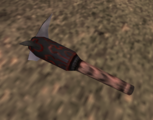 The original Halo 2 cut spike grenade weapon, restored via modding.
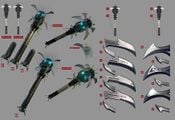 Halo Online concept art of the spike grenade.
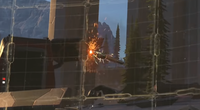 A spike grenade stuck to a drop wall in the Halo Infinite Campaign Gameplay Premiere.
 First-person view of John-117 throwing a spike grenade at a Jiralhanae Captain in the Campaign Gameplay Premiere.
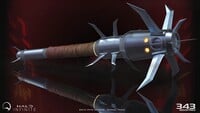 The high-poly source for the spike grenade in Halo Infinite.
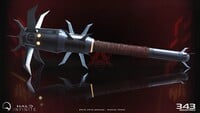 The high-poly source for the spike grenade in Halo Infinite.
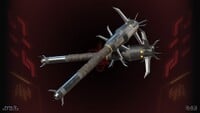 A pair of spike grenades in Halo Infinite.


Renders and screenshots[edit]
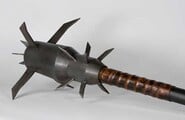 A photo of the spike grenade prop built by WETA Workshop for Halo: Landfall.
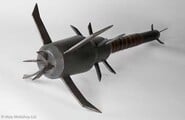 Another photo of WETA's spike grenade prop.
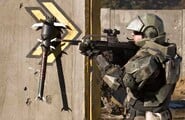 A spike grenade impaled in a wall, from the set of Halo: Landfall.
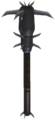 An in-game view of the spike grenade in Halo 3.
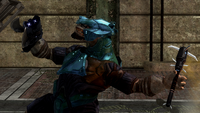 A Jiralhanae Minor throwing a spike grenade in Halo 3.
 The glow of an active spike grenade on a Jiralhanae Minor in Halo 3.
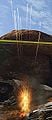 A spike grenade detonating on High Ground in Halo 3.
 An example of two spike grenades stuck together in Halo 3.
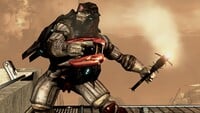 A Jiralhanae Jumper Major prepares to throw a spike grenade in Halo 3: ODST.
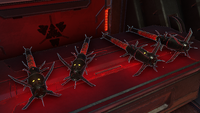 Four spike grenades on a crate in the Armory of Reckoning in Halo Infinite.
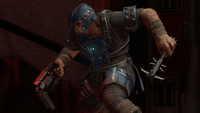 A Jiralhanae Warrior prepares to throw a spike grenade in Halo Infinite.
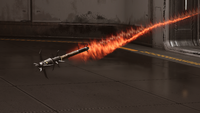 A spike grenade mid-air in Halo Infinite.
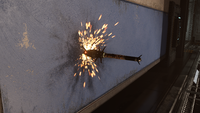 A spike grenade stuck to the wall in Halo Infinite.
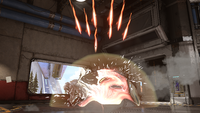 A spike grenade's explosion in Halo Infinite.
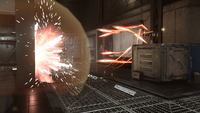 Spikes from a spike grenade's explosion deflecting from a wall in Halo Infinite.
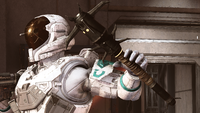 A Zvezda-clad Spartan prepares to throw a spike grenade in Halo Infinite.
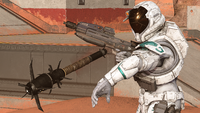 A Zvezda-clad Spartan throwing a spike grenade in Halo Infinite.


List of appearances[edit]
- Halo: Landfall
- Halo: Combat (First appearance)
- Halo: Last One Standing
- Halo 3
- Halo: Contact Harvest
- Halo 3: ODST
- Halo: Retribution
- Become
- Halo Infinite
- Halo: The Rubicon Protocol
Sources[edit]
- ^ a b c d e f g Halo Encyclopedia (2022 edition), page 483
- ^ a b c d e Halo: The Essential Visual Guide, page 185
- ^ a b c d e f Halo Encyclopedia (2022 edition), page 306
- ^ a b c d e Halo Encyclopedia (2011 edition), page 347
- ^ a b c d e f g h i j k l m n o p q r s t Bungie.net, Spike Grenade (Retrieved on Feb 7, 2021) [local archive] [external archive]
- ^ Halo Infinite, Forge - Spike Grenade description: "Banished anti-infantry grenade which is crude and deadly in a particularly brutish combination. The blades on the grenade case allow it to embed itself on a target before detonating, blurring the distinction between grenade and limpet mine. Embedded spike grenades bypass shields."
- ^ a b Halo 3, gameplay
- ^ Halo: Contact Harvest, chapter 21: "The Staff Sergeant noticed thin black smoke wafting from the club’s spiked head. "Aw, hell," he growled a split second before the grenade detonated, flinging fire and shrapnel."
- ^ Halo: Landfall, episode HLOS
- ^ Halo 3: ODST, gameplay
- ^ Halo Infinite, campaign
- ^ Halo Waypoint, Digsite Discoveries (Retrieved on Jul 17, 2023) [archive]
| |||||||||||||||||||||||


