
Domotos-pattern energy sword
From Halopedia, the Halo wiki
| Domotos-pattern fireblade | |
|---|---|

| |
| Production overview | |
|
Manufacturer: |
|
|
Type: |
|
| Specifications | |
|
Length: |
|
|
Width: |
|
|
Height: |
|
|
Weight: |
|
|
Ammunition type: |
|
|
Feed system: |
100 battery units[4] |
|
Effective range: |
Short[4] |
| Service history | |
|
In service: |
|
The Domotos-pattern fireblade (UNSC Type classification: Type-1 Energy Weapon/Sword, T-1 EW/S),[3] more commonly known as the energy sword, is a Covenant melee weapon manufactured by Assembly Forges and the Merchants of Qikost.[2][5]
Overview[edit]
Design details[edit]
- Main article: Energy sword (fiction)
The Domotos-pattern fireblade is one of the many energy sword variants manufactured by the Covenant. The Domotos-pattern is characterized by its angular contour and a rectangular hole along the inner edge of either blades.[2] The design for the blade's contour likely arose during the Writ of Union, as murals recording the event in Nuusra, Sanghelios, depicted ancient San'Shyuum and ancient Sangheili sharing blades of the same design.[10]
Usage[edit]
Within the Covenant, the Domotos-pattern fireblade is a weapon typically carried by high-ranking Sangheili, like Sangheili Zealots.[6] Following the Human-Covenant War and the dissolution of the Covenant, the Domotos-pattern energy sword was inherited by its splinter factions, including the Banished,[9] the Sword of Sanghelios,[11][12] and Jul 'Mdama's Covenant.[7][8] Spartan-II Leon-011 carries a customized Domotos-pattern energy sword.[13][14]
 A cloaked Hesduros Zealot killing Junjie Chen with a Domotos-pattern energy sword during the Battle of Circinius IV.
 Shipmaster N'tho 'Sraom using a Domotos-pattern energy sword during Operation: FAR STORM.
 Rtas 'Vadum wielding a Domotos-pattern energy sword during the Battle of the Prototype Halo installation.
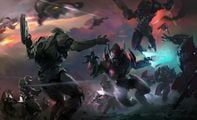 Orda Val 'Saham charging into battle with a Domotos-pattern energy sword during the Second Ark Conflict.


Variants[edit]
- Necroplasma - A necroplasma is a green colored Energy sword.[15] One version of the blade features a dull green blade that transitions to an inky black near the basket hilt and was used in War Games.[8]
- Ravening Sliver - A blade with a deep blue hue and a green hilt.[8]
- Vorpal Talon - A blade that produces an orange-to-cyan gradient. [8]
