Halo: Outcasts - Halopedia Reviews
From Halopedia, the Halo wiki

The staff at Halopedia are happy to present our third ever review of a Halo novel! In this article, we will share our thoughts Troy Denning's latest novel, Halo: Outcasts. While the novel was released about a month ago (at the time of publishing this article) and we allow any of its content to be posted to the site, we have ensured that the first half of this review is spoiler-free, with only a few allusions to topics covered in the three chapter previews officially released prior to the novel. You can safely read the first five questions if you have yet to complete the novel yourself, but make sure to avoid the second set of questions and the summary section!
If you would like to experience the novel for yourself, you can find it at Amazon (US or UK), Forbidden Planet, Simon & Schuster, Waterstones, and Barnes & Noble.
Given that collaboration between people of varied opinions and backgrounds is core to the concept of a wiki, our review consists of a number of talking points with multiple editors giving their thoughts individually. This time, we’ve got Halopedia staff members BaconShelf, JackVibe, Sith Venator, and TheArb1ter117!
Please note that we were not asked by 343 Industries, Microsoft, or any other party to produce this review, nor were we asked to promote or praise the book.
Spoiler-Free Questions
Question 1
What are your overall thoughts on Halo: Outcasts? Was it what you expected?
BaconShelf: I generally quite liked Outcasts. I've had a bit of an on-and-off relationship with the Halo novels released in the past decade, but Outcasts was definitely one of the higher highs in that list—with certain parts of the book being real page turners. In terms of expanding on both the wider Halo setting and the nature of the Created/their war, my immediate reaction upon finishing it was "this is exactly what we needed seven years ago". While Halo 5 is still a fairly controversial game in the community, I think that this book (and the Halo: Precipice short story that lightly ties in somewhat) would have done wonders to smooth the ripples in the setting caused by that game. Still, it's here now. I can't say much of what the book contained surprised me—at this point I think Halo stories generally have a certain rhythm to them that is both a good and bad thing in terms of the kinds of areas and subject matter they will or won't go near—and Outcasts, for the most part, delivered essentially what I was expecting. Except for closer to the end—if you know, you know. There's some particular element that gets more focus towards the end that really did take me out of left field, and was a very pleasant surprise.
JackVibe: My overall thoughts on Halo: Outcasts are very positive. I read the book not knowing what to expect; I avoided any discussion on the novel before its release and, since I have not read Halo: Silent Storm or Halo: Oblivion (having taken a long break on Halo media, including its literature, between 2014 and 2019), pre-release information teasing the Netherop setting didn't tell me much. Thus, all I knew it was that it would be the first time in a while for fans to spend time with the Arbiter Thel 'Vadam and Olympia Vale. I loved Denning's storytelling, his exploration on different types of characters, and watching these characters interact; it was a very enjoyable read.
Sith Venator: As I already told Troy Denning on Twitter when I finished the book, I liked it a lot! I did a much better job of not looking at spoilers this time around, at least plot-wise. I suppose it was largely what I expected, to an extent. There's an element of the book I for sure was not expecting. There's probably a question below where I can go more into detail.
TheArb1ter117: While I expected to see some specific characters given the setting of the novel, I really had no clue where the story would go, and I definitely did not see the ending coming. It was a very enjoyable read, resulting in it being one of the few Halo novels that I finished in less than a week. For fans of the Sangheili and Troy Denning's writing style, this really is a must-have book. I would say it's my third favorite Halo novel by Troy Denning, right behind Halo: Silent Storm and Halo: Last Light.
Question 2
Is there any other Halo media that you think fans need to play, read, or watch before picking up Halo: Outcasts? Or any that you think would simply enhance the reading experience?
BaconShelf: Overall, Outcasts is probably the Denning novel most detached from other Halo content—especially when considering the last few books by him (Shadows of Reach and Divine Wind—which had very extensive required reading lists). Silent Storm and Oblivion are the two major recommendations, with Halo 5: Guardians as a hopefully-obvious further recommendation I imagine most people reading the novels would be familiar with already. As with all Denning novels though, there are smaller callbacks to things from all across the series. Hunters in the Dark is covered by Arby below, so I also want to shout out some callbacks to 2008's Halo: The Cole Protocol with the setting of Vadam keep on Sanghelios.
JackVibe: I would imagine Halo: Silent Storm and Halo: Oblivion are the most relevant, because Netherop serves as the main setting. Though, given my own experience with not having read either of them, they are not mandatory to understanding the story (though I am much more interested in both after reading Halo: Outcasts). In fact, I would not say a reader needs to read up any specific media; Denning did a brilliant job recapping previous events from other media (not just Halo: Silent Storm and Halo: Oblivion, but others like Halo 2, Halo 3, and even Halo: Ghosts of Onyx) in a way that felt natural and not out-of-place at all—the summaries did not interrupt the main narrative, but either informed the reader or fleshed out the characters further. If you have not played, read, or watched those previous media, the various narrative connections made the universe feel more expansive. If you have, then the various allusions might make you giggle; in my case, it made me appreciate Denning's deep understanding of the Halo universe. That being said, Halo: Outcasts features some direct connections to Halo: Oblivion, so I would suggest at least reading the latter for a better reading experience and more rewarding pay-offs.
Sith Venator: Everyone else is going to recommend novels so I'm gonna' be that guy and recommend Halo 5: Guardians and Halo Infinite. Halo 5 to know what just happened and Halo Infinite to know what's about to happen.
TheArb1ter117: The book's setting on Netherop makes Halo: Oblivion an obvious answer, though I would argue that it's not required reading to understand Halo: Outcasts as Denning does a good job summarizing the key events from the novel. However, you will have a much better time reading Outcasts if you understand the history behind some of the key plots points. Aside from reading Oblivion, I also recommend checking out Halo: Hunters in the Dark, a novel which gave us an in-depth look at Olympia Vale's character. Also, if you plan to read Oblivion, I would strongly suggest reading Halo: Silent Storm before that given that Oblivion is its direct sequel.
Question 3
Prior to Halo: Outcasts, Troy Denning's Halo novels always followed the Spartan-IIs of Blue Team and/or the Ferrets, while the main characters of this novel are Arbiter Thel 'Vadam and Spartan-IV Olympia Vale—both of which have never appeared in any of his previous novels. How do you think Troy did in writing these two established characters?
BaconShelf: The Arbiter's scenes in particular were the real star of the show in this book, and they were absolutely page-turners—and I find it criminal that it's been 15 years since we last got to see the world through his eyes! Overall, I think Denning pretty consistently shines when writing alien characters. Conversely, I've always found Spartan perspectives in Halo books fairly boring on a personal level, and I've never been the biggest fan of Vale. In that sense, I don't have much bad to say about Vale's POV in this book—but I don't think I have anything particularly noteworthy to say either. This is probably more a reflection on the character than of Denning's treatment as I had similar thoughts on her in Hunters in the Dark, too.
JackVibe: Like I mentioned, I have not read Denning's previous work, but I believe he has done a fantastic job taking on these two established characters. I love how introspective both characters are, dedicating paragraphs to their inner thoughts, which, in turn, reveal their personality and values. I appreciate how the novel allowed us to better know these characters, especially when compared to the games, which struggled to provide the same depth. I especially love 'Vadam's motivation for this mission, because it is very fitting of a brilliant strategist that would have brought humanity to its knees. Denning also nailed down their speech; I only wish we can hear the amazing voices of Keith David and Laura Bailey bring Denning's writing to life.
Sith Venator: Since Divine Wind is my favorite Troy Denning novel I'll actually make the argument that Denning writes Jiralhanae and Sangheili best. Which is good since both are featured in this novel. So I feel like Troy writes Thel 'Vadam pretty well. Olympia Vale is pretty professional so she's really not acting that different from the other Spartan characters Denning's written before.
TheArb1ter117: As you may or may not expect given my username, I quite enjoy the character of Arbiter Thel 'Vadam, and Denning did not disappoint! If you've read his previous works (particularly Silent Storm and Oblivion), you are well-aware of his talent for bringing Sangheili characters to life. In the case of Olympia Vale, I was already as fan as well, particularly due to her portrayal in Hunters in the Dark and because of her love for Sangheili culture. If you love diving deep into the history and psyche of characters, I definitely think you'll enjoy the portrayal of Arbiter and Vale in Outcasts.
Question 4
Without revealing any key details, what did you think of the novel's exploration of the Created occupation of the galaxy and the lead-up to the Battle for Zeta Halo? How well does it bridge the gap between the two?
BaconShelf: Despite the delay, the novel has some nice tie-ins to the intel drops and Halo: Precipice short story released with Season 3 of Halo Infinite, and I think people who like that will be rewarded later on in the story. Between them, I think the Created have started to get the kind of fleshing out they really needed eight years ago—and have begun to form their own identity separate from just being a discount SkyNet or Geth. As far as the occupation itself goes, I feel more could be done to explain what things are like; the brief interaction between some armigers and the Arbiter's party (shared in the pre-release previews) is fairly standard authoritarian crackdown stuff, but it'd be nice to get some more looks at how the Created uprising is affecting the lives of an average citizen who isn't in the upper echelons of the military of political hierarchy. Outcasts has probably done the most work of anything released since Halo 5 to flesh out this aspect of the Created, but even despite that I was left somewhat wanting in terms of details of how life has changed.
JackVibe: The novel has done some interesting worldbuilding on the Created uprising by telling the story from multiple perspectives, though I would say the Created took on the role of a Greater-Scope Villain, so we were only given a little exploration of the consequences of Created occupation (maybe both fortunately and unfortunately not enough!). I suppose the uprising was not as much of a bloodbath as I had imagined. Interestingly enough, with how little the novel had given on the major players of the Battle for Zeta Halo, I don't know if it has major links to the Battle for Zeta Halo. Without revealing any key details, it certainly made me wonder if the novel explains something we see in the open world of Halo Infinite. The novel did not bridge the gap, but it was not intended to. Instead, it told an excellent and self-contained story in another part of the universe without having too much baggage on existing narratives.
Sith Venator: I feel pretty positive that this book has done the most to establish what living in a Created occupied Orion Arm is like. Halo: Bad Blood was too fresh after Halo 5: Guardians so nothing had quite settled down yet. Outcasts does a good job of making the Created even more scary, while also putting some limits on their power. The Battlestar Galactica mood remains from Shadows of Reach; if a Guardian shows up, you better already be gone. I'll save some of my thoughts for Zeta Halo in the spoiler section. Just know I knew where the Guardian killer plot point was going, at least in regards to Halo Infinite.
TheArb1ter117: As the others touched on, Outcasts does cover what it's like to live in a Created-occupied galaxy. As such, it feels like a worthy continuation of the scenario set up in Bad Blood. I also wouldn't say that this novel alone bridges the gap between Created occupation and the events of Halo Infinite's campaign, but I don't think that was necessarily the point of the novel. Yet, there is one aspect of the book's ending that might directly lead into something shown in Halo Infinite, but at the moment it's unclear. I do hope a future novel or other piece of media covers this aspect further.
Question 5
For fans who haven't read any previous Halo novels and are unsure if they should start with Halo: Outcasts, what advice would you give to them? For the fans who have read previous Halo novels, which novels would you say feel most like Outcasts?
BaconShelf: Outcasts is definitely not a beginner-friendly novel; it's steeped in lore ranging from a massive array of prior novels and games while of course, building into the events of Infinite, that I can't imagine how any of it would make sense at all if you weren't already a fan. Denning does a decent job in bringing prospective readers up to speed on the necessary bits, but much of the payoffs of this novel are probably a lot less meaningful without knowing where they came from and what they're building towards. For new fans, I'd never recommend anything but release order for at least the first four or five books. As far as similarities to other novels in the series go, I think this is probably one of the more unique entries out there. The sheer breadth and scope of perspectives and events covered is something hard to match in many other novels in the series.
JackVibe: For fans who have not read any Halo novels, this novel prominently features Arbiter Thel 'Vadam and Vale, two of the more interesting player characters in the games. It is a satisfying continuation of 'Vadam's story and we get a fair amount of expansion of Vale's history; the games were unable to provide either of those, so I love the novel for it. It is difficult to pick a novel that is similar to this one, however. The large and diverse cast of characters, along with having the pleasure to have the story told from their own perspective, made this quite a unique read, regardless of which franchise the book belonged to. This is a novel I would recommend to anyone who follows the universe, but it is especially good for fans that want a story set during the Created uprising while having a large focus on non-human perspectives.
Sith Venator: First thing's first, real Chads start with Halo: Cryptum. Boomers like me who started with Halo: The Fall of Reach and Halo: Combat Evolved will just never have that flex. But yeah, I would advise against this being your first Halo novel, though some young Zoomer out there feel free to prove me wrong. As for other Halo novels with a similar feel, I'll actually say Halo: Envoy. Multiple factions post-war fighting and negotiating on an arid world go brrrt.
TheArb1ter117: Personally, I would never recommend any novel aside from Halo: The Fall of Reach as someone's first Halo novel. It's not that Outcasts would be a terrible place to start; it's moreso that I believe The Fall of Reach to be the perfect introduction to the broader Halo universe. However, if someone knows the characters of Thel 'Vadam and Olympia Vale from the games (as well as the overall story presented in the games), I don't think they'd have much trouble following the story of Outcasts. As for fans who have read previous Halo novels...I'm having trouble pointing to any previous novel for comparison. Outcasts has a wholly unique feel and a particularly direct main plot. For its themes of humans and Sangheili learning to work together, I could point out Hunters in the Dark and even Breaking Strain, but these stories really only have superficial similarities.
Spoiler Questions
Question 6
BaconShelf: The Arbiter's interactions with Nizat 'Kvarosee were a highlight for me. I recall, when Halo Wars 2 released, being somewhat disappointed that we never got to see the UNSC Spirit of Fire's crew learn about how the galaxy had changed in their absence; that's something this novel more than provides. Getting to see a direct depiction of an old Covenant loyalist and the modern Sangheili interacting was very welcome—as was finally getting a reasonably in-depth look at the political structure of the Sangheili. I also really enjoyed the brief look we had at Sloan and the Created.
JackVibe: If you have read my review of Halo: The Rubicon Protocol, you may recall my only gripe was the lack of Banished perspectives (which again, I acknowledge it was done to build up tension for the human-focused narrative). You may also recall I mentioned I love stories told from multiple perspective. Outcasts is fantastic with this. The constant jumps between 'Vadam, Vale, and 'Kvarosee, sprinkled with a little bit of Atriox and even one chapter with Sloan, were executed to perfection. Denning did not shy from having Sangheili bring up species we have never heard of, because that is just how people speak, not unlike how we just use idioms in our everyday speech; previously-named characters were not named when the narrative adopts a different character's point of view, because Denning trusted the readers to understand the context to identify the character and make those connections themselves. With these jumps, I was dying to know what happens next for the character I was leaving, all the while excited to see another character returning. The perspective changes were smooth; in the first chapter we were introduced the Defenders of the Sanctum, there was an abrupt change to the Sangheili names (return of the "-ee" suffix) and even in the way they speak, with the Sangheili characters once again adopting a more religious tone. As another example, early on, the way Petrov spoke to 'Vadam like he was an enemy highlighted the contrast between humans before and after the war; it made me giggle a little, but I also felt bad for her—the Human-Covenant War had gone on seven years longer for her, and now she has been fighting the war longer than anyone else. It effectively highlighted the differences between the characters (especially the foil characters!) that made me appreciate how rich and unique the Halo universe can be. Each faction (other than Vale and the ODSTs, I suppose) are outcasts in one way or another, and this juxtaposition really sold how differently they deal with being outcasts. The juxtaposition also gave us a few comedic moments of Sangheili-human cultural clashes, which worked well despite the relatively serious tone of the story.
Sith Venator: I really enjoyed Thel picking up on some human non-verbal communication techniques in the book. Thel learning how to wag his finger is a delight to read. Atriox continues to emulate Transformers: Prime Megatron, which I don't mind at all. Strangely enough, I enjoyed finally seeing a "fat" Sangheili, if not just for the fact it makes this particular member of the Silent Shadow a bit more memorable. Also. just like everyone else. I enjoyed the brief Sloan chapter. Hope he doesn't do anything weird later.
TheArb1ter117: As Bacon also mentioned, I love the trope of "character who was out of the loop for a long time being updated on current events." It's always so interesting to see how the knowledgeable party describes the events, including if they leave things out or twist the truth a bit to serve their ends. Likewise, it's great to see how the ignorant party reacts to flood of the information, especially when a lot is riding on it (as there was with Nizat and Thel's conversations). However, I think it was even cooler to see how Thel had this conversation with Amalea Petrov and ultimately gained her trust somewhat. Nizat and Thel are both Sangheili and both have extensive histories within the Covenant, but Petrov has only ever known the Sangheili to be enemies. Yet, with patience and calmness, the Arbiter managed to convince Petrov that he sincerely saw humans as allies. I think witnessing that was very special. Another aspect of the novel that I wanted to mention was Denning's portrayal of the Precursor technology on Netherop. I'm sure it isn't easy to write about technology that borders on the realm of magic, but I think he nailed it. There were a few parts where I felt like I was reading one of Greg Bear's novels from The Forerunner Saga, and I really enjoyed it.Question 7
BaconShelf: Getting to hear from the survivors of Bomber Whitcomb's attack on Joyous Exultation was probably one of my favourite little bits of brought-back stuff. For such a critical event in-universe, I've always felt the lack of a follow-up to that to be a little bit weird so I was really excited to hear from those guys. I'd love to see how Olabisi Varo'dai and Meduu the Fierce might interact one day.
JackVibe: While I loved all the instances Denning had casually brought up random lore tidbits or impressively summarised major events in a sentence or two (how can I learn to write so succinctly?!), Olabisi Varo'dai and Ghe 'Talot wearing "ranger-commander harnesses" deserve a special mention from me. The BOBs in Halo: Reach were originally intended to be Easter eggs with no bearing on lore, but they were later canonised as being "Ranger Commander" in the gallery of the Halo Waypoint article on Sangheili. Using that as a reference point is a pretty neat detail for lore fans without making it impossible for others to visualise what they looked like.
Sith Venator: Everyone else stole the ones I was going to say so I'm going to go with the Benjamin Giraud indirect mention. Hunt the Truth material doesn't get brought up very often. Someone should also really make sure Petra Janecek is okay.
TheArb1ter117: There are so many to talk about, from the description of the State of Vadam referencing details first discussed all the way back in Halo: The Cole Protocol, to the mention of Heian which was first seen in The Babysitter. I have to pick the expansion of Caleb Aagard's story and the revelation that he is the father of Olympia Vale. Caleb is such a obscure character, only being referenced in Dr. Halsey's personal journal and a prime example of a "Glup Shitto" in the Halo universe. It makes me wonder if this was always the plan, even back in 2015 when it was established that Vale was born on the same planet as Caleb.Question 8
BaconShelf: The stars of the show in this regard were definitely Nizat 'Kvarosee, Tam 'Lakosee, and the other Defenders of the Sanctum. Every scene involving them was great, and I can't think of enough positive things to say. When reading Oblivion the first time, I felt a marked disappointment that the novel's namesake (referencing the Path of Oblivion that Nizat was on) felt like a relative B-plot in the book, despite being the much more interesting story. Getting to see more of that was very welcome, and overall I did enjoy Nizat's transition from a calculating commander to a fanatical zealot—especially given his insistence on revering an artifact built by a civilisation his gods explicitly tried to destroy (i.e. the Precursors). The long war on Netherop I found somewhat weirder, and I'm still of a mixed mindset about: there's not too much specific context I can provide for this thought, beyond a general impression that the two survivor groups surviving on Netherop utterly alone for thirty-three years felt like it was starting to stretch my sense of disbelief a little bit, given how hellish the environment is somewhat consistently described as. Overall though, I enjoyed both and I really enjoyed the use of Nizat to contrast the dogmatic Covenant with Thel's more modern views.
JackVibe: lol idk. Like I said before, I have not read any of Denning's past novels, but I would imagine Nizat's death would give readers a mixed feeling of catharsis (I'd imagine he had done some awful things) and pity (because he had given his life for a lie). On a serious note, I quite enjoyed how the Nizat and Petrov were very clear foils to each other; despite both being stranded on the sample planet, the motivations they held and the actions they had taken were so different. While I did not know much about Petrov whilst reading the novel, the way it was written, with Vale's various observations of Petrov, certainly made me happy and relieved to know that the humans left the planet after being stranded for decades.
Sith Venator: Nobody tell Troy Denning, but I haven't actually finished Oblivion. However I did watch Halo Canon's YouTube video of it back in the day so I knew what happened. So based on that, it seems like this does a good job largely wrapping up what Oblivion set into motion. I'm happy that the humans and one fat Sangheili managed to get off the dreadful planet. I actually feel really bad for Nizat and Tam; Halo antagonists often meet pretty gruesome ends, but this was by far one of the saddest ways for some to go out.
TheArb1ter117: Going into Outcasts, I was totally expecting Nizat 'Kvarosee and Tam 'Lakosee to still be alive given that Sangheili have comparatively long lifespans. I had also considered the possibility of Amalea Petrov still kicking. However, if Petrov was still alive, I theorized that she may have allied with the Sangheili castaways out of necessity (quite a stretch, I know). I definitely was not expecting that a war had raged between the two groups for over three decades. The detail that Petrov's group had been able to replace any fallen members with their own children over time—while the Sangheili could not—was a very realistic and morbid inclusion. Additionally, I was stunned by Nizat's personality in Outcasts as it is diametrically opposed to his very rational demeanor in Silent Storm and Oblivion. Though, it makes a good deal of sense given the Sangheili's situation on Netherop, with Nizat only having his faith in the gods to give him purpose for more than thirty years. He became a zealot incapable of accepting anything other than the status quo, a quality that lead to his pathetic death. Nizat's end legitimately made me sad; not that it was done poorly, but that it felt like all too much of a realistic end for a proud and stubborn warrior like himself. Finally, I'd like to mention Rosa/Roselle. The reveal that she wanted to return to Netherop out of guilt for marooning Petrov and her subordinates on the planet was great, and I was glad that she survived the novel's events (something I definitely did not expect).Question 9
BaconShelf: The exploration of Sangheili culture was far and away my biggest takeaway from this novel. Their political systems, their mythology, their past, future, technology, and so forth. It's so rare to get a true look at the Covenant species' aside from how they compare to humanity, that when we do it's always a massive treat. Halo: Contact Harvest, Halo: Broken Circle, and Halo: Shadow of Intent were all great for this reason and it's always great to add something to the pile. I'd love to see more examination of exactly how the Swords of Sanghelios/keep alliances/Concert of Worlds systems are supposed to work and overlap—it's an area ripe for interesting storytelling, and you could really do well to take some inspiration from the Holy Roman Empire to make an absolute tangled knot of alliances and allegiances. On an unrelated note, I'm currently trying to plan out ideas for how the Swords of Sanghelios will be implemented in Sins of the Prophets, and this book has been absolutely ripe in ideas to help make them have a unique gameplay style.
JackVibe: I absolutely enjoyed the focus on the Sangheili culture in this. It should be no surprise this exploration was done very well, especially with such a rich Sangheili cast. Thel 'Vadam, moving on from his past in the Covenant, aspires to unite the Sangheili. Ghe 'Talot is an old kaidon who values tradition and joins the mission out of self-interest (but for the betterment of his clan, so who can blame him?). Olabisi Varo'dai is the opposite of 'Talot, being a radical nonconformist female kaidon, with her foremost reason for her involvement as a sign of loyalty for 'Vadam. Crei 'Ayomuu is an opportunistic bounty hunter who has no particular allegiance other than himself. Nizat 'Kvarosee and Tam 'Lakosee are religious zealots that still believe in the Covenant religion, and have invested too much time in a cause (in the religion and in his master, respectively) to abandon it now. Eto 'Saljhoo is solely focused on the pursuit of science (can't blame him either) and apathetic to his funders being the Banished. Each character has their own plotlines, motivations, and obligations in a varied way. While this diversity does not pertain to just Sangheili characters in Halo: Outcasts, in the case of the Sangheili characters, it exemplified the various lifepaths a Sangheili can go on after centuries of servitude to the San'Shyuum, and the potential for each to be their own protagonist of their own story. Given a large enough budget, this could be an entire anthology of stories on these characters prior to, and after, the novel. Oh, huh, I guess... that would be how I want to see these ideas are expanded in the future.
Sith Venator: Jack and Arby are for sure stealing most of my answer, so I'm going to just say yes I very much enjoyed that aspect of the novel. As I said earlier Troy Denning writes Sangheili characters pretty well. Be bold 343 Industries, let Troy write a book with no humans in at all! Why yes I do think Halo: Broken Circle is great how could you tell?
TheArb1ter117: The Sangheili are undoubtedly my favorite species within Halo, primarily because of their unique culture. As usual, I thoroughly enjoyed Denning's deep exploration of the Sangheili people, their factions, and their state of mind give the current galactic situation. Early on in the book, we see Thel submit and surrender his personal weapons to a group of Created armigers, an act that would generally be unthinkable for a member of his species. However, this action did not show Thel to be weak or timid; rather, it displayed his intelligence and acknowledgement that the wise warrior picks his battles. Another aspect of Sangheili culture within the novel that I enjoyed was the differing motivations of each of the primary Sangheili characters, whether that be respect for the Arbiter, a legally-binding contract, self-preservation, scientific curiosity, allegiance to the Banished, religious fervor, or a combination of these. As for how I'd like to see Sangheili culture expanded on in the future, I'd really want Olabisi Varo'dai to show up again to give a further look at the duties of a kaidon and the unique challenges she faces by being a female in such a position.Question 10
BaconShelf: I'm somewhat cautious where it comes to the Divine Hand and the Banished; I'm often fairly skeptical of the use of ancient superweapons in Halo media, as it's a trope I feel the series has fallen on too many times. I had some frustration that it fell into the hands of the Banished, as it definitely feels at times like they have a huge degree of plot armour and luck that lets them win essentially everything to an almost overbearing degree. However, I did enjoy that they won the spoils without needing to fight for it, and that the protagonists were more-or-less able to outwit Atriox right up until the end. It was also nice to see the side of Atriox as a strategist and one for diplomacy, which is an angle I felt has been lacking in more recent depictions of him. As far as Nizat goes, I thought his death was reasonably fitting and I didn't have many issues with it, beyond a general sadness that he has no room to show up again in any other stories going forward. I'd love to Denning take on writing Sali 'Nyon—a similarly-zealous commander who's had a relatively shallow characterisation so far and I think would be perfect to continue some of the ideas that went into writing Nizat.
JackVibe: I would admit I did not expect Atriox to overthink the protagonists' intent during the parley. It was satisfying to have the protagonists "win" without truly outsmarting Atriox, as that may have taken away Atriox's characterisation as a cunning master strategist that has yet to meet his equal. I guess Atriox has been spoilt by destructive Halo Wars 2 leader powers not affecting friendly units, so the impartial power of the Divine Hand was no concern to him. Anyway, I am glad the Divine Hand gave us an opportunity to see all of these characters and their interactions. It would be interesting to explore what the consequences of the Banished taking the Divine Hand if or when it returns in some capacity in the future. Maybe they can use it to destroy the Guardian at the end of Halo Wars 2, so they can take Installation 09, instead of Installation 07, as their new home.
Sith Venator: As I talked about earlier I found Nizat's death to be very sad, though probably owed. As soon as I saw Atriox was in the book I knew the Banished were going to be the ones to get the Guardian killer to explain why the Guardian in Halo Infinite is just crashed into Zeta Halo (though this has yet to be confirmed). But, how that was handled was unexpected and well done. Now my friend Hayden wanted a big battle, but I very much enjoyed the shenanigans of the parlay. Troy wrote to the non-physical strengths of both Thel and Atriox very well. I had a big smile on my face when Atriox said "I almost believed it." I'm also very happy Atriox and Thel have finally talked to each other. Not to say Thel is the paragon of selflessness, but Thel trying to create a Concert of Worlds and Atriox wanting to just take what he can is a good selfishness vs selflessness theme that I hope will be explored going further.
TheArb1ter117: Wow...just, wow. I expected the book was going to come to the obvious conclusion of Nizat squaring off with Thel and/or Vale, resulting in him dying in combat. Nizat slowly succumbing to his wounds after being abandoned on Netherop was tragic, especially given that he continued to think that it was all the will of the gods. Seeing him ultimately being too weak to stand and too injured to speak properly, and Tam having to collect food for him made Nizat look pathetic in comparison to how we first saw him: a proud and intelligent fleetmaster leading the Covenant's early assaults on human space. His final meal being the rotten fruit that Tam had collected for him made me feel incredible pity toward him. Tam clearly shared this feeling with me as he prepared to put Nizat out of his misery.
I also thought that the Banished would arrive right at the end and immediately surprise attack the human and Sangheili protagonists, forcing them to make a fighting retreat with the Divine Hand in...hand. However, the standoff and parley offered a unique chance for two opposing major characters (Thel 'Vadam and Atriox) to speak face-to-face, and I greatly enjoyed their conversation. Thel letting Atriox have the Divine Hand was not something that I saw coming at all either, though it made sense given the situation. Just another example of Thel not being too proud to pick battles he can win. To continue on what I alluded to in Question 4, I wonder if the crashed Guardian that can be seen in Halo Infinite was the result of the Banished actually getting the Divine Hand working. I hope we get confirmation of that one day.Summary
Ultimately, we at Halopedia greatly enjoyed Halo: Outcasts, particularly how it expanded Sangheili culture and our understanding of the state of the galaxy under Created occupation. We have agreed on giving the book a rating of 8.1/10!
This concludes our third review of a Halo novel! We will be continuing this with Kelly Gay's Halo: Epitaph next year, so any feedback on the format and content of this review is appreciated! In the meantime, you can check out our reviews of Halo: Divine Wind (here) and Halo: The Rubicon Protocol (here).
We’ll leave you with some Halo: Outcasts-themed memes originating from Halopedia staff discussions about the novel, arranged in order of appearance:
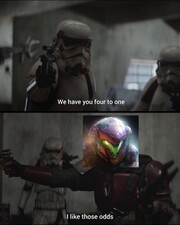 Editor's note: Vale was wearing scrubs in this scene.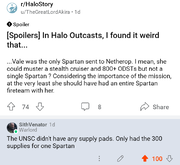
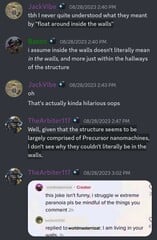
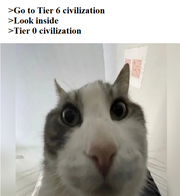

 TFW you've accidentally been working for the Banished.