
Microsoft Flight Simulator
From Halopedia, the Halo wiki
 |
There is more information available on this subject at Microsoft Flight Simulator (crossover) on the English Wikipedia. |
| Microsoft Flight Simulator | |
|---|---|
|
Developer(s): |
|
|
Publisher(s): |
|
|
Platform(s): |
|
|
Release date(s): |
|
|
Genre(s): |
Simulation |

Microsoft Flight Simulator is a simulation game developed by Asobo Studio and released in 2020. The game allows players to fly dozens of highly-detailed aircraft anywhere on Earth. In 2022 the Flight Simulator franchise celebrated its 40th anniversary, and in celebration released numerous new aircraft into the game, including the D77 Pelican dropship from Halo Infinite. The Pelican DLC was released on the same day as its announcement on June 12, 2022, and is free to all players.[1][2]
To celebrate the Pelican's release, Asobo Studios held an official in-game event on June 24, 2022, where they encouraged players to meet up in-game and fly to various locations on Earth featured in the Halo series. These included a number of places in Africa including Zanzibar Island, Mombasa, and Mount Kilimanjaro.[3]
The Flight Simulator release represents the first time a flyable Pelican has been given extensive detailing, following an easter egg in Halo: Reach and a short section of the level Shutdown in Halo 4.
D77-TC Pelican[edit]
Official description[edit]
| “ | The Pelican is an iconic aerospace vehicle originating in the Halo™ universe. It is a combat dropship, able to carry cargo and troops from orbit to a planet’s surface, then back again. It is a highly adaptable, multi-role vehicle that forms the backbone of United Nations Space Command (UNSC) transport squadrons in the 26th century.
Designed and built by Misriah Armory, the D77 Pelican has a typical crew of three (pilot, copilot, and crew chief) and can carry up to 14 fully-equipped infantry and their equipment. A vehicle can be carried in the external hardpoint clamp for immediate deployment. It has a lifting body design powered by four high-efficiency fusion thrusters with secondary positional / stability augmenters. The wings have three hardpoints each, which can hold sensors, cargo pods, or weapons. The D77 featured here has a full post-Covenant War avionics modernization kit and engine overhaul, but has the performance throttling typical of civilian models and UNSC military trainers. With remote authorization these limitations can be removed. The D77-TC Pelican offers: - A unique flight model, with the ability to switch between a drone type and a jet type propulsion. - Custom avionics, inspired by the Halo games. - Complete interior model, including cargo bay. - 13 liveries.[4] |
” |
In-game information[edit]
In-game, the Pelican has the following characteristics:
| Misriah Armory D77-TC PELICAN | |
| Cruise Speed | 210 KTAS |
| Max Altitude | 45,000 feet (14,000 m) |
| Endurance | 10 hours |
| Range | 5,300 nautical miles |
Liveries[edit]
 This section is a stub. You can help Halopedia by expanding it.
The Pelican features 13 unique liveries which change the paintjob of the craft. Most of these simply change the vehicle to various kinds of colour scheme, though one livery repaints the Pelican in the colours of the D77C-NMPD Pelican, as used by the New Mombasa Police Department in Halo 3: ODST.
Production notes[edit]
The Pelican model featured in Flight Simulator appears to be based on, and nearly identical to, that created by 3D artist Andrew Bradbury for Halo Infinite,[5] even down to the decals used throughout the vehicle. This includes the decal for a "troop deployment pod"; a fan design first concepted by Stephen Loftus to justify a disrepancy in the original 2001 print of Halo: The Fall of Reach, and later properly canonised in Halo Infinite.[6] However, the two models have some differences, such as Flight Simulator forgoing the chin-mounted M370 autocannon featured in Infinite and instead replacing it with a searchlight similar to that of the NMPD Pelican in Halo 3: ODST.
The model for Flight Simulator was handled by art outsource studio Room 8 Studio,[7] with multiple specific artists working on it. These include Room 8 3D artist Yuri Shevchenko, who created the Pelican's cockpit and interior sections,[8] and Asobo Studio UI lead Charlotte Couderc, who created the user interfaces on the cockpit screens.[9]
Gallery[edit]
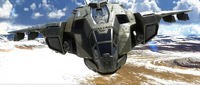 A screenshot of the Pelican in-game.
