
Titan (canceled game)
From Halopedia, the Halo wiki


- "Ensemble has been wanting to make an MMO for a long time. That was in production for a long time. The Halo IP was a great IP to launch an MMO with. Microsoft... hasn't had the best track record with those.
And we worked on it for a long time--we had staffed up an almost-40 person team. And then there was some reorganization at Microsoft, and the new bosses thought it wasn't the best idea anymore. It had actually been green-lit, and then it got cancelled after that." - — Dave Pottinger[1]
Titan was the codename for a canceled Halo massively multiplayer online role-playing game (MMORPG) developed by Ensemble Studios between 2004 and 2007.[2] Following the project's cancellation in 2007, Ensemble Studios focused all of its resources into developing Halo Wars.
Overview[edit]
Development[edit]
Titan's origins began in 1998 following the release of Ultima Online. At this time, designer Ian Fischer began pitching a sci-fi MMO to Ensemble Studios, due to his love for the genre.[3] The game was designed to compete against Blizzard Entertainment's World of Warcraft,[2][4] The prototype went through many design iterations, before eventually being married to the Halo IP and being given the codename Orion.[3] At some point, the project name was changed to Titan.
By 2004, development on the project had begun fully, with a budget of around $90 million USD.[2] To support the operations of such a large scale project, a new 60,000 square-foot campus was commissioned for construction.[3][4] Around 40 staff in three teams worked on Titan while other Ensemble staff focused on developing Halo Wars, though one team remained on the project for six months.[1][5] According to user "goneisgone", who was responsible for leaking many of the images and details known of Titan, the project never left pre-production and only ever had about eight staff working on it.[6]
During the early stages of Titan's development, Ensemble took inspiration from World of Warcraft's general structure and gameplay.[4] During production, the team at Ensemble consistently did evaluations of how successful they expected the game to be; at the time the only noteworthy science fiction MMO on the market was Eve Online, which had a very different style to more conventional MMOs. The analysis', conducted in conjunction with Microsoft, used the most critical and negative calculations possible and still estimated that the Halo MMO would earn just over a billion dollars at minimum - on account of the quality of Ensemble's team and the value of the Halo intellectual property at the time. Ultimately, the project was estimated to need three and a half years to finish, [7]
The project was said to be radically different in the later stages, exploring then-novel concepts and gameplay additions such as "heroic stylized artform" and cover system (later used in Star Wars: The Old Republic), and public quests (later used in Warhammer: Online).[8] Instead of mana points as used in World of Warcraft, a character's special ability energy was referred to as psion.[9]
Cancellation[edit]
Titan was internally cancelled in mid-to-late 2007 with no formal announcement of its development by Microsoft.[10][5] By this time, the majority of the studio's staff were expecting the MMO to be the company's focus in the future[3] and Ensemble had a server infrastructure for the game, a World of Warcraft-scale gameplay zone and many of the vehicle and gunplay mechanics in a playable state.[11] Ultimately, the planned new campus was never greenlit for construction and requests to know why ignored, until a source within Microsoft leaked that the company planned to dissolve Ensemble following the release of Halo Wars.
Titan was cancelled due to a shift in leadership within Microsoft, as the company saw the success of the Nintendo Wii and ultimately decided to change their shift into a more casual-friendly direction - with this came the decline of interest in the Titan project and the $90 million funding. With the cancellation of Titan, the studio's staff and efforts were shifted into the ongoing Halo Wars project which released in 2009.[2] Part of this shift in leadership came in 2007, when Don Mattrick became the head of Microsoft Game Studios. As part of his hiring contract, Mattrick had three years to make the gaming part of Microsoft profitable which, if achieved, would see him given a substantial monetary bonus. As such, despite the potential long-term gains that the Halo MMO was forecasting, the development time was too long and wouldn't allow Mattrick to keep his bonus. Additionally, Ensemble Studios were a very expensive studio to run and Mattrick had personal investment in keeping around other studios such as Rare due to his personal connections - as such, he kept Ensemble around until Halo Wars released, then shut down Ensemble Studios to increase the profitability of Microsoft gaming - even at the cost of potential long-term profits. Ultimately, Mattrick never got the bonus due to his less successful endeavours with Xbox LIVE.[7]
Art direction, story and setting[edit]
- "That idea of that sort of stylized approach to Halo was something that we were very interested in, in terms of the art. Some of the art that leaked out wasn't art that was actually in the game, so people were a little more torqued than they needed to be."
- — Dave Pottinger[1]
Titan was to have been set in the era of the Forerunners[12], intending to go back in time within the Halo universe to tell a "more broad story" similar to that employed by The Old Republic within the Star Wars setting.[4] Although Covenant species such as the Elites, Grunts, Jackals and Brutes were to feature, the game would not feature the Covenant as a faction with things being "more broken up", explained by Dave Pottinger as "The Covenant weren't quite the Covenant yet".[1] Despite the Forerunner era setting, the Covenant and UNSC forces featured in the game retain the designs of the modern-era Halo setting.
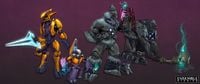 Concept art for Covenant species.
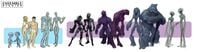 Concept art for humanity, Covenant and other miscellaneous species.


During the game's earlier stages of development, Ensemble studios produced concept art to explore the "heroic stylised" artform employed by the game. Much of the artwork developed was done to explore what would and would not work in the final game, with no guarantee any concept design would make it to the final shipped title.