
UNSC rank structure
From Halopedia, the Halo wiki
The rank structure of the United Nations Space Command's mainline branches of service (the Navy, the Marine Corps, the Army, and the Air Force) is largely derived from the system employed by the 21st century United States military.[1]
Overview[edit]
- Main article: UNSC military organization
The UNSC's rank structure is similar to that used by 21st century militaries, primarily the United States military. Unlike contemporary military forces, however, the UNSC largely employs two main rank schemes throughout its organization; NAVCOM rankings for organizations within UNSC Naval Command (namely, the UNSC Navy and Office of Naval Intelligence) and UNICOM rankings for Unified Ground Command subordinates (UNSC Army, Air Force, Marine Corps). UNSC ranks can be broadly categorized into several groupings;
- Enlisted: Regular personnel who perform the "front line" duties. This includes regular infantry personnel.
- Non-commissioned Officers: Non-commissioned officers (NCOs) are enlisted personnel that fill most intermediary leadership and administrative roles. Their responsibilities vary by service, occupational specialty and duty station. The UNSC relies heavily on NCOs, and they share many responsibilities with officers.[1]
- Warrant Officers: Warrant officers are technical specialists and subject matter experts who are given an officer's commission in recognition of their expertise and leadership role. They take the officer's oath of service and are rated above enlisted troops but are subordinate to full officers. The Air Force does not select or utilize warrant officers, and they are rarely found in the Marine Corps.[1]
- Officers: UNSC officers are commissioned, meaning that their authority is granted by a formal legal document issued on the authority of the UEG President. This commission is awarded after the completion of Officer Candidate School (OCS) and after taking the oath of service.[1]
NAVCOM ranks[edit]
UNSC Naval Command uses rank titles which are different to the other branches. Navy ranks and terminology have a long history which dates back to eras when ships sailed on the oceans of Earth rather than in space. These ranks are used by the UNSC Navy and ONI.[2]
Enlisted ranks[edit]
| Rank[navcomnote 1] | Crewman Recruit (CR) | Crewman Apprentice (CA) | Crewman (CR)[navcomnote 2] | Petty Officer, Third Class (PO3) | Petty Officer, Second Class (PO2) | Petty Officer, First Class (PO1) | Chief Petty Officer (CPO) | Senior Chief Petty Officer (SCPO) | Master Chief Petty Officer[navcomnote 3] (MCPO) |
| Typical responsibilities | Boot camp and training school | Initial fleet assignment | Work crew | Work party lead | Compartment supervisor | Work division supervisor | Deck supervisor | Oversight of ship enlisted personnel | Fleet administration or HIGHCOM staff |
Officer ranks[edit]
| Rank code | OT | WO-1 | WO-2 | O-1 | O-2 | O-3 | O-4 | O-5 | O-6 | O-7 | O-8 | O-9 | O-10 |
| Rank | Cadet (CDT) | Warrant Officer (WO) | Chief Warrant Officer (WO-2) | Ensign (ENS) | Lieutenant, Junior Grade (LTJG) | Lieutenant (LT) | Lieutenant Commander (LCDR) | Commander (CDR) | Captain (CAPT) | Rear Admiral (RADM) | Vice Admiral (VADM) | Admiral (ADM) | Fleet Admiral (FADM) |
| Typical responsibilities | No command authority | Resident technical expert | Command advisor or captain of utility ship | Initial officer posting | Command of staff section | Command of work division or Captain of support ship | First officer on small warship or command of ship department | HIGHCOM staff or captain of small warship[navcomnote 4] | Captain of line warship or installation[navcomnote 5] | Battle group commander | Command of Sector fleet or academy | HIGHCOM staff | Fleet commander |
Notes[edit]
- ^ Rank codes are not provided for enlisted Naval personnel in Halo: Official Spartan Field Manual. While it is likely they use the same "E-1, E-2" etc. system as other rank codes, they are omitted from this table as to only display confirmed information.
- ^ The "CR" abbreviation is also used for Crewman Recruit in the Halo: Official Spartan Field Manual. In real life Crewman uses the abbreviation "CN", leading to it likely a typo for Crewman to use this. CR is however used here due to it appearing in one source.
- ^ Although Master Chief Petty Officer is the official rank held by many naval servicemen, they are typically referred to as "Top Chief" by crew out of respect for John-117, more commonly known as "The Master Chief".
- ^ Commanders have also been shown to command small fleets and battle groups, an example being Commander Miranda Keyes commanding Seventh Fleet and Commander Lasky commanding Battle Group Dakota.
- ^ Captains have also been shown to command entire fleets and battle groups, an example being Captains Del Rio and Lasky commanding Expeditionary Strike Group 1 Fleet and Captain Veredi commanding Battle Group 4.
UNICOM ranks[edit]
UNSC ground forces rely on little administrative overhead and bureaucracy thanks to artificial intelligences and automated services, which handle the majority of routine paperwork and coordination. The UNSC's standards of training and high "tooth to tail" ratio of fighting troops to support personnel also allow senior enlisted and junior officers to be given much more responsibility and command authority than what was historically possible.[3] While the below tables present a standard for UNICOM as a whole, some differences still exist per-branch. For example, warrant officers are not utilised by the Air Force at all and only rarely by the Marine Corps.[4] Some UNSC Army and Air Force personnel additionally make use of ranks and/ or roles that do not fit into the UNICOM system of organisation.[unicomnote 1]
Enlisted ranks[edit]
| Rank code | E-1 | E-2 | E-3 | E-4 | E-5 | E-6 | E-7 | E-8 | E-9 | ||||
| Rank | Private (PVT) | Private, First Class (PFC) | Lance Corporal (LCPL) | Corporal (CPL) | Sergeant (SGT) | Staff Sergeant (SSGT) | Gunnery Sergeant (GYSGT)[unicomnote 2] |
|
| ||||
| Typical responsibilities | Boot camp and training school | Initial assignment | Fireteam assistant | Fireteam leader | Squad leader | Assistant platoon leader | Assistant company commander |
|
|
Officer ranks[edit]
| Rank code | OT | WO-1 | WO-2 | O-1 | O-2 | O-3 | O-4 | O-5 | O-6 | O-7 | O-8 | O-9 | O-10 |
| Rank | Cadet (CDT) | Warrant Officer (WO) | Chief Warrant Officer (WO-2) | Second Lieutenant (2LT) | First Lieutenant (1LT) | Captain (CPT) | Major (MAJ) | Lieutenant Colonel (LTCOL) | Colonel (COL) | Brigadier General (BGEN) | Major General (MGEN) | Lieutenant General (LTGEN) | General (GEN) |
| Typical responsibilities | No command authority | Crew chief or Army pilot | Senior subject matter expert | Platoon commander | Company executive officer | Company commander | Battalion executive officer | Battalion commander | Brigade commander | Division commander | Task Force commander | CENTCOM commander | HIGHCOM senior staff |
Notes[edit]
- ^ In the Fireteam mechanic in Halo: Reach, Army troopers can be seen with the rank of "SPC", most likely meaning Specialist as used by modern militaries. In Spartan Ops, a member of the UNSC with the rank of Airman can be seen. It is presently unclear where these roles lie in regards to the rank scheme provided by the Official Spartan Field Manual.
- ^ a b c d Master Gunnery Sergeants can also be referred to informally as "Master Guns", while Master Sergeants in the Army and Marine Corps may be referred to as "Top".
Spartan Operations[edit]
Unlike NAVCOM and UNICOM, the Spartan Operations division does not employ traditional ranks.[5] Instead, the Spartan branch works to take the informal leadership traditions of the SPARTAN-IIs and adapt them into a structure that emphasizes independence and unity of purpose over rigid adherence to the chain of command. Nevertheless, SPARTAN-IV personnel are given additional responsibilities and authority as they advance in their careers. All Spartans receive a direct commission as an officer of the UNSC, though this authority does not typically extend out of their chain of command.[6][7]
Overall, Spartans are considered strategic assets in the post-war environment. While Spartan Operations does retain administrative control of Spartan personnel, tactical deployments are the responsibility of the unit to which they are assigned. As such, they are often paired to work alongside UNICOM and NAVCOM special forces - in particular Orbital Drop Shock Troopers and UNSC Army Rangers.[7]
While aboard naval vessels, Spartans report directly to the ship's captain in all matters relating to the safety and security on-board the ship - superseding all other responsibilities and orders. In all other cases, the Spartan Commander has operational control of Spartan personnel, and Spartans cannot give or be given orders to/from Navy or ONI personnel. Spartans are, however, encouraged to accommodate reasonable requests when they do not violate existing orders or the Spartan Code.[2]
| Role | Spartan | Fireteam Leader | Mission Handler | Spartan Commander | Director of Spartan Operations |
| Responsibilities | Augmented special forces equipped with MJOLNIR Powered Assault Armor. | Field leader of a fireteam of 4-5 Spartans. | Spartan Command liaison and intelligence support stationed at headquarters. Responsible for managing 5-10 fireteams, or 20-50 Spartans. | Overall command-and-control of Spartan Company. Responsible for upwards of 300 Spartans. | Commander-in-Chief of the Spartans (CINCSPAR) |
| UNSC authority | First Lieutenant | Captain | Major | Colonel | General |
Trivia[edit]
- The Halo Encyclopedia (2009 edition) erroneously describes the structure and insignia of the UNSC's ranking system as being identical to those used in Halo multiplayer, Halo 3 in the original printing and Halo: Reach in the 2011 edition.[8] It also lists the O-11 rank "Commanding General".[9]
- In Halo 3: ODST's VISR mode, rank icons can be seen given for the various members of Alpha-Nine. The rank icons on display use the icons found in the multiplayer ranking of Halo 3, and for the most part match up with the ranks of the various squadmembers with the exception of Jonathan Doherty (see gallery for a full comparison).
Gallery[edit]
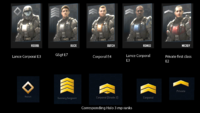 The various members of Alpha-Nine and their corresponding Halo 3 multiplayer rank icons.

Sources[edit]
- ^ a b c d Halo: Official Spartan Field Manual, page 139
- ^ a b Halo: Official Spartan Field Manual, page 140-141
- ^ Halo: Official Spartan Field Manual, page 142-143
- ^ Halo: Official Spartan Field Manual, page 139
- ^ Halo 4: The Essential Visual Guide, page 33
- ^ Halo: Official Spartan Field Manual, page 32-33
- ^ a b Halo Encyclopedia (2022 edition), page 65
- ^ Halo Encyclopedia (2011 edition), page 50-51
- ^ Halo Encyclopedia (2011 edition), page 49


