
UNSC starship
From Halopedia, the Halo wiki

UNSC starships[1][2] are Human starships operated by the United Nations Space Command (UNSC) and its various branches and forces.
Overview[edit]
Organization[edit]
In the UNSC, ships can also be operated by different departments and branches. Warships like the UNSC In Amber Clad were often operated by the UNSC Navy.[3] UNSC Navy ships were deployed by UNSC Fleet Command.[4] In the case of the UNSC Swift Justice, it was operated by the Incident Response and Investigation division of the UNSC.[5] The UNSC Department of Commercial Shipping also operated a number of Freighters.
These organizations as well have ways of identifying their ships. There was the Hull classification symbol, which gives each ship a letter classification and a number.[6][7] There was also the ship emblem, which was a unique image that crew wore on their uniforms.[8][9] Some warships also used the UNSC REG system, which was also a special serial number.[10] There was also the UNc system.[11]
The UNSC Department of Commercial Shipping operated its own identification codes for freighters that were primarily used in COM transmissions.[12]

Tactical Groupings[edit]
- Main article: UNSC Navy tactical formations
UNSC ships were organized into fleets; specifically numbered expeditionary fleets and named defensive fleets. Further down, ships were arranged into battle groups.[13] As well, squadrons were a type of tactical grouping for support ships early in the Covenant War,[14] but by the end of the war were relegated to a type of administrative grouping.[13]
Often, naval groupings had a flagship from which commanding officers lead their groupings from.
Personnel and operations[edit]
It is expected of all navy ship personnel to participate in working parties. The working parties help with routine maintenance and replenishment.[15]
Ensigns often did not pilot capital ships.[16]
The commanding officer of a UNSC starship, like other human starships, is referred to as a Captain regardless of actual rank.[17] The actual military rank of the leader is dependent on the size of the ship. Those of the rank Lieutenant often are in charge of small support vessels, Commanders are in charge of small warships, and Captains are in charge of line warships.[18] The commanding officer in radio communications is referred to as the ships name followed by "Actual".[19][20]
UNSC Starships were often given a Ship Director, an AI who could manage much of the ship's tasks with the Captain's authority. Generally, these AI were "Smart".[17] Various shipboard electronic systems fell into the purview of the UNSC Data Administration.[21][22]
Children were sometimes born on board UNSC ships as well, with children being born on the UNSC Savannah and the UNSC Grafton.[23]
Procedures, traditions and culture[edit]
Several procedures affected the operations of UNSC ships as well. Prior to crash landings, active cryo pods were to be ejected into space.[24] The Cole Protocol also affected the possible destinations of ships.
Navy personnel UNSC ships often follow old naval tradition. Boarding a UNSC warship is considered a ceremony, not a formality. When boarding a ship, the boarder requests permission from the officer on deck. The officer on deck will reply with a curt "Very well".[15]
"Dead fleets" or "paper fleets" are maintained as tradition and to honor those who died while serving. Inadvertently, some starships will be attached to these fleets by bureaucratic error. Many crewmen regarded this as a bad omen.[13]
Design and specifications[edit]

Most ships of the Human-Covenant War era were strictly utilitarian in design.[26]
Construction, decommissioning and repairs[edit]
A number of corporations seemingly based in numerous places, helped construct UNSC ships including Sinoviet Heavy Machinery, Aerofabrique SA,[27] TanSec AB,[28] Reyes-McLees Shipyards,[29] Kuushan Shipyards,[30] and Martian Metals Shipyards.[31]
These companies were located at a number of places in human space with construction typically taking place in orbit of planets. Tribute, Mars[27][32] Jupiter,[33] and Reach[34] had ship building yards. Reach also had its own ship breaking yards that decommissioned ships were sent to.[35] Earth as well had orbital facilities for repairs and float outs.[25] The UNSC Cradle on the other hand was a mobile Refit station that could travel to ships.
On ship facilities[edit]

Design guidelines for ships emphasize that the command crew should have visibility of the surrounding exterior area of the ship. This is usually achieved through windows on the bridge.[36]
UNSC ships have an internal deck naming structure. On most ships, the Hangar deck is considered Zero Deck. Decks below that are "belowdeck" and are numbered in descending order starting at First Deck. Everything above the hangar deck is a "level", starting at Level One and going in an ascending order.[37]
Facilities to create simulated War Games training sessions could be found on several ships. Though they were mostly on post-war vessels and most prominently on the UNSC Infinity.[38]
From the Phoenix-class carrier UNSC Spirit of Fire[39][40] to the Marathon-class heavy cruiser UNSC Say My Name,[41] numerous ships featured holotables for battlefield situational displays.
Cryo chambers were an important feature that allowed the crews to travel large distances without aging as much. Cryo facilities were often large and individual chambers displayed crew member names.[42]
UNSC starships also featured mess halls,[9][43] hangar bays,[9][44] and armories.[45][46]
Crew quarters on UNSC navy ships vary by ship type. Halberd-class light destroyers crew quarters were cramped[47] with members being allocated a single sleeping pod that would sometimes need to be shared when the ship has additional crew.[36]
Propulsion, movement, and docking[edit]
- Main articles: Fusion drive, Shaw-Fujikawa Translight Engine
UNSC ships were equipped with fusion drive engines to help them move and maneuver in real-space. Shaw-Fujikawa drives help ships reach supraluminal speeds.
UNSC ships had docking capabilities, though the exact details are dependent on what the ship is docking with. Stalwart-class light frigates were capable of docking with Moncton-class orbital weapon platforms.[8] Class-L flash-docks routinely held frigates and corvettes, though the UNSC Pillar of Autumn was able to use one.[35]
Armament and defenses[edit]

A number of UNSC vessels, particularly those under the control of the UNSC Navy are equipped with weaponry and self-defense mechanisms.
MACs[edit]
- Main article: Magnetic Accelerator Cannon
MACs are massive coil guns that are used to accelerate multi-ton projectiles at extremely high velocities. These projectiles were a super-dense ferric (iron) tungsten shell.[48] The Mulsanne-class trades in its MAC weaponry for the Brightlance reflex laser.[49]
As an example, frigate based MACs are capable of firing their slugs at roughly 30,000 meters per second.[48] UNSC Infinity has miniature MAC guns along its hull, to compliment its built in, larger MAC guns.[50]

Missiles and rockets[edit]
- Main articles: Missile, Nuclear weapon
UNSC ships generally carry an array of missile batteries. Most UNSC ships carry Missile Delivery Systems which, depending on the pod, could fire a variety of missiles. The Archer Missile is a common type of missile from these system that fire from one of many pods. Other missile systems include These were complemented with Fusion rockets.
UNSC warships usually contain nuclear weapons of some sort. Shiva-class nuclear missile and M4093 Hyperion nuclear delivery system were known shipboard nuclear weapons used by the UNSC.
Point-defense guns[edit]
- Main article: Point-defense gun
Point defense batteries were common on UNSC warships. Some of these batteries include the M910 Rampart, the M870 Rampart, the M710 Bulwark, and the Mark 57 Arena.
Electronic warfare[edit]
- Main article: Electronic warfare
 This section is a stub. You can help Halopedia by expanding it.
Complement[edit]
- Main articles: Space fighter, Dropship

Attached to various UNSC vessels are a number of small craft that perform a variety of roles both for the ship's operation and separate from it.
Space fighters are maneuverable craft that perform interception, interdiction, or space supremacy roles. Corvettes cannot contain space fighters as they cannot contain anything larger than a shuttle.[51] The GA-TL1 Longsword is the primary fighter of the UNSC's fleet.[52] Space fighters could be operated by other branches though, even when stationed on the ship with the F-41 Exoatmospheric Multirole Strike Fighter, for example, being most often operated by the UNSC Air Force.[53]
Another type of small craft is the tactical aerospace lifter, more commonly known as a dropship. Like space fighters, they were sometimes operated by other UNSC branches. The ubiquitous Pelican was operated by several branches including the UNSC Marine Corps.[8]
Some starships, like the UNSC Pillar of Autumn, had lifeboats for the crew. The most well known of these lifeboats were the Bumblebee series.[54]
History[edit]
Rise of humanity[edit]
The Insurrection would start because of fighting over a UNSC ship, the UNSC Callisto, in the Callisto Incident.[55]
The time of the Insurrection saw a number of class additions and developments to the UNSC's fleet. In 2493, the Valiant-class super-heavy cruiser entered service. Though serious cost problems over five years cast doubt in the class' future.[56] At some point in the Insurrection, a new carrier, the Orion-class assault carrier, was built to help with ground operations.[57] One of the last known class additions during the Insurrection was the Halcyon-class light cruiser. In 2510, the class first entered service.[58]
Human-Covenant War[edit]

- Main article: Human-Covenant War
Course of the war[edit]
- "We returned to Harvest with enough firepower to assault the vaults of heaven."
- — Preston Cole discussing Battle Group X-Ray at the Battle of Harvest.[59]
- Main article: Massacre of the Outer Colonies
In 2525, the UNSC would strip away the CMA's naval resources and give them to NAVCOM.[60] As well, the UNSC would begin to take over the Colonial Administration Authority in the midst of the Human-Covenant War. With these additions, the UNSC received several different types of ships. This included the CAA's Springhill-class mining ship[61][62] and the Diligence-class from the CMA.[63] Both of which would be brought back to service or continued service such as with the UNSC Kronstadt and the CAA Heavy Burden.
Impressive fleet actions characterized the early war. 40 ships of Battle Group X-Ray fought a single Covenant vessel over Harvest,[64] over 100 ships saw action in the Battle of Alpha Aurigae[59][64] and another 70 clashed with the Covenant at the XI Boötis A system.[59] However these actions were tempered by large losses in each; 13 ships destroyed at Harvest,[64] 37 lost at Alpha Aurigae and 30 destroyed at XI Boötis A.[59]
The war saw combat losses far outstripped shipyards' abilities to build replacements for both military and commercial ships. Trade restrictions were also put in place to limit the risk that slipspace travel represented to remaining colonies.[65] Over the course of the war, the Fleet of Particular Justice destroyed 120 ships[66] and 185 UNSC capital ships were destroyed by Writh Kul's Dagger of Mercy.[67]
End of the war[edit]
- Main article: Siege of the Inner Colonies

In 2551, numerous UNSC starships were destroyed as part of fighting at Promise.[22]
By the final year of the war, a majority of the UNSC's ground forces had been consolidated at Reach and at Earth. For many colonies, it was only the ships of the navy that were reminders of the UNSC and gave aid to those cut-off. Though in many instances, the Navy couldn't afford the loss of ships and personnel, often leaving these colonies to their own devices including destruction by the Covenant. No appreciable differences could be seen in expeditionary and defensive fleets as the UNSC lost the ability to conduct offensive naval operations. Navy AIs by this point were still assigning ships to squadrons, though at that point they were administrative groupings that had lost meaning over the course of the war. As well, numerous fleets only existed on paper, having been destroyed in lost sectors years prior.[13]
With over 152 ships present at the Battle of Reach,[68] a large number of these ships were destroyed. This included many capital ships such as the UNSC Trafalgar, the flagship of the Epsilon Eridani Fleet and pride of the Navy.[69]
Starting September 5, 2552 all remaining UNSC starships and their fleets were consolidated under a single command grouping under the UNSC Home Fleet.[70] Numerous ships arrived at Earth on October 20, 2552.[71] The ships above Earth would then go onto engage Covenant forces when they arrived the same day with a very large contingent of UNSC vessels and fleets that was later destroyed by overwhelming Covenant reinforcements on November 17, 2552.[8][72] By the end of the war, the plethora of UNSC starships had been reduced to only a few hundred.[73]

Postwar[edit]
- Main article: Post-Covenant War conflicts
- "And if we do that, we lose a massive deposit of resources that our fleets need to rebuild. We’ve barely managed to get the Home Fleet back up to a few dozen ships while the Brass is demanding whole battle groups be assembled..."
- — Captain Pedro Alvarez to Lycaon during the Outbreak at Site 22.[74]
Following the Human-Covenant War, the surviving UNSC starships were brought back to Sol to be repaired, refitted, and counted.[73]
In the wake of this, the UNSC sought to rebuild the ships they had lost.[74] As such, postwar shipbuilding mainly focused on rebuilding UNSC naval vessels, which combined with limited shipbuilding capacity to begin with, affected the production of merchant ships.[65] To help facilitate all of this, the UNSC placed great importance on partnerships between corporations such as those between BXR Mining Corporation and Imbrium Machine Complex.[74]
A variety of starship classes and several ship improvements that were created during the war finally became commonplace. The Autumn-class heavy cruiser, the Strident-class heavy frigate and the Infinity-class supercarrier were all added to the fleet. All three have shielding,[75][76] an unprecedented addition to UNSC ships.
As part of ongoing offences, UNSC Strident-class frigates and Anlace-class light frigates were being deployed to the Outer Colonies to route out Covenant remnant occupiers.[27]
Created uprising[edit]
- Main article: Created uprising
During the Cortana Event, many UNSC starships were disabled by Guardian Custodes.[77] Some ships were ripped out of Slipstream Space with the activation of the Guardians, like the UNSC Nereid.[78] Shipboard AIs from numerous starships also defected to the Created.[77]
Several ships survived this event. At least five Strident-class heavy frigates and two Anlace-class light frigates were able to see combat in Operation: WOLFE.[79] At least six Mulsanne-class light frigates were able to see combat during the Battle for Installation 07. However, during that battle over Installation 07, those frigates were destroyed.[80]
Post-Created uprising[edit]
Following the death of Cortana at Installation 07, one of the largest fleet actions would take place since the Covenant War. At Boundary four fleets of ships totalling about 200 ships would fight the Banished and Sali 'Nyon's Covenant in orbit of the planet.[81]
Classes[edit]
.jpg)
Colony ships[edit]
- Main article: Colony ship
Support starships[edit]
- Main article: Support starship
Several types of support ships that were used include the stealthy prowler and its subtypes. Other stealth ship classes existed including the Chiroptera-class subprowler. There was also the incredibly small sloop. Another type of ship that was used by the UNSC was the Calypso-class exfiltration craft. Following the UNSC's take over of the CAA, the Springhill-class mining ship helped build materiel for UNSC forces.
Warships[edit]
- Main article: Warship
The UNSC employs a number of warships including frigates, destroyers, cruisers, and corvettes. The Vindication-class was unique as it was a Battleship, an uncommon warship in UNSC ship design and classification.
UNSC carriers were among the largest, most heavily armed ships the UNSC possesed. Two carrier classes were so large that frigates could dock with them; the Punic-class supercarrier and the Infinity-class supercarrier.[82]
Other[edit]
ONI's Reverse Engineering and Prototyping–Xenotechnology department have recovered, refit and begun testing on multiple Covenant starships.[83]
Known vessels[edit]
| Class | Fleet or last known tactical grouping | Ship Name | Hull classification symbol | Last known captain | Notes |
|---|---|---|---|---|---|
| Epoch-class heavy carrier | Unknown | UNSC Epoch | Lead ship | ||
| UNSC Atlas | |||||
| UNSC Ozymandias | Destroyed over Mars in 2557. | ||||
| UNSC Lyonesse | |||||
| Infinity-class supercarrier | Expeditionary Strike Group 1 | UNSC Infinity | INF-101 | Thomas Lasky | Lead ship. Missing over Installation 07. |
| Unknown | UNSC Eternity | Not Completed | |||
| Orion-class assault carrier | Unknown | UNSC Fifth Winter | |||
| UNSC Orion | Lead ship | ||||
| Phoenix-class carrier | Third Fleet | UNSC Spirit of Fire | CFV-88 | James Cutter | Active but officially listed as lost with all hands. |
| Poseidon-class light carrier | Unknown | UNSC Milwaukee | |||
| UNSC Poseidon | Lead ship | ||||
| Punic-class supercarrier | Unknown | UNSC Punic | Lead ship | ||
| Epsilon Eridani Fleet | UNSC Trafalgar | Flagship of Epsilon Eridani Fleet. Destroyed over Reach | |||
| Unknown | UNSC Home Fleet | UNSC Stalingrad | Carl Patterson | ||
| UNSC Witness | |||||
| Third Fleet | UNSC Totem Lake | CVA-92 | |||
| Unknown | UNSC All Under Heaven | ||||
| UNSC Magellan | |||||
| UNSC Musashi |
| Class | Ship Name | Notes |
|---|---|---|
| Gladius-class corvette | UNSC Gladius | |
| UNSC Sagan Blue | ||
| Lancer-class fast-attack corvette | UNSC Lancer | |
| Mako-class corvette | UNSC Pony Express | |
| Scholte-class missile corvette | UNSC Scholte | |
| Fast-attack corvette | UNSC Two for Flinching | |
| Unknown | UNSC Bum Rush | |
| UNSC Callisto | ||
| UNSC Chalons | ||
| UNSC Coral Sea | ||
| UNSC Glamorgan |
| Class | Ship Name | Notes |
|---|---|---|
| Banta-class transport | UNSC Dartmouth | |
| Phoenix-class colony ship | UNSC Phoenix | |
| UNSC Spirit of Fire | Modified into Warship prior to Human-Covenant War |
| Class | Ship Name | Notes |
|---|---|---|
| Springhill-class mining ship | CAA Heavy Burden | Repurposed by the UNSC as an ordnance transport during the Human-Covenant War |
| Vancouver-class courier | Han | |
| Ammunition Ship | UNSC Diadochi | Crashed on what became Partition |
| UNSC Taulanti | ||
| Cargo Freighter | UNSC Onan | |
| Mona Lisa | Converted to a prison transport, Destroyed | |
| UNSC schooner | UNSC Donoma | |
| UNSC Santori | ||
| Colony freighter | UNSC Glasgow | |
| Military cargo tender | UNSC Dark Was the Night | Crashed on Losing Hand, some crew recovered |
| Unknown | UNSC Jamaica | |
| UNSC Nereid |
Non-canon and dubious canon appearances[edit]
Silver Timeline[edit]
 |
This article contains information about the Silver Timeline, and is not a part of the established Halo canon. |
- Main article: Silver Timeline

Numerous ships exist in the Silver Timeline, battling the Covenant during the Human-Covenant War.
| Class | Ship Name | Notes |
|---|---|---|
| Logistics ship | UNSC Bukovac | |
| Halcyon-class light cruiser | UNSC Himalaya | Destroyed |
| Gladius-class heavy corvette | UNSC Gladius | Attacked by Makee |
| Stalwart-class light frigate | UNSC Stalwart Dawn | |
| Halberd-class light destroyer | UNSC Pioneer | Destroyed in the Battle of Eridanus II |
| Destroyer | UNSC Iroquois | |
| Sahara-class heavy prowler | UNSC Glamorgan | |
| UNSC Mirthless Smile | ||
| UNSC Port Stanley | ||
| UNSC Silent Joe | ||
| Hospital ship | UNSC Solace | |
| Unknown | UNSC Ice Storm |
Depictions in canon[edit]
In the introductory level Prepare to Drop in Halo 3: ODST, the UNSC In Amber Clad was represented with a model of a Charon-class light frigate. In all other media, including Halo 2: Anniversary, the In Amber Clad is a Stalwart-class light frigate.
In Halo 4, the Charon-class UNSC Forward Unto Dawn is depicted as a modified Strident-class. This depiction is non-canon.[84] The Strident-class itself is also depicted differently across multiple media.
Production notes[edit]

A few UNSC craft have been concepted for various titles. The UNSC Andraste was a ship that appeared in a piece of concept art for Halo 3.[85] The UNSC Frontend, an M-class carrier was the center piece of a cancelled idea for Halo Wars 3. The UNSC Olympus[86] and the UNSC Sword of Ascalaphus was concepted for Halo Infinite.[87]
Gallery[edit]
Concept art[edit]
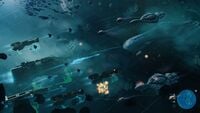 Concept art of a space combat mode for a Halo Wars 3, featuring several UNSC starships.
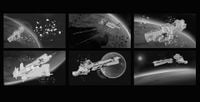 Concept art of various destroyed UNSC ships for Halo: Fleet Battles.
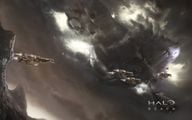 Concept art of UNSC frigates underneath a Sh'wada-pattern supercarrier.
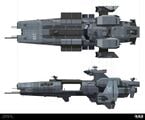 Unused Halo Infinite concept art for a UNSC spacecraft, UNSC Olympus. The ship measures roughly 106m long.
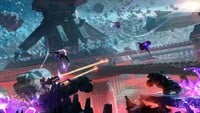 The unused ship in the prior concept can be seen in this artwork for Halo Infinite multiplayer.
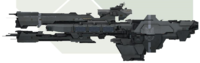 Unused Halo Infinite concept art for the Sword of Ascalaphus.


Overview[edit]
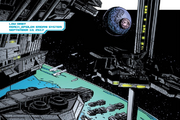 A number of UNSC starships in orbit of Reach.
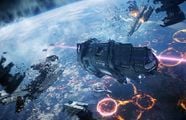 The UNSC Pillar of Autumn fleeing through a debris field of UNSC starships over Reach.
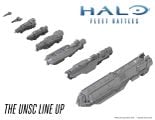 The UNSC starship line-up for Halo: Fleet Battles.
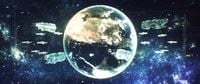 Several UNSC starships in orbit over Camber.
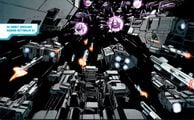 Numerous UNSC ships fighting Covenant over Sigma Octanus IV.
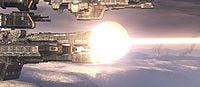 Several Charon-class light frigates at the Battle of Voi.
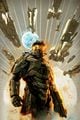 Numerous UNSC ships used on a poster.
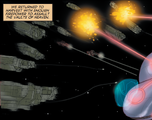 Battle Group X-Ray fighting Heaven's Brilliant Bier over Harvest.
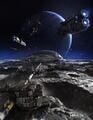 UNSC ships in orbit of Luna.


Sources[edit]
- ^ Halo Legendary Crate, Crate 12
- ^ Halo: Envoy, chapter 28
- ^ Halo: Warfleet, page 36-37
- ^ Halo Encyclopedia (2011 edition), page 64
- ^ Halo: Retribution, chapter 2
- ^ Halo: Official Spartan Field Manual, page 14-15
- ^ Halo: Warfleet, page 42-43
- ^ a b c d Halo 2, campaign level Cairo Station
- ^ a b c Halo: Combat Evolved, campaign level The Pillar of Autumn
- ^ Halo 4, campaign level Dawn
- ^ Halo 2: Anniversary, campaign level Cairo Station
- ^ Halo: Contact Harvest, chapter 1
- ^ a b c d Halo: Fleet Battles core rulebook, page 9
- ^ Halo: Silent Storm
- ^ a b Halo: Official Spartan Field Manual, page 10
- ^ Halo: The Fall of Reach, chapter 21
- ^ a b Halo: Warfleet, page 90-92
- ^ Halo: Official Spartan Field Manual, page 140-141
- ^ a b Halo: Reach, campaign level Long Night of Solace
- ^ Halo 4, campaign level Epilogue
- ^ Halo: Campaign Evolved, campaign level The Pillar of Autumn: Bulletin board
- ^ a b Halo: Campaign Evolved, campaign level Heavy Burden
- ^ Halo: Reach, campaign level The Pillar of Autumn: Marine dialogue
- ^ Halo: First Strike, p. 185 (2010 edition)
- ^ a b Halo Waypoint, Community Update - Chasing Shadows (Retrieved on Jun 1, 2020) [archive]
- ^ Halo: Trial of Reckoning
- ^ a b c Halo: Warfleet, page 38-39
- ^ Halo: Warfleet, page 19
- ^ Halo: The Fall of Reach, chapter 25
- ^ Halo Encyclopedia (2022 edition), page 129
- ^ Halo Encyclopedia (2022 edition), page 125
- ^ Halo Waypoint, Canon Fodder - Buzz Generating (Retrieved on Sep 14, 2016) [archive]
- ^ Halo Encyclopedia (2022 edition), page 127
- ^ Halo: Warfleet, page 36-37
- ^ a b Halo: Reach, campaign level The Pillar of Autumn
- ^ a b Halo: Warfleet, page 32-33
- ^ Halo: Silent Storm, chapter 4
- ^ Halo Waypoint, Canon Fodder - Needle Me This (Retrieved on Jun 1, 2020) [archive]
- ^ Halo Wars, campaign level Dome of Light
- ^ Halo Wars 2, campaign level A New Enemy
- ^ Halo 3: ODST, campaign level Prepare to Drop
- ^ Halo Wars, campaign level Escape
- ^ Halo Legends - The Babysitter
- ^ Halo 5: Guardians, campaign level Blue Team
- ^ Halo: Combat Evolved, campaign level The Maw
- ^ Halo: Evolutions - Midnight in the Heart of Midlothian
- ^ Halo Mythos, page 82-83
- ^ a b Halo: The Fall of Reach, chapter 12
- ^ Halo Encyclopedia (2022 edition), page 121
- ^ Halo 4, campaign level Infinity
- ^ Halo: Contact Harvest, chapter 4
- ^ Halo Encyclopedia (2009 edition), page 261
- ^ Halo 4: The Essential Visual Guide - Vehicles, page 114
- ^ Halo: Combat Evolved, campaign level The Pillar of Autumn
- ^ Halo: Evolutions - The Impossible Life and the Possible Death of Preston J. Cole
- ^ Halo Waypoint, Canon Fodder - Bulkhead Banter (Retrieved on Jun 1, 2020) [archive]
- ^ Halo Waypoint, Canon Fodder - Armory Amore (Retrieved on Jun 1, 2020) [archive]
- ^ Halo: Combat Evolved: Sybex Official Strategies & Secrets, page 60
- ^ a b c d Halo Wars: Genesis
- ^ Halo Wars, Timeline: ??
- ^ Halo 4: The Essential Visual Guide - Locations, page 208
- ^ Halo 4, multiplayer map Adrift
- ^ Halo Waypoint, Canon Fodder - Clarity & Grace (Retrieved on Dec 23, 2019) [archive]
- ^ a b c Halo: Evolutions - The Impossible Life and the Possible Death of Preston J. Cole
- ^ a b Halo Encyclopedia (2022 edition), page 38-39
- ^ Halo 2: Anniversary, Terminal 3
- ^ Halo Infinite, High Value Target dossier, Writh Kul
- ^ Halo: The Fall of Reach, chapter 33
- ^ Halo: First Strike, p. 168
- ^ Halo Legendary Crate - Data Drop #2: Naval Records Archives
- ^ Halo 2, campaign level The Armory
- ^ Halo 3, campaign level Crow's Nest
- ^ a b Halo Mythos, page 132
- ^ a b c Halo: Saturn Devouring His Son
- ^ Halo 4 - Spartan Ops, episode Departure
- ^ Halo Waypoint, Canon Fodder - En Voyage (Retrieved on Jul 12, 2017) [archive]
- ^ a b Halo 5: Guardians, campaign level Guardians
- ^ Halo: Tales from Slipspace - Undefeated
- ^ Halo: Shadows of Reach, chapter 13
- ^ Halo Infinite, campaign
- ^ Halo: Empty Throne, chapter 21
- ^ Halo Waypoint, Canon Fodder - Infinity & Beyond (Retrieved on Jun 1, 2020) [archive]
- ^ Halo Waypoint Forums, Catalog Interaction: "[frumentarii] records indicate multiple [research vector] approaches in adapting [Covenant] offensive technologies. Human materials exploitation [Builders] [ref: REAP-X] have recovered and refitted [handful?] of [Covenant] vessels for threat dynamic and [destructive testing] analysis." (Retrieved on Sep 12, 2015) [local archive] [external archive]
- ^ Halo Waypoint, Canon Fodder - Have S'moa (Retrieved on Mar 28, 2019) [archive]
- ^ The Art of Halo 3
- ^ HINF Olympus Concept
- ^ The Art of Halo Infinite, page 50
| ||||||||||||||
| |||||||||||||||||||||||||||||||||||||


