
Blam engine
From Halopedia, the Halo wiki
 This article is a stub. You can help Halopedia by expanding it.
| Blam engine | |
|---|---|
|
Also known as: |
|
|
Developed by: |
|
|
Entered development: |
|
|
Derivative engines: |
|
|
First use: |
Halo: Combat Evolved (2001) |
|
Latest use: |
Halo 5: Guardians (2015) |
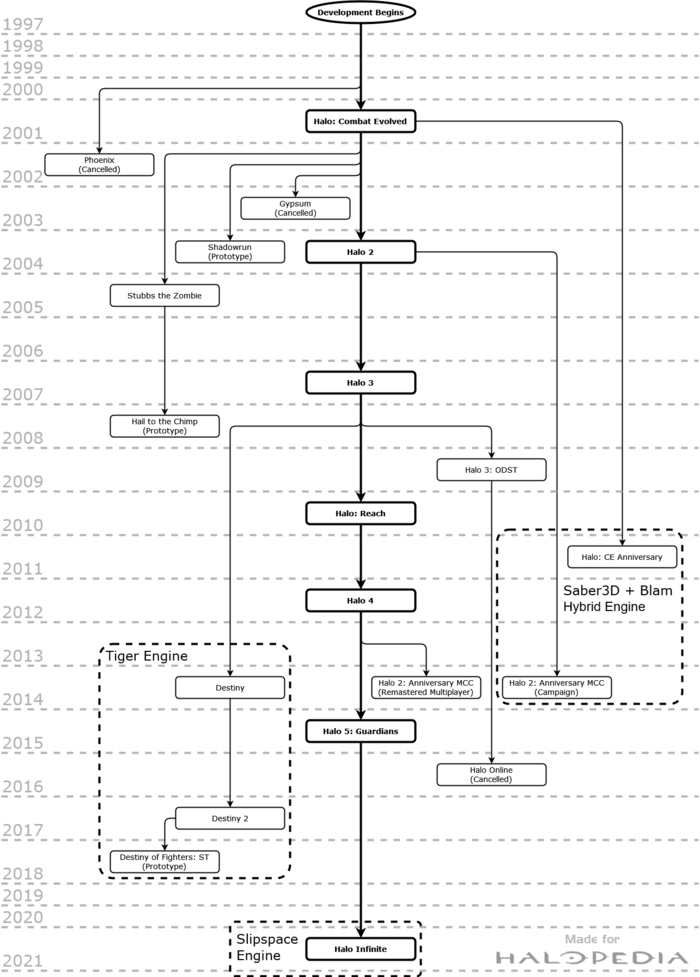
The Blam engine,[1] often stylised Blam! engine, alternatively known as simply the Halo engine, and sometimes known as the Midnight engine in the case of Halo 4,[2] is the game engine that powers the majority of Halo titles, beginning with Halo: Combat Evolved in 2001. It has since been succeeded by the Slipspace Engine in 2021, with the release of Halo Infinite.
Development history[edit]
Early roots: Minotaur and Pathways into Darkness[edit]

Blam's origins can be traced back as early as Bungie's 1993 game Pathways into Darkness. Inspired by id Software's 1992 title Wolfenstein 3D, which itself began as a 3D remake of 1981's Castle Wolfenstein, Pathways was originally conceived as "Minotaur 3D", a 3D remake of Bungie's previous game Minotaur: The Labyrinths of Crete, released the year before.[3] In the summer of 1992, Jason Jones began work on creating a 3D rendering framework for Bungie's next game, soon producing a simple graphics engine that was able to simulate halls and walls using wireframe trapezoids. Though crude, this rendering engine laid the foundations of what would become the engine used for the game, and was improved and modified for months by Jones and others at Bungie until late 1992, introducing features such as texture mapping for walls.[4]

It was quickly decided that Minotaur was not well suited to a 3D perspective, as the original game's design heavily relied upon its top-down perspective, and so Bungie chose to pivot towards an entirely original game adventure game, instead of a remake or successor to Minotaur.[3] By the end of January 1993, the story for this new IP had been written, and work began in earnest on the game. During this time, Jones continued to improve upon the graphics engine and the game's interface, but also produced a level editor to allow the placement of walls, doors, guns, monsters and other miscellaneous objects into levels. This editor dramatically sped up development of the game.[4] Pathways into Darkness was eventually released in August 1993.[5]
Further development: Mosaic, Marathon and Myth[edit]
Following the release of Pathways into Darkness, Bungie began work on two future projects, Mosaic and Marathon.[4] Mosaic was to feature significantly improved graphics than Pathways, including texture mapping for the floors and ceilings, as well as optimizations aimed to make it possible for slower computers to reach acceptable framerates without switching to a lower-resolution mode. Another goal of the game was to produce more intelligent enemy artificial intelligence, capable of reacting to the player in more unique and interesting ways, such as searching for backup when outnumbered.[3]


Originally a sequel to Pathways into Darkness, Marathon entered development around the same time as as Mosaic,[3][4] initially starting out as a series of coding experiments aimed at making the Pathways engine faster and more structurally elegant, while also seeking to improve enemy intelligence, as with Mosaic. These experiments led to the creation of Marathon Zero, an alpha version of the game that was demoed at the Macworld Expo at San Francisco in January 1994. However, this demo garnered very little reaction from the public, and many dismissed the game as Pathways into Darkness with some minor cosmetic improvements.[6