
Erebus VII
From Halopedia, the Halo wiki
| Erebus VII | |
|---|---|

| |
| Astrographical | |
|
System: |
|
|
Orbital position: |
Seventh planet[1] |
| Physical | |
|
Gravity: |
1.12 G[1] |
|
Atmosphere: |
|
| Societal | |
|
Species: |
|
|
Colonized: |
|
|
Government: |
|
Erebus VII is the seventh planet in the Erebus system, and a world under the Unified Earth Government's control.[1]
Overview[edit]
Topography and ecology[edit]
The planet's equator is covered by a forest of immense, spiny, vine-like "trees" with exotic morphology.[1] These "trees" had a plated, scaly bark, and seemed to be a clonal organism that propagated by sending off stolons. In some areas the "trees" were so densely grown their structures formed openings where air was ejected with such pressure it could lift a MJOLNIR-clad Spartan. These trees hosted a second species of vine that appeared to function similar to Earth's parasitic strangler figs, with serrated leaves of a purple-pink coloration. Juniper-like bushes grew in the equatorial soil, on rocky outcroppings, and on the trunk structure of Erebus VII's "trees". The planet had many species of aerial cryptogams, such as mosses, lichens, and fungi.[3]
Its native wildlife includes the highly-intelligent Anglers, a species of large, presumably carnivorous, quadrupedal reptilian creatures; several specimens were kept at the UNSC facility located on the planet. The planet was also home to a bird species which was found on many other worlds in human space, a small bioluminescent flying insect which congregated in and around 1 meter glowing bulb-like structures contained within the "strangler fig", and small fly-like insects which were attracted to the light given off by signal flares.[3]
 A forest "canopy" on Erebus VII.
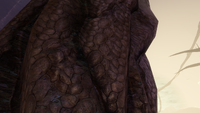 The scale-like bark of the "trees"
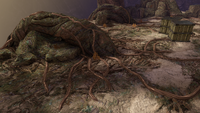 Stolons growing from the "trees"
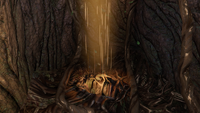 The organic man cannon
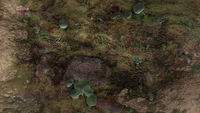 Grass, moss, lichens, and fungi on Erebus VII
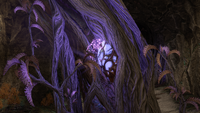 A glowing hive of bioluminescent insects within a "strangler fig"
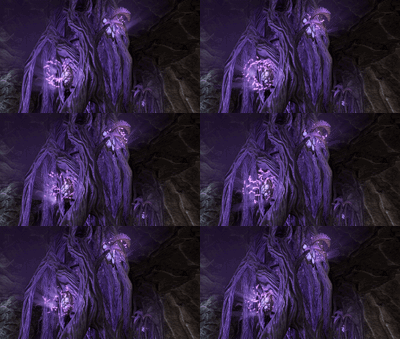 Swarms of the bioluminescent insects
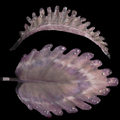 Close-up of a "strangler fig" leaf
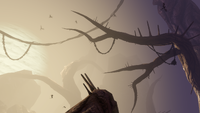 The birds of Erebus VII
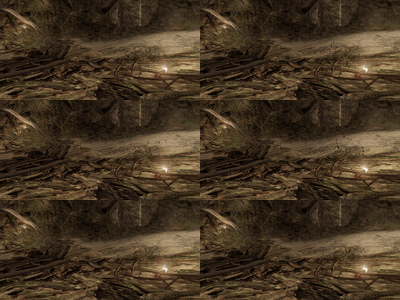 Small insects attracted to a signal flare


History[edit]

The planet's atmospheric composition makes Erebus VII habitable for humans, though extremely hostile indigenous wildlife has prevented the world from becoming a viable candidate for full colonization. Additionally, the interference of the UNSC's Office of Naval Intelligence have also prevented the consideration; ONI has established numerous facilities on the planet, though their research goals have remained unannounced.[1]
In 2557, ONI lost contact with its research teams and the planet's facilities were left abandoned. Several remote contact teams were sent to determine the cause of contact loss, but they only found empty laboratories and were unable to determine the location of i