
List of references to Aliens in the Halo series
From Halopedia, the Halo wiki
(Redirected from List of References to Aliens in Halo)
 |
This article does not meet the wiki's general standards and/or standards on layouts. You can help by cleaning this article. |
There are numerous similarities between the Halo and Aliens universes. Bungie has even admitted to being inspired by the movie. Below is the list of references to Aliens in Halo.
Marines[edit]
- The UNSC Marines in Halo: Combat Evolved heavily resemble the Colonial Marines from Aliens in terms of armor design and behavior.
- Both Sergeant Apone and Sergeant Johnson have a strikingly similar appearance. Both are tough-as-nails, mustache-lipped, black, cigar-chomping, gung-ho Sergeants with a penchant for playfully mocking their Marines and spouting humorous one-liners, and Johnson occasionally repeats Apone's lines.
- Marines in both Halo and Aliens have mission log cameras installed in their helmets.
- The Colonial Marines' main weapon, the M41A Pulse Rifle, is equipped with a digital ammo counter and fires caseless ammunition. Similarly, the UNSC Marines' service rifles have digital ammo counters.
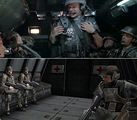 Both Colonial and UNSC Marines are en route to battle via dropship, ready to rock.
 Sergeant Apone from Aliens (left) and Sergeant Johnson, as he appears in Halo 3 (right).


The Flood[edit]


There are numerous similarities between the Flood and the Xenomorphs from the Alien series of films.
- Both aliens exhibit similar qualities such as climbing walls and jumping large distances. They are also hive-minded yet learn as individuals.
- The Facehugger and the Pod infector are both roughly the size of a football, their coloring is extremely similar, neither has visible eyes or mouths, both move around low to the ground on numerous long, thin appendages, and both have a ridged tail. Both are able to leap with appendages spread open in order to latch on to their soon-to-be-hosts.
- The Aliens and Flood both reproduce in a way that could be described as parasitic, though the Flood seems to modify existing biomass, (or create their own in the case of the Pure Form) while the Xenomorph "chestbursters" only develop inside the host up to a certain point, at which time they erupt from the victim's chest and presumably make up the rest of their mass by food consumption.
- In the case of both aliens, the genetic makeup of the host will influence the appearance and behavior of the resulting creature "born" from the parasitic process. For example, if a Xenomorph hatches from a human, it will retain human characteristics; if a Pod infector attaches to a human, it will also retain human characteristics (though this is due to the fact that the combat form is a mutation of the host's body).
- The android Ash describes the alien in the franchise's first film as "the perfect organism," while the Gravemind (as well as the artificial construct Mendicant Bias) considers the Flood to be the perfect society—the last, most advanced stage of evolution. The "societies" of both species are governed by queen-bee-like leaders of a central hive-mind. In both societies, there appear to be no internal divisions or opposing behaviors.
- The Flood screeches in Halo 2 resemble the Xenomorph screeches at a higher pitch.
 Concept art for the Flood blightlands in Halo Wars 2: Awakening the Nightmare. Several Facehugger eggs can be seen in the image as stand-ins for the Flood blisters.
 Another concept piece depicting the Facehugger eggs.


The Covenant[edit]

- The headdresses worn by Sangheili Councilors closely resemble the Alien Queen's head, albeit smaller and narrower. In addition, both Halo's Covenant and Aliens' titular species have caste systems. Whereas the Covenant's is based primarily on race and religion, the Aliens' is based on their different life stages and host species.
- Many other aspects of Elite design, such as the "shoulder spikes" on Heretic armor and the shape of the species' legs, are similar to that of the Aliens.
The Forerunner[edit]
The Halo Array's effect of killing off The Flood's food source to starve them mirrors the purpose of the nuclear bombardment tactic to kill the Xenomorphs, as is described in Aliens tie-in novel Earth Hive.
Vehicles and technology[edit]

- Several vehicles and structures within the Halo trilogy are inspired by the Alien franchise. One such example would be the Pelican dropship, which bears some resemblance in form and function to Aliens' UD4L Cheyenne dropship (shown in their descent to the surface of LV-426). The UD-4L has an armored personnel carrier loaded internally in its belly, and the Pelican is capable of holding various vehicles externally from under its tail section. Both swoop in, drop the Marines off, and get out of dodge. Also, the Pelican cockpit seats are similar to the UD-4L as one is in the front right and the other is in the back le