
Forge
From Halopedia, the Halo wiki

Forge is a gameplay mode introduced to the Halo games starting with Halo 3 which allows for both playing and editing multiplayer maps. While originally intended as a simple map editor in Halo 3, it has gotten more complex and in-depth in subsequent releases, allowing players to create custom geometry, script custom encounters, add NPCs to fight, and create entirely original minigames within the Halo engine.
The mode was named after the Forge editor in Marathon. a game series produced by Bungie before Halo.
Background[edit]
Halo, and Bungie's prior games, have a long history of user-generated content (UGC) creation tools. The third Marathon game, Marathon: Infinity, had a map editor tool called Forge, and was the source for Halo's Forge tool being named as it is. This is one of many allusions to Marathon found in Halo.[1] Unlike Halo, Marathon: Infinity's Forge was an external application used for creating full modded maps, and could be used in conjunction with another editor named "Anvil" which handled physics, sounds, and shape files. By contrast, Forge in Halo is an in-game editor with less functionality, but more suited for casual players to easily create new map variants.
Modded map editing continued in the Halo series with the release of Halo Custom Edition for PC in 2003. Custom Edition came bundled with the Halo Editing Kit, a suite of tools derived from the ones used by Bungie and Gearbox to develop the game itself, and was used to spur an active modding scene that created custom maps, vehicles, weapons, and levels. This tradition continued into Halo 2 with the release of Halo 2 Vista and the Vista Map Editor toolkit.
The same year as Halo 2 Vista, Halo 3 launched on Xbox 360 and with it the first iteration of Forge - the first time such a UGC toolkit was made available on console.
Overview[edit]
Halo 3[edit]

- Main article: H3:Forge
2007's Halo 3 was the first Halo game to feature Forge mode. The mode was designed for players to be able to do simple alterations to multiplayer maps; changing how and which weapons and vehicles spawn, objectives, simple scenery and cover, and similar. The mode was first revealed in August 2007 shortly before the game's launch as a facet of the Halo 3 Epsilon build,[2] and later featured in a dedicated ViDoc: Cinema Paradiso.[1]
Unlike the editing kit used by developers and modders, Forge can not be used to make original maps, but instead map variants. The original BSP geometry and lighting are left intact, and specific elements can be placed and moved as desired. Players can quickly switch from a standard player mode to edit mode, in which players play as a monitor and can freely fly around.[2][3] In this first version of Forge, maps came with dozens of objects pre-placed that had to be manually deleted by players, with each object costing a part of the map's "budget" to spawn in. Each map itself had a limited palette of objects, with some weapons (such as the Flamethrower or Fuel Rod Gun) only available on a very small selection of maps. In addition, Forge objects were physics objects, meaning that they responded to gravity and forces such as explosions.
These restrictions limited the kinds of maps that could be made in the mode, though tricks on the part of the community allowed players to overcome these issues to an extent and create experiences beyond what Bungie ever expected, including "Forge art" and minigames like Grifball. In response to this time and effort put into Forge by the players, two "Forge canvas" maps were released for the game, consisting of mostly-blank slates which allowed for greater creativity for mapmakers. The first was Foundry, released as part of the Heroic Map Pack, and later Sandbox, released as part of the Mythic Map Pack.
Halo: Reach[edit]

- Main article: Reach:Forge
Halo: Reach came with the introduction of Forge 2.0, a revamped map editor with greater functionality based on observations of how players used Forge in Halo 3. The mode was first revealed in a dedicated ViDoc, "Forge World". One of the biggest changes for Reach was the ability for players to change the physics state of an object, now allowing them to be phased into BSP terrain and unaffected by physics interactions. The ability to delete all objects on the map was also added, to make working with the default maps less frustrating. The other key feature of Reach's Forge was a new Forge canvas map, Forge World, which was the then-largest map in the entire series. Forge World was a massive map that had a large variety of environments allowing for maps to be built inside it using the vastly expanded toolset and object palette of Reach, with several example map variants included on the disc.
Reach's downloadable content expanded the Forge offerings further, with an additional canvas map Tempest, and a number of maps in the Anniversary Map Pack specifically built with objects included that allowed players to block off certain passageways or tunnels to restore the map layouts to the iterations found in Halo: Combat Evolved in 2001.
Halo 4[edit]

- Main article: H4:Forge
Forge returned in Halo 4 with several improvements from its previous iteration in Halo: Reach, though not to the same extent as the changes experienced going into Reach. The duplication tool has returned from Halo 3, and selected objects now glow green depending on what type of object is selected for better precision, preventing players from accidentally deleting objects they did not intend. The feature now supports dynamic lighting on Forge objects, enabling each individual pieces to cast shadows. It features additional tools for user for map-making such as the ability to link Forge objects seamlessly through the use of the magnet utility and adding trait zones (such as enhanced movement and gravity). Objects can be locked, preventing being grabbed/moved. More Forge objects have been added to the sandbox to provide variety to the map-making experience.[4]
Halo 4 launched with three Forge canvas maps: Erosion, Impact, and Ravine. Each map features a different environment and unique palette elements.[5] A fourth, Forge Island, was released as a free DLC later on.
Halo: The Master Chief Collection[edit]
Halo: The Master Chief Collection launched in 2014 with the Forge editors for Halo 3 and Halo 4 included, alongside a new Forge mode, that of Halo 2: Anniversary.[6] For the earlier games, the Forge modes were mostly unchanged, save for some bugfixes in the Halo 4 Forge that restored functionality like the ability to zoom the camera in edit mode. The Forge from Halo: Reach was added in a 2020 update after the game's launch on PC, with a number of updates made to the Forge modes codenamed "Thorage" (detailed below).
Halo 2: Anniversary[edit]

- Main article: H2AMP:Forge
Halo 2: Anniversary features a Forge mode, the first available on the Xbox One, though only in the reimagined multiplayer component based on the Halo 4 engine. The new Forge features several bug fixes from Halo 4, including menu polishing and adding magnet location consistency. Precision control and zoom have also been added. New features include "Snap to Ground", "Align to Ground", and "Movement Snap". Tool settings are now stored between Forge sessions. The Forge "Structure" palette is now cleaner and smoother, along with new mirrored versions of objects. Additional natural and terrain structure pieces—including cliffs and large pieces of land—have also been added to the Structure palette.[7] Three Skybox-only maps—Awash, Nebula, and Skyward—have been added, allowing players to create maps and structures without interference from previous existing structures.[8][9]
The new Forge budget is now based on the amount of objects in a map. The budget can essentially be replaced by a "Performance Meter", presumably determining how well the map will run given the amount of objects placed.[7] In an official demonstration, the developers showcased a map containing a remake of Beaver Creek within a much larger Forged landscape, built completely on a flat canvas using the new terrain pieces. "Simple scripting objects" have been added as Forge objects; these allow players to create interactive systems including switches that can be used to perform various tasks, including opening doors, spawning vehicles or terrain objects, or triggering explosions.[9] There have also been Gadget improvements and new Gadgets.[7]
All seven of the Halo 2: Anniversary remastered maps feature dynamic features that alter gameplay, such as falling stalactites and breakable glass roofs on Lockdown. These features can be disabled to Forge if the players wish to have a gameplay experience that is closer to the original Halo 2.[7]
Thorage[edit]
When The Master Chief Collection launched on PC in 2019, Reach was added to the collection, with its Forge mode released the following summer. With this, the Forge modes of Halo 3, Reach, and Halo 4 were all given quality-of-life improvements, codenamed "Thorage" internally at 343 Industries. A brief summary of the additions is as follows:
- Halo 3: Thorage for Halo 3 updated Foundry, Sandbox, and Avalanche to have several new weapons, vehicles, and scenery objects, alongside backporting the object physics options from Reach onward into Halo 3. The map budgets were also increased accordingly to allow for more objects to be placed.
- Halo: Reach: Thorage for Reach updated Forge World and Tempest to have a number of new items such as previously campaign-exclusive weapons and vehicles, alongside every single Forge item previously-exclusive to other maps. The map budgets and item costs were also updated to allow for more objects to be placed.
- Halo 4: Thorage for Halo 4 updated the four canvas maps to have all previously map-exclusive objects available (including those from the other canvas maps).
Halo 5: Guardians[edit]
- Main article: H5G:Forge

Forge for Halo 5: Guardians was released in the Cartographer's Gift update after the game's launch, and featured the most radical shakeup of the mode's functionality since Forge 2.0 in Reach.[10] Among the improved features are the control scheme, selecting and manipulating up to 64 objects at once, a free camera, and smart magnets. Objects are no longer constrained to certain maps, as was the case in previous games. Up to 1700+ objects can be spawned into the map and new types have been added. Terrain objects are designed to seamlessly blend into the prebuilt terrain. Objects can be grouped with a single button press and "welded" to a parent object, allowing the objects to physically move around together. Almost any object can be scripted to move, change colors, spawn, and etc. The budget system has been improved, including a multi-budget system, where a terrain piece will only eat into the memory budget once. Additional pieces only use up the object count because the shared texture is already loaded. Other budgets are considered "soft" and can be exceeded, but doing so causes glitches.[10]
New light objects have been added with various different properties. Unlike Halo 4 and Halo 2: Anniversary, lighting is no longer generated automatically when switching to player mode. A button tap will drop the Spartan, while holding it down will bake the lighting before dropping.[10] Props like the Pelican were added in Hammer Storm and can be customized with colors. Weather effects including rain, snow, embers, floating papers, dust, and motes were added with Ghosts of Meridian. Sound options ranging from chanting Covenant crowds to waterfalls are also available to place on maps.
As with previous games, forging is available for any Arena, Breakout and Big Team Battle maps, alongside several Forge canvases.[10] Halo 5's Forge launched with three dedicated Forge maps; Alpine, Parallax, Glacier, and Breakout Arena, though several more were added in successive updates; Barrens, Depths, and Tidal.
Halo 5: Forge[edit]
- Main article: Halo 5: Forge
Halo 5: Forge is a port of the Forge mode to Windows 10. It is available for free and enables players to forge, test, and share their own maps on PC, with compatibility with Halo 5: Guardians on Xbox One.[11]
Halo Infinite[edit]
- Main article: HINF:Forge
Forge mode was released for Halo Infinite in the Winter Update. It improves upon the foundations set by Halo 5's version of Forge by introducing object scaling,[12] a menu wheel for more complex options, the ability to undo and redo a previous edit,[13] the ability to customize FX, the sun's color and its time of day,[14] the ability to create a sequence of events and conditions to trigger it through a node graph,[15] the ability to set objects as static or dynamic, etc. It also makes a huge change to the lighting system that allows the player to set the option to cast static and/or dynamic shadows when selecting a light placed by the player, introduces a heatmap for lights and shadows to assist in map performance, introduces light probes with a limit of 14,000 light probes on a map, and removes the ability to bake light.
With the launch of Season 05, Forge has been improved to incorporate AI units into Forge. The AI units include Marines, Grunts, Jackals, Elites, Brutes, Skimmers, Hunters, and the variant of frames supporting Adjutant Resolution, with a limit of 32 AI units in the map. These AI units can be spawned through AI spawners, Drop Pods, and/or Phantoms; spawners and Phantoms can spawn up to 8 AI units while Drop Pods can only spawn 1 AI unit. If the Phantom is selected, it will also be able to drop off a Ghost, a Chopper, or a Wraith, but the pilot of that vehicle will take the place of the 8th AI unit if the vehicle piloting is enabled. AI units can also move in specific move zones to act as a patrol route. AI units can also spawn with different weapons (i.e. Jackals can spawn with an S7 Sniper), and properties that affect AI units are added using node graph.
Infinite's Forge supports eight different blank canvases of different themes: Arid, Mires, Seafloor, Institute, Ecliptic, Void, Barrage, and Permafrost.
Trivia[edit]
- The Halo: Reach player spawn point object features a holographic Spartan crouching with an M6G pistol aimed forward. The Spartan has a specific armor permutation that includes a variation of the Mark V[B] helmet with UA that was exclusive to Halo: Reach Beta, Mark V right shoulder, CQC left shoulder, Tactical/Tacpad wrist attachment, Tactical/Trauma Kit utility on the right thigh, and FJ/PARA knee guards. This model has since been used in all subsequent Forge releases.
Gallery[edit]
Halo 3[edit]
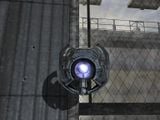 A Forge Monitor in Halo 3.
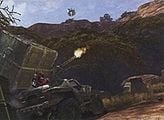 Crates and an M12 Chaingun Warthog on Forge.
 Spawning an M808C Scorpion on High Ground.


Halo: Reach[edit]
 Concept art of a Forge game in Halo: Reach.

Halo 4[edit]
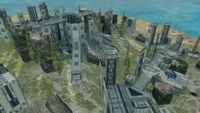 A Forge creation in Halo 4.
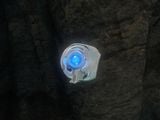 A Forge Monitor in Halo 4.


Halo 2: Anniversary[edit]
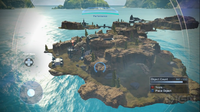 Forge in Halo 2: Anniversary.
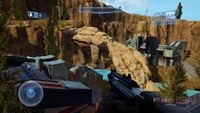 Beaver Creek recreated in Halo 2: Anniversary's Forge.


Halo 5: Guardians[edit]
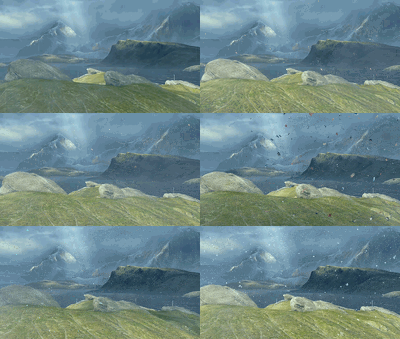 Some of the weather effects in Halo 5: Guardians' Forge.
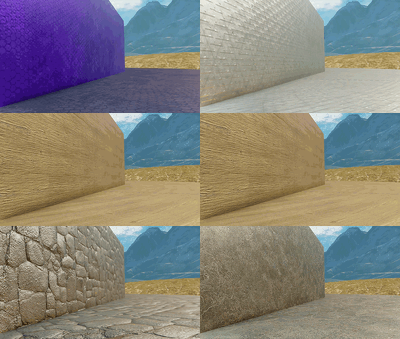 Some of the material bases in Halo 5: Guardians' Forge.
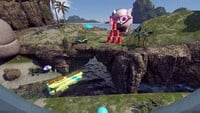 Features introduced into Forge with Warzone Firefight.
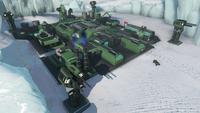 A remake of the Firebase from Halo Wars in Halo 5: Guardians Forge.


Halo Infinite[edit]
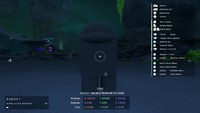 Forge in Halo Infinite.
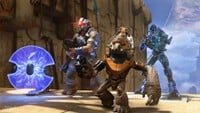 Forge AI in Halo Infinite.


Sources[edit]
- ^ a b Halo 3 marketing, Halo 3 ViDoc: Cinema Paradiso
- ^ a b Bungie.net, Bungie Weekly Update: 8/17/07 (Retrieved on Oct 13, 2014) [archive]
- ^ Bungie.net, Halo 3 How-to: Forge Basics (Retrieved on Oct 13, 2014) [archive]
- ^ YouTube - Elijah's Videos, Halo 4 Forge Demo at RTX [HD] [1080p] (Retrieved on Dec 27, 2025)
- ^ Examiner.com Final Halo 4 Forge map goes spelunking, holds Griffball arena in video
- ^ Gamesport, New Skulls, Forge Returns, and More Coming in Halo: The Master Chief Collection (Retrieved on Dec 27, 2025) [archive]
- ^ a b c d GameInformer: 343 Details Halo 2’s Many Changes And Additions
- ^ Twitter: Halo
- ^ a b IGN.com - See Forge in Halo 2: Anniversary
- ^ a b c d Halo Waypoint, Building the Biggest Forge Yet (Retrieved on Dec 31, 2015) [archive]
- ^ Halo Waypoint: Forging Ahead - The Forge Experience Comes to Windows 10
- ^ YouTube - Halo, Halo Infinite Forge Fundamentals - Building (Retrieved on Sep 9, 2022)
- ^ ForgeHub, Outpost Discovery Round-Up + Halo Infinite First Forge Details (Exclusive) (Retrieved on Aug 21, 2021) [archive]
- ^ YouTube - Halo, Halo Infinite Forge Fundamentals - Lighting & Audio (Retrieved on Oct 3, 2022)
- ^ YouTube - Halo, Halo Infinite Forge Fundamentals - Scripting & Bots (Retrieved on Sep 19, 2022)


