
Digon
From Halopedia, the Halo wiki

Digon was an ancient dialect of the Forerunner language. By the final millennia of Forerunner civilization, this dialect was used almost exclusively by the Warrior-Servants and yet later only their highest class, the Prometheans,[1][2] in contrast to Jagon, a newer language which was mainly spoken by the Builders.[3]
There were several forms of the dialect, including middle Digon and archaic Digon. The dialect reached its peak around 400,000 BCE, three hundred thousand years before the end of Forerunner rule in the galaxy.[4] However, not even the earliest forms of Digon were in use by 10,000,000 BCE when the Forerunners rebelled against the Precursors.[5]
During his first encounter with the Primordial, the being spoke to the Didact in an archaic form of Digon he could barely understand.[6] While the Didact was being escorted to his first Cryptum, Haruspis's associate spoke a ritual litany to him in middle Digon.[7] The phrase "You are what you dare" was also inscribed to the Cryptum in ancient Digon characters.[1]
After being composed, the Didact found himself in a recreation of Mendicant Bias' tomb within the Domain. There he identified the written script around Offensive Bias' hologram as Digon.[8]
Production notes[edit]
The text system meant to depict ancient Forerunner script first appeared in older Halo titles, most notably the Halo 3 multiplayer maps Sandtrap and Epitaph. The script appears as repeating vertical patterns of digital glyphs, digits, and lines inscribed on metallic surfaces and light panels. This texture was also featured on light bridges in Halo Wars, and the visual motif later resurfaced in Halo Infinite. In Kelly Gay's novel Halo: Epitaph, this text was retroactively canonized as being ancient Digon scripture alongside permutations of the Mantle of Responsibility.[8]
Since 2007, the Halo community has been captivated by the Sandtrap map script. Dedicated fans have spent years analyzing the mysterious texture patterns from game files, attempting to determine if Bungie developers included a functional language cipher that could be decoded to reveal hidden Forerunner lore or in-game Easter eggs. Through various unscrambling techniques, fans have discovered that the distinct layers of symbols correspond to strings of ASCII code and are therefore alphabetic in nature.
In 2010, Justin Hayward, the Bungie artist who directed the art and environment for the map Sandtrap, stated that he could not remember if there was any cipher of "secret" of Sandtrap.[9] This sentiment was reinforced in 2026 when he shed light on the long-standing mystery surrounding the script. Hayward stated that there was no broad or comprehensive code intentionally built into the script, noting that time constraints during Halo 3's fast-paced development cycle necessitated a more practical approach to level design. The primary purpose of the text was strictly aesthetic; the goal was to craft a visual language that evoked a sense of complexity, antiquity, and the vast knowledge of the Forerunners. However, Hayward did not entirely rule out the presence of hidden details, acknowledging that because development in that era was often "fast and loose," it remains entirely possible that an individual artist or programmer may have tucked away a small, personal Easter egg, symbol, or isolated lore snippet within the assets.[10]
Gallery[edit]
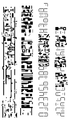 A high-contrast image showing the varying elements of the script.
 Digon on Sandtrap's ruins.
 Digon featured in Halo 2: Anniversary.
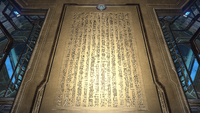 A metal plaque inscribed with Digon in the Conservatory's cradle.
 An early concept for the cover of Halo: Epitaph, depicting the Didact in front of holographic Digon.


List of appearances[edit]
- Halo 3 (First appearance)
- Halo Wars
- Halo: Cryptum (First named)
- Halo: Silentium
- Halo 2: Anniversary
- Halo: Fractures
- Halo Infinite
- Halo: Epitaph
- Halo: Still Midnight
Sources[edit]
- ^ a b Halo: Cryptum, chapter 3
- ^ Halo: Cryptum, chapter 28
- ^ Halo Waypoint, Cryptum Glossary (Retrieved on Mar 14, 2014) [local archive] [external archive]
- ^ Halo: Silentium, page 133
- ^ Halo: Silentium, page 179
- ^ Halo: Cryptum, page 327
- ^ Halo: Silentium, page 55
- ^ a b Halo: Epitaph, chapter 5
- ^ Bungie.net, Sense of Scale - Postmortem (Retrieved on Oct 13, 2014) [archive]
- ^ Reddit, New Discoveries and Partial Translation of the Halo 3 Sandtrap "Cipher" Over Two Years (Retrieved on Jun 14, 2026) [local archive] [external archive]


![[local archive]](/File:H3_JustinHayward_SandtrapReply.png)