
Arum
From Halopedia, the Halo wiki

- "Patience! An arum is not solved in seconds!"
- — A Covenant remnant Sangheili to his Unggoy underlings.[1]
An arum is a small device used to teach young Sangheili the value of patience when faced with a difficult problem. Part ornament and part puzzle, they are wooden balls composed of nested concentric spheres which need to be aligned properly in order to release an object from its center (usually some type of gemlike crystal).[2]
Overview[edit]
Design[edit]
Arums were fashioned and carved from various types of wood. Many were usually crafted from dark woods such as ebony or mahogany, though some were made from pale wood instead. They also come in various styles, ranging from the simple pale polished spheres of Ontom to highly decorative affairs carved from a single block of material complete with display stand found in the Mdama region.[2] Arums can be designed with varying levels of difficulty, with ones made by the monks of the Ontom region of Sanghelios being regarded as the most difficult to solve.[3] Few Sangheili ever managed to free more than a handful of crystals from their prisons in their lifetimes. Fewer still could unlock an arum within days, let alone hours.[4]
Cultural and historical significance[edit]
In Sangheili culture, arums are considered to be both a diversion and a lesson in character, alongside representing what makes Sangheili strong; a perfectly engineered, orderly system that presents a smooth, impenetrable face to the outside world, with each given its appointed place in it.[2][5]
Throughout Sangheili history, arums appeared as recurring objects in countless tales and legends. Many stories often featured characters uncovering special contents within the puzzle-spheres. In traditional plays about war, worthy Sangheili commanders would solve arums and uncover vital information and strategies held inside. In older romantic tales, arums held tokens of affections between lovers. In one particular fable, the journeying maiden Cdel the Fair went across Sanghelios' five continents challenging her many suitors to solve her arum and claim her as lifemate. Sangheili merchants were also known to promise rare jewels and treasures hidden inside their arums.[6]
In the early ages of the Covenant, arums were used by the San'Shyuum to seal away puzzle-vaults around Sanghelios and its moons to store weapons caches, under the belief that only a handful of individuals would ever be able to open them, and even fewer willing to risk the punishment of heresy to do so. One such vault was located deep inside a cavern on Qikost. In January 2560, the cache was uncovered by artisan-armorers Oebrin and Silset 'Chava, who were able to solve the arum that locked the vault and gain access to the interior. The two took four Vestige Carbines from the vault; one to preserve, two to experiment on, and one to gift to their SPARTAN-IV escort, Abalan.[7]
Enthusiasts and artisans[edit]
Kaidon Levu 'Mdama kept an arum displayed on his office desk at his keep.[2]
Atun 'Etaree was a known craftsman of arums who grew-up in High Charity. Some of his earliest arums concealed white opal gems inside them. He took joy in fashioning his own arums and few could ever solve them. It was one of Atun 'Etaree's challenging arums that drew him the attention of the San'Shyuum Minister of Aretalogy, Kanto'Boreft.[6]
Professor Evan Phillips is the only human known to have solved an arum. He has also gained quite the reputation on Sanghelios as he has yet to tackle an arum that he is unable to solve in less than an hour. This has impressed and awed many Sangheili; one asked the Professor if all humans were capable of solving the puzzles so quickly. When Phillips answered in the negative, the response was: "Good. Then you would be a much more dangerous species."[8] This is confirmed when Serin Osman was given an arum to help her pass the time, and she not only was unable to solve the puzzle, but gave up after countless attempts.[9]
Origins[edit]
Professor Evan Phillips theorized that puzzle-locks such as arums were inspired by puzzle locks of Forerunner design.[10] A Forerunner structure in the state of Ontom featured a lock that strongly resembled an arum, consisting of layered concentric spheres that needed to be aligned; unlike an arum, however, this lock also included holes in the layers.[11]
Several other Forerunner structures bear resemblance to an arum. These include energy conduits used to power Jul 'Mdama's Ra'aam-pattern burst cannons during the Requiem Campaign, and the shield world Requiem itself. Requiem is composed of several layers, and whereas an arum has at its center a valuable stone, Requiem holds the Ur-Didact's Cryptum at its core.[12]
Gallery[edit]
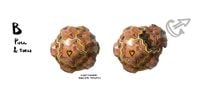 Halo 5 concept art of an arum.
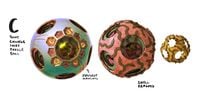 Halo 5 concept art of an arum.
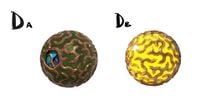 Halo 5 concept art of an arum.
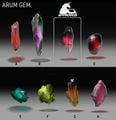 Halo 5 concept art of the crystal at the centre of an arum.


List of appearances[edit]
- Halo: Glasslands (First appearance)
- Halo: The Thursday War
- Halo: Mortal Dictata
- Halo 5: Guardians (Mentioned only)
- Halo: Ascension on Atropos
Sources[edit]
- ^ YouTube - A Villanous Toaster, Halo 5: Guardians - Funny Dialogue: 1:59 (Retrieved on Aug 9, 2025)
- ^ a b c d Halo: Glasslands, chapter 3
- ^ Halo: Glasslands, chapter 18
- ^ Halo: Glasslands, chapter 14 <