
Orbital Drop Shock Troopers
From Halopedia, the Halo wiki
| Orbital Drop Shock Troopers | |
|---|---|
 The emblem of the ODSTs
| |
|
Formed: |
|
|
Affiliation: |
|
|
Branch: |
|
|
Type: |
Rapid reaction force[4] |
|
Role: |
|
|
Size: |
|
|
Nicknames: |
Helljumpers[4] |
|
Notable commanders: |
|

- Major Antonio Silva: "Most of the crew—not to mention your fellow jarheads—will be leaving the ship in lifeboats. They'll ride to the surface in air-conditioned comfort, sipping wine, and nibbling on appetizers. Not you, however. Oh no, you're going to leave the Pillar of Autumn in a different method. Tell me boys and girls… how will you leave?"
- Shock Troopers: "We go feet first, sir!"
- — Major Antonio Silva rousing his battalion aboard the Pillar of Autumn[7]
The Orbital Drop Shock Troopers (ODST),[Note 1] informally referred to as Helljumpers,[8][Note 2] are an elite special operations[8][9] component of the UNSC Marine Corps and the Corps' rapid reaction force specialized in transorbital support interdiction tactics.[4] One of the primary special operations forces of the United Nations Space Command, the ODST are under the administrative and operational control of Naval Special Weapons.[2][3] The organization is headquartered in the Martian city of Kenosha, Tanais.[1] Its primary training facilities were located on Reach prior to the glassing of the planet.[10]
Roles and operations[edit]
- "We had a damn hard job, and we did it better than anyone."
- — Spartan Edward Buck, a former Shock Trooper, referring to the ODST.[11]
Serving as the rapid reaction force of the UNSC Marine Corps,[4][12] Orbital Drop Shock Troopers are distinguished by their unconventional method of deployment, known as "transorbital support interdiction",[1] in which the troopers are dropped to the surface of a world aboard small, purpose-built deployment vehicles. This allows them to conduct a variety of missions against targets that more conventional forces cannot approach undetected.[2] ODSTs—trained for any kind of landing operation—expect to arrive at a world with hellish conditions, only to enter incredibly difficult combat zones.[12] ODST deployment via SOEIVs is often considered more effective than dropship deployment, as it allows for a spacecraft to make a quick pass over a world and deploy hundreds of ODSTs in SOEIVs in rapid succession. Additionally, since ODSTs are deployed separately, rather than together in one ship, the casualty rate of SOEIV deployment is lower than that of conventional dropship deployment.[13]
Each ODST combat team specializes in a particular mission set, though they are expected to be flexible enough to adapt to any given situation. ODSTs are known for their unusual methods of insertion, dropping from orbit onto terrestrial environments.[2] Often landing behind enemy lines, ODSTs are sometimes ordered to eliminate enemy units and clear a landing zone for the wave of troops that follow.[11] ODSTs also operate as the primary special forces raiding unit of the Marines, deployed to tip the scales in a close battle, raid enemy bases, capture strategically valuable points, and eliminate high-value targets.[14] Similar to their infantry counterparts, the ODSTs maintain units of varying strength aboard many UNSC vessels and installations.[2] ODSTs may also occasionally serve as military police for UNSC installations.[15]
The ODSTs perform highly specialized, small-scale, high-risk operations including the following:[2][3]
- Deep ground surveillance (DGS) and long range reconnaissance: Patrols in small groups, in uniform, usually far behind the enemy lines. While direct ground surveillance units may direct air or artillery strikes against enemy positions, they strive to be unobserved, and have only self-defense, not direct action, capability. Groups engaging in surveillance deep behind enemy lines, are commonly known as Long Range Reconnaissance Patrols.[2]
- Direct action (DA): Short-duration strikes and other small-scale offensive actions conducted as a special operation in hostile, denied, or politically sensitive environments and which employ specialized military capabilities to seize, destroy, capture, exploit, recover, or damage designated targets. Direct action differs from conventional offensive actions in the level of physical and political risk, operational techniques, and the degree of discriminate and precise use of force to achieve specific objectives.[2]
- Unconventional warfare: Military and paramilitary operations, normally of long duration, predominantly conducted by indigenous or surrogate forces who are organized, trained, equipped, supported, and directed in varying degrees by an external source. It includes guerrilla warfare and other direct offensive, low visibility, covert, or clandestine operations, as well as the indirect activities of subversion, sabotage, intelligence gathering, escape and evasion.[2]
- Counter-terrorism operations: The response to terrorist threats and/or acts, both real and imputed.[2]
- Counter-contraband operations: Missions undertaking the recapturing of smuggled/stolen goods.[2]
- Personnel and special equipment recovery/capture: The recovery/medical treatment of friendly personnel in combat environments, as well as the capability of capturing high valued individuals and any equipment.[2]
History[edit]
Origins and Interplanetary War[edit]
- Main article: Interplanetary War
The idea of inserting highly trained troops behind enemy lines from high altitudes has its roots in the paratroopers of 20th and 21st century fame, who dropped frequently behind enemy lines to capture strategically important targets in anticipation for a larger advance by more conventional and numerous military forces. Although they were only marginally successful, they proved the concept of paratroops as useful and effective in large-scale warfare.[1][16]
The United Nations created the first iterations of the ODST deployment concept in 2129;[1] these early incarnations were referred to as the Drop Jet Platoon,[12] members of which were known as "Drop Jet Jumpers".[17] The Orbital Drop Shock Troopers in their current form saw their advent in 2163 with the formation of the UNSC Marine Corps and the UNSC itself from Earth's disparate national military forces.[1][18] That year also saw the historic first extraterrestrial deployment of UNSC Marines in the Mars Campaign against the neo-communist Koslovics. With the conclusion of the Interplanetary War in 2170, along with the signing of the Callisto Treaty and the subsequent years of relative peace that followed, the ODST saw little action as more political and important issues such as overpopulation, famine, and a massive military with no purpose gripped the postwar nations of Earth.[19]
Insurrection[edit]

- Main article: Insurrection
The first major combat re-emergence of the ODSTs occurred in 2490 during the beginnings of the civil conflict between the Unified Earth Government and the Insurrectionists. Using the members of the ORION Project as exemplary models,[20] the reputation of the ODST, as well as their training, was restored and enhanced as time passed. For the years leading up to 2525, the ODST conducted high-risk operations against the Insurrectionists, to either stop the enemy before they could carry out attacks against supporters, and officials of the Unified Earth Government or to cut off major suppliers to the Insurrectionists.[1]
The ODSTs' 10th Shock Troops Battalion was deployed to Jericho VII for over 131 days to put down local insurgent forces. Shortly after, the unit was sent to Arcadia to deal with Insurrectionist activity. In 2526, the battalion was deployed to Andesia to eliminate Insurrectionist strongholds on the planet. During the deployment, several members of the unit were killed by insurgent forces.[21]
Human-Covenant War[edit]
- Main article: Human-Covenant War

On November 1, 2525, the UNSC moved to full alert status after the devastating first contact with the Covenant at Harvest; this marked a change in objectives for the ODST, who up until that point had been fighting the Insurrectionists.[22] As humanity's military turned to meet the threat of the Covenant, divisions of ODSTs prepared to participate in the most critical engagements in the war and also to conduct the riskiest missions in the history of mankind. In April 2526, the Corbulo Academy of Military Science on Circinius IV came under attack by Covenant forces. ODSTs were deployed directly onto the campus to reinforce the already-present Marine garrison. But by the time Spartan-IIs John-117, Kelly-087, and Frederic-104 arrived, the deployed ODSTs, along with the entire academy's staff, students (save for four survivors), and garrison were slaughtered.[21]
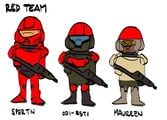
The Battle of Hat Yai marked one of the first deployments of ODSTs against Covenant ground forces; although the planet was lost in the ensuing conflict, the ODSTs were successfully extracted before the UNSC retreated.[23] Not long after the Harvest campaign, the ODST participated in the Battle of Arcadia, where they assisted Marine forces and SPARTAN-II Red Team in defending the capital city from Covenant ground forces, thus allowing the evacuation of the civilian population. Having successfully kept Covenant forces from occupying the city, the Corps began launching multiple assaults on the Covenant's bases of operations to reclaim the planet.[24][25][26][27] Several ODST platoons joined UNSC Spirit of Fire's rescue operation after retaking the planet and soon participated in the Battle of Trove.[citation needed]

Following the enactment of the Cole Protocol in 2535, ODST combat teams were tasked with boarding commercial and private vessels and purging their navigation databases.[28] During one of these routine operations, a group of ODSTs aboard the UNSC Midsummer Night were captured and taken to the Rubble.[29] They, in conjunction with SPARTAN-II Gray Team, would later defeat a Kig-Yar plan to trick the inhabitants of the Rubble out of their navigation data, which could compromise the location of Earth.[30] As the Human-Covenant War progressed, the ODST would participate in many engagements; among these were the Battle of Jericho VII,[31] an assassination mission on Heian,[32] the Battle of Skopje,[23] the Battle of Sigma Octanus IV, the Battle of New Jerusalem, the Battle of Tribute,[33] and the Battle of Ariel.[34] The numerous campaigns and operations in which the ODST participated throughout the long war all pale in comparison to the Fall of Reach in 2552, during which countless ODSTs lost their lives defending strategic locations on the planet.[35]
During the initial invasion of Reach, a large contingent of ODSTs participated in the Battle of Viery, assisting the Army in repelling the Covenant forces from the planet. Throughout the course of the battle, the UNSC formed joint-forces to combat against the overwhelming Covenant forces.[35] Some time during the event, several battalions were stationed on UNSC Pillar of Autumn. As the planet fell to the Covenant onslaught, the vessel made a blind slipspace jump away from the Epsilon Eridani system, discovering the long-abandoned Installation 04. During the Battle of Installation 04, shock troopers led by Major Antonio Silva and First Lieutenant Melissa McKay, operated as a guerrilla force by conducting hit-and-run operations against the forces of the Covenant's Fleet of Particular Justice.[36]
Battle for Earth and Fall of the Covenant[edit]

Following the disastrous loss of Reach and their massive casualties during the Battle of Installation 04 - where all but one of the troopers deployed were killed in action,[37] either on the ring itself or aboard the Flood-infested Covenant cruiser Truth and Reconciliation when it was destroyed by First Lieutenant Melissa McKay to contain the outbreak[38] - the ODST participated in the most significant battle of the entire war: the Battle for Earth.[39] The battle began on October 20, 2552, when a smaller-than-expected Covenant fleet led by the Prophet of Regret jumped into the Solar System.[40] ODST combat teams, along with the Marines, began engaging Covenant forces on the Orbital Defense Platforms Cairo, Athens, and Malta. Despite the ODSTs' valiant efforts, Malta and Athens were destroyed.[40] As the Covenant ship carrying the Prophet of Regret landed over the African mega-city of Mombasa, teams of ODSTs were deployed over the city from orbit in an attempt to board the carrier; before the teams could reach the target, however, the carrier jumped into Slipspace. Only a single squad managed to safely land in the city to carry out the retrieval of the Superintendent's data.[41]
After Regret's unexpected retreat from New Mombasa, members of the 7th Shock Troops Battalion would later drop from the In Amber Clad onto Installation 05 during the operation to capture the Prophet of Regret. Most of these troopers would perish during the initial firefights against the Covenant, and only a few would escape back to Earth with Commander Miranda Keyes to lead a resistance against the Covenant occupation forces.[42][43]
Overall, the defense of Earth was one of the largest campaigns the ODST fought in during the entire war. The fighting spread across the globe and in space as newly-arrived Covenant fleets of warships scattered the Orbital Defense Grid. The fleets deployed troops throughout the continents of North America, South America, Europe and Asia and a multitude of other locations, including many parts of the Sol system.[44][45] The Battle of Cleveland is one example of the ODSTs' participation during the war on Earth.[46] On November 17, 2552 after the orbital defense grid was almost completely overwhelmed by Prophet of Truth's own massive loyalist armada and too much of UNSC planetside forces was overrun during the same day,[47][42] two ODSTs from the 2nd Shock Troops Battalion fought alongside a detachment of Marines in the Battle of Sector Six.[48] Troopers T. Rymann and S. Hartley were tasked with calculating the crash site of John-117 on Earth, while a Marine battalion was tasked with defending a narrow corridor between Covenant and UNSC forces in Pakistan.[49] Bravo-21 and numerous Marines were killed in the clash, while Bravo-22 was injured along with some of the other surviving Marines. Their actions successfully allowed HIGHCOM to track and locate the Spartan.[50]
After the opening of the Portal on November 17, 2552, the 11th Marine Force Reconnaissance/ODST, stationed aboard the UNSC Forward Unto Dawn, fought alongside Spartan John-117, during Operation: BLIND FAITH.[51] Men and women from this battalion were also some of the first modern humans to travel outside the Milky Way Galaxy, during the Battle of Installation 00.[43] One such assault happened during a mission to destroy numerous Covenant anti-aircraft artillery platforms overlooking a desert. These AA guns were destroyed by the ODSTs, allowing the UNSC Forward Unto Dawn to successfully land near the Cartographer building.[43] During the last battle of the Ark campaign—the last battle of the war—ODSTs were again airlifted into combat. This time, they punched holes in Covenant armor and artillery positions to allow John-117 and the Arbiter to eliminate the Prophet of Truth.[52] After the battle, the surviving ODSTs were taken back to Earth aboard the Sangheili flagship Shadow of Intent.[53]
Post-war[edit]

Some ODSTs were recruited into the SPARTAN-IV program after the war ended, prompting the development of a MJOLNIR (GEN2) variant of the ODST BDU.[54] The ODSTs remain an active military unit, with the 3rd Helljumper Platoon participating in the Battle of Draetheus V against Merg Vol's Covenant in 2554.[55] In 2555, a small fireteam pulled from ODST squad Alpha-Nine participated in a mission at an unknown United Rebel Front facility on the moon Talitsa.[56] There was a battalion of ODSTs aboard the UNSC Infinity as of 2558.[57]
The ODST's 9th Shock Troops Battalion aboard UNSC Spirit of Fire saw action against the Banished, an anti-Covenant mercenary organization, during the Second Ark Conflict in the spring of 2559.[58] The ODST squad Sunray 1-1, the command element of Boomerang Company under the command of Major Elijah Vaughan, managed to prevent Banished forces led by the Mgalekgolo pair known as Colony from gaining control over Forerunner Despair-class fighter, which they planned to use against the Spirit of Fire.[59] Later on, Sunray 1-1 participated in numerous operations in the most hostile, Banished-occupied areas of Installation 00, terminating some of the most valuable of the Banished commanders.[60]
ODSTs continued to play a pivotal role in UNSC operations throughout the Created uprising from 2558-2560. These included a massive deployment of ODSTs from UNSC Infinity to Reach during Operation: WOLFE in October 2559,[61] a full battalion deployed from UNSC Hidden Point during the battle of Netherop in November,[62] and the use of ODST teams from UNSC Victory of Samothrace to support Gray Team during the battle of Boundary in December.[63][64]
In mid-December of 2559, a slimmed-down element of the 86th Shock Troops Battalion was present aboard UNSC Infinity when it was attacked and destroyed during the battle over Installation 07.[65] During the battle the 86th deployed in their drop pods onto Installation 07 and now make up parts of the various UNSC survivor groups operating on the ring in a guerilla war against the Banished occupation there.[66] One particularly notable unit included the "Gravediggers", formed from particularly hardened ODSTs and specialised in taking out Banished supply and logistics forces.[67]
Some time in 2560, ODSTs were deployed in Operation: HIVEBREAKER against a Yanme'e hive.[64]
Organization[edit]
See here for a list of ODST units.
Under the operational authority of the Naval Special Weapons division of UNSC Special Forces, the Orbital Drop Shock Troopers are a special operations unit of the UNSC Marine Corps. Though ODST units are not embedded within conventional UNSC forces, they do participate in joint operations and tend to be force multipliers, increasing the effectiveness, willingness, and morale of those they fight alongside.[39] There are at least four divisions of Orbital Drop Shock Troopers,[5] with the 105th Shock Troops Division being the most notable,[12] as well as the 65th Shock Troops Division.[45] The Orbital Drop Shock Troopers also maintain ODST Special Purpose Forces, a subset of ODSTs with additional training and equipment that enable them to operate in unique and challenging environments; among these are the Air Assault units, (nicknamed "Bullfrogs") who are trained as urban warfare specialists.[4] Likewise, the ODSTs maintain the Special Tactics and Equipment Group (STEG), or "Hellbringers", who provide support for chemical, biological, radiological, and nuclear weapons use,[68] and the 21st Space Assault Battalion or "Black Daggers", who were specialized ODSTs equipped for naval boarding and space warfare operations but have since been dispersed to train other units.[69] [70]
The number of ODST combat teams varies from company to company, but it generally consists of six to eight, with each combat team specializing in a particular mission-set. Every ODST combat team consists of anywhere between ten and fourteen members, each one having a specific skill or function on the team.[39] ODSTs are also organized into fireteams of six to eight personnel each.[1] Though every team and every individual is expected to particularly excel in their given skills and assigned mission-sets, they are expected to be flexible enough to adapt to any given situation.[39] Every ODST unit's equipment is tailored for a specific mission and task, with each operator being proficient with a wide range of weapons, sensors, and mobility systems optimized for hazardous and difficult environments.[4]
Personnel[edit]
See here for a list of ODST personnel.
- "Feet First into Hell."
- — The ODST motto[23]
A strictly volunteer force, the Orbital Drop Shock Troopers are recruited from special operations units in the UNSC Marine Corps, UNSC Army, UNSC Air Force, and UNSC Navy; they are also drawn from the special operations groups of all UEG member nations' standing militaries.[2][71] The rigorous selection standards and the high level of bravery required to join the organization helps ensure the ODST are one of humanity's most elite military formations,[12] second only to the Spartans.[1]
Potential ODSTs are selected because of their performance in their chosen Military Occupational Specialty; because every ODST candidate is a veteran from another special operations outfit they have already gone through at least two layers of screening and months of intense training—not counting the years of training received before volunteering for the ODST. There are no age or gender restrictions as long as the candidate meets the physical and mental requirements they are guaranteed the opportunity to try out for the ODST. Once in the ODST a candidate's training continues—its entrance requirements serve as a third layer of screening upon two more, where applicants would have theoretically failed to pass. Candidates would therefore already have extensive experience in conducting the types of high-risk missions that the ODSTs typically perform.[39]
After the Human-Covenant War, some ODSTs that could become SPARTAN-IVs were recruited by UNSC, in some cases even after the ODST in question had retired. Edward Buck, one of the ODSTs, was recruited by Jun-A266 along with the rest of the Alpha-Nine during active service, while Taylor Miles and Gretchen Ketola were recruited from retirement.[citation needed]
Training[edit]

Orbital Drop Shock Troopers receive months of intense training, outside the training they had originally received from their previous line of duty.[39] For three weeks, to get all personnel physically fit, ODST candidates may endure daily runs, push-ups, and numerous obstacle courses. These obstacle courses include training simulations with slush, artificial snow, and live-fire simulated battles. Candidates are trained to crawl for miles through environments with barbed wire, rubble, and destroyed buildings as drill instructors fire rounds mere inches above the trainees' heads.[23] Additionally, trainees practice jumping from high positions to prepare for transorbital drops.[72] The rigorous training process also serves as an opportunity for candidates—those who prove unfit to become an ODST—to drop out of the program[23] or they are removed from the training by an instructor. These candidates are Returned to Unit (RTU), meaning that they are sent back to their previous unit and post.[73]
Following the three weeks of physical training, the next portion of ODST training is squad tactics, in which teamwork is a priority. In one example, remaining candidates are to don a full set of ODST training gear and are given weapons loaded with tactical training rounds (TTR), and are then dropped off at the base of a mountain. Candidates are then ordered to reach the peak of the mountain; the drill instructor accompanies them. Drill instructors may occasionally shoot trainees in the leg with a pistol loaded with TTRs, which essentially causes paralysis in the leg. Any candidates that are not quick enough to pick up speed are shot in the other leg, forcing them to crawl the rest of the way. This training simulation may be ran several times with added difficulties, such as trainers serving as opponents armed with TTR-loaded weapons. Some trainees would have to serve as distractions to give their peers the opportunity to eliminate their opponents.[23]
After squad tactics, ODST candidates are given tactical training. The trainees are assembled into fireteams and are then given the same challenges that they had experienced in the squad tactics training; the fireteams work together individually to attempt to reach the peak of the mountain. After the fireteams are individually trained for a period of time, squad tactics is reintegrated back into the candidates' training. Two fireteams work together to reach the top of the mountain, with each fireteam providing support and suppression against opponents for the other.[23]
The ODSTs have their own dedicated training unit, the 340th ODST Combat Training Unit, used for training UNSC special forces personnel in a realistic combat environment.[74]
ODSTs with the potential to become part of Special Warfare were assigned based on their capabilities. Morgan Kinsano, one of the ODSTs, was reassigned to the Special Tactics and Equipment Group, or "Hellbringers", leading the Firestorm Battle Group, a dedicated ODST Special Tactics and Equipment Group specialized in anti-infantry battle.[citation needed]
Psychology[edit]

Orbital Drop Shock Troopers are famous among those of the United Nations Space Command for their tenacity in combat.[75] The wide diversity of individuals who serve as ODSTs occasionally leads to cultural barriers; it was considered to be part of their "curious charm".[71] The dangerous method in which ODSTs are deployed often leads to the creation of an important distinguishing psychological characteristic commonly displayed among their ranks.[1] Orbital Drop Shock Troopers are very proud of their accomplishments and skills. Many ODSTs believe they uphold a "commando's state-of-mind", meaning that they can do anything with the right attitude.[73] Among their peers, ODSTs are often jovial and almost carefree. However, when an ODST is around someone who is not a member of the organization, they often become stoic, overtly unfriendly, and have a complete absence of any expression, though they still often remain relaxed. Many individuals have confidence that the ODST can do nearly anything they are tasked to do, no matter the difficulty of the assignment.[71] Being Returned to Unit (RTU)—not successfully completing ODST training—is considered highly humiliating, to the point that it makes death seem like a "minor embarrassment" in comparison.[73]
ODST officers lead from the front and command their troops with acts of bravery and combat proficiency, as most ODSTs are not impressed by authority wielded without competence, nor are they cowed by threats of administrative punishment.[4] UNSC Insertion Protocols dictate that the commanding officer's drop pod should accelerate after an ODST unit is deployed, thus placing it before the rest of the unit's drop pods. This is due to the strongly held belief—among the ODSTs—that officers should lead their troopers into battle, rather than follow. It is also held that officers should be willing to do anything they would ask their subordinates to do, and should expose themselves to the same level of danger as their troopers.[2][12] Leaders among ODST ranks who can successfully control their subordinates are often rare to find and highly valued, yet the high degrees of danger that ODSTs are exposed to on their missions mean the life expectancy for ODST officers is demoralizingly short. Though they accept the grim statistics, ODSTs are immensely proud of the fact that most of their officers rose from within the ranks, inspired by the heroism and sacrifice of preceding officers, and willing to serve despite the dangers they often face.[4] ODSTs occasionally give tattoos of the kanji symbol for either "bastard" or "bad ass"—as the meaning differs depending on who is asked—to officers they greatly respect. Allegedly, should the tattooed individual reveal their mark to any ODST, the ODST would unhesitatingly aid that person.[76]
Orbital Drop Shock Troopers—especially those from the 105th Shock Troops Division—traditionally had a somewhat rough relationship with members of the SPARTAN-II program. Due to the fierce pride found in many ODSTs and their inferiority compared to the elite Spartan supersoldiers, most Shock Troopers have some form of resentment toward the Spartan-IIs.[77] Former ODST Edward Buck remarked that he once considered the Spartan-IIs to be "glory-hungry bullet catchers".[11] This one-sided rivalry originated on April 22, 2525, when members of the 105th were involved in a fight with the fourteen-year-old Spartan John-117, resulting in two ODST deaths and two severe injuries.[78] Although these animosoties did continue throughout the war with the Covenant, the tensions cooled as the war went on and the two continued to fight side-by-side. By the later years of the war and the post-war conflicts of the 2550s, these attitudes remain consigned to the "old guard" veterans of the early conflict, with newer generations of ODSTs less attached to those prejudices and having grown up with ONI Section Two propaganda of Spartan heroes in the war. However, those ODSTs who choose to join the SPARTAN-IV program may be seen as "traitors" to their brethren, particularly to the aforementioned "old guard".[64]
Equipment[edit]
Battle dress uniform[edit]
- Main article: ODST armor

The ODST battle dress uniform is the signature piece of equipment used by the ODSTs—the armor is vacuum-rated and capable of extra-vehicular activity for fifteen minutes.[79] The helmet, a derivative of the standard-issue CH252 helmet, is equipped with modern communications gear, a heads-up display, and motion trackers.[12] The helmet is also issued with Visual Intelligence System, Reconnaissance, a proprietary integrated data management system that provides its users with navigational data, access to certain infrastructure systems, and allows them to store mission content.[2]
Manufactured by Misriah Armory,[80] the ODST armor incorporates titanium composites for armor plating to give the user added protection.[81] The armor includes a heating and cooling system that has the capabilities to match the infrared signature of the current local weather. There is several editions and variants of the armor with mission-specific functions.[12]
Drop pod[edit]
- Main article: Drop pod
The ODSTs' iconic deployment method is the drop pod - a teardrop-shaped vehicle protected with a ceramic skin coating.[12] The SOEIV drop pod is the signature piece of equipment used by the ODST and is known for its risks and intense heat which has garnered the 105th ODST Division the nickname "Helljumpers". While most combat deployments are made by means of ordinary dropships, the drop pod was designed as a more efficient method of orbital deployment for high-risk operations.[7] Often deployed from orbiting spacecraft or space stations, drop pods are equipped with its occupant's weapons, ammunition, and other supplies. Upon landing, each ODST is responsible for removing the supplies from their SOEIV and bringing it to their unit's temporary base.[2]
Gameplay[edit]
- Main articles: ODST (NPC), ODST (player character)
Halo Wars[edit]
In Halo Wars, the ODSTs are available as an upgrade to the Marine unit, and are unique to Captain Cutter as a Super Unit. They are equipped with M90 Shotguns.
Halo Wars 2[edit]
In Halo Wars 2, ODSTs are listed as an Elite Infantry unit and are deployed three squads at a time via orbital drop, with each squad having four SOEIV pods. If the ODST drop lands near enemy infantry, they will be stunned temporarily and take damage. They are available exclusively in the main campaign, OPERATION: SPEARBREAKER, and if the player picks Captain Cutter as a leader in multiplayer. Their main loadout is an M7S SMG equipped with a laser sight. ODSTs are more durable than regular Marines and are a good all-rounder unit. They can only be deployed with the ODST drop leader power.
- Info: Elite Infantry, good all-rounder.
- Cost: 800 Supplies, 12 Population.
ODSTs (Sunray 1-1)
- Info: Hero Unit
Sunray 1-1 is a Hero Unit for ODSTs. It is equipped with an EMP Charge as its hero ability, which can disable and damage any mechanical units.
 This section is a stub. You can help Halopedia by expanding it.
Trivia[edit]
| Language | Equivalent |
|---|---|
 French |
Official names:
Troupes de Choc Aéroportées Orbitales (TCAO) in the Halo novels and on Halo Legends' back cover. |
 Spanish |
Soldados de Choque de Descenso Orbital |
 German |
Full name: Orbitalen Absprung-Schocktruppen Acronym: OAST |
- The ODST were heavily influenced by the Mobile Infantry from Robert A. Heinlein's seminal novel Starship Troopers, which popularized the use of drop pods in science fiction. The ODST's tradition of officers deploying before enlisted personnel is also inspired by the Mobile Infantry.
- If an ODST is transformed into a Flood combat form in Halo 3 his armor will become that of a regular Marine. This is because no model for an ODST combat form exists in the game's files. If a player character dies in a Floodfight mode in Halo 3: ODST on Halo: The Master Chief Collection, their body can be reanimated by the Flood. Like in Halo 3, it will use a regular human attacker model, although with a unique dark coloration, reminiscent of ODST's signature camouflage pattern.
- During development of Halo 2, Eric Trautmann and Brannon Boren argued for the inclusion of ODSTs in the game, despite Bungie questioning their recognizability to fans and the in-universe role they served.[82]
Gallery[edit]

 Another version of the ODST crest.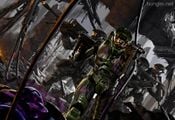
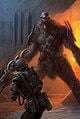 Concept art of an ODST facing an enraged Jiralhanae.
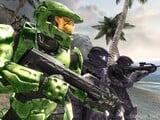 Promotional image of Halo 2 featuring two ODSTs with the Master Chief.
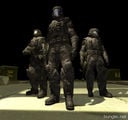 An ODST fireteam in the streets of Mombasa.
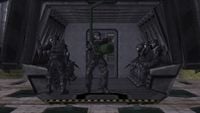 Nine ODSTs in a D77-TC Pelican dropship.
 An ODST wielding a BR55 Battle Rifle on Delta Halo in Halo 2.
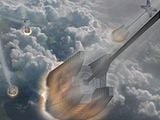 Shock Troopers descending in their SOEIVs over Installation 05.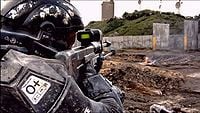
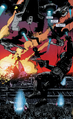 ODSTs dropping into a Covenant prison camp in Cleveland in Halo: Uprising.
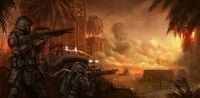 ODSTs facing the Flood in Voi in concept art for Halo 3.
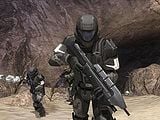 A team of ODSTs deployed on Installation 00 alongside John-117 in Halo 3.
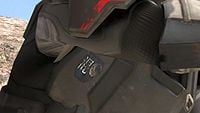 The Chinese character "混", (meaning "Confusion", or "Chaos"), on an ODST's body armor.
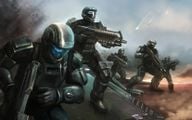 Halo Wars concept art.
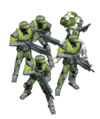 An ODST fireteam in Halo Wars.
 In game closeup of an ODST in Halo Wars.
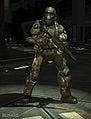 The Rookie in the streets of New Mombasa in Halo 3: ODST.
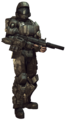 The Rookie standing at arms.
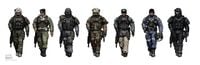 Halo: Reach concept art for various UNSC personnel including an ODST.
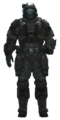 An ODST in Halo: Reach.
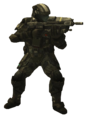 An ODST in Halo: Reach.
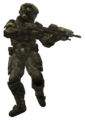 An ODST in Halo: Reach.
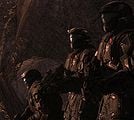 Three ODSTs outside ONI Sword Base on Reach in Halo: Reach.
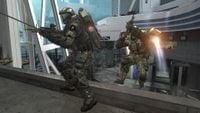 A team of Bullfrogs during the Raid on New Alexandria.
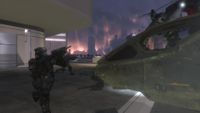 Two ODSTs get ready to board Gunnery Sergeant Buck's UH-144 Falcon in New Alexandria.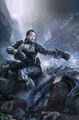
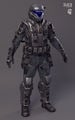 A render of an ODST for Halo 2: Anniversary.
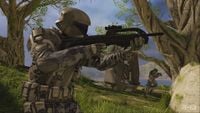 An ODST on Installation 05 in an early build of Halo 2: Anniversary.
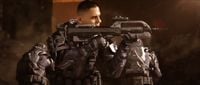 ODSTs led by Marcus Stacker in Old Mombasa.
 An entire contingent of ODSTs deploy onto Installation 05 from the UNSC In Amber Clad in Halo 2: Anniversary.
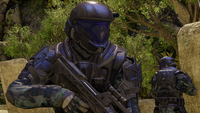 ODSTs in the stone structures of Installation 05.
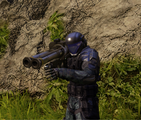 An ODST with an M41 rocket launcher on Installation 05.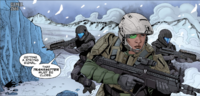
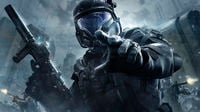 ODSTs in Hunt the Truth.
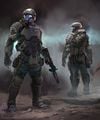 Concept art of an ODST for Halo 5: Guardians.
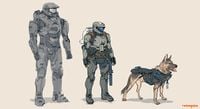 Concept art of an ODST and a dog for Halo 5: Guardians.
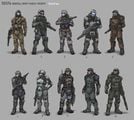 Concept art of an ODST for Halo 5: Guardians.
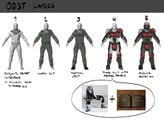 Concept art of an ODST for Halo 5: Guardians.
 Concept art of an ODST for Halo 5: Guardians.
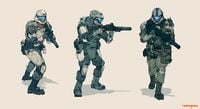 Concept art of an ODST for Halo 5: Guardians.
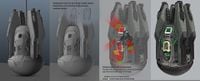 Concept of an ODST and a SOEIV for Halo 5: Guardians.
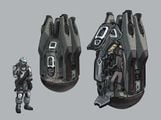 Concept of an ODST and a SOEIV for Halo 5: Guardians.
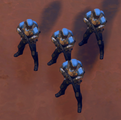 ODST in the Halo Wars 2 Open Beta.
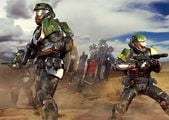 Blitz card of ODSTs in Halo Wars 2.
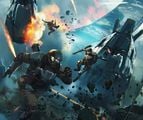 Sunray 1-1 during Operation: SPEARBREAKER.
 Fireteam Raven in Halo: Fireteam Raven.


List of appearances[edit]
- Halo: The Fall of Reach (First appearance)
- Halo: The Flood
- Halo: First Strike
- Halo 2
- Halo Graphic Novel
- Halo: Ghosts of Onyx (Mentioned only)
- Halo: Landfall
- Halo: Uprising
- Halo 3
- Halo: The Cole Protocol
- Halo Wars
- Halo: Helljumper
- The Life
- Halo 3: ODST Pre-mission Evaluation
- Halo 3: ODST
- Halo Legends
- Halo: Evolutions - Essential Tales of the Halo Universe
- Halo: Reach
- Halo: Fall of Reach
- Halo: Glasslands
- Halo: The Thursday War
- Halo 4: Forward Unto Dawn
- Halo 4 (Mentioned only)
- Halo: Spartan Assault
- Halo: Initiation
- Halo: Escalation
- Halo: Mortal Dictata
- Halo 2: Anniversary
- Halo: New Blood
- Hunt the Truth
- Halo: Spartan Strike
- Halo: Hunters in the Dark (Mentioned only)
- Halo: Last Light (Mentioned only)
- Halo: The Fall of Reach - The Animated Series
- Halo 5: Guardians (Mentioned only)
- Limited Edition dossiers (Mentioned only)
- Know Your Enemy
- Halo: Ground Command
- Halo Mythos
- Halo Wars 2
- Halo: Envoy
- Halo: Retribution (Mentioned only)
- Halo: Legacy of Onyx (Mentioned only)
- Halo: Fireteam Raven
- Halo: Bad Blood
- Halo: Silent Storm
- Halo: Official Spartan Field Manual
- Halo: Outpost Discovery
- Halo: Oblivion (Mentioned only)
- Halo: Meridian Divide (Mentioned only)
- Halo: Shadows of Reach[83]
- Halo Infinite (Mentioned only)
- Season 04: Infection (Mentioned only)
- Halo: The Rubicon Protocol
- Halo: Outcasts
- Halo: Saturn Devouring His Son
- Halo: Empty Throne
- Halo: From the Soil to the Stars
- Halo: Ascension on Atropos
- Halo: Fifth Canticle (Mentioned only)
- Halo: Edge of Dawn
- Halo: Campaign Evolved
- Halo: Still Midnight (Mentioned only)
Notes[edit]
- ^ The plural form, when referring to the organization, is "ODST". However, individuals or small groups of troopers are addressed as "ODSTs".
- ^ The first usage of the name "Helljumpers" in Halo: The Fall of Reach (Chapter 7) specifies it as the nickname of the 105th Shock Troops Division. In most media (including a later reference in The Fall of Reach and the subsequent novels Halo: The Flood and Halo: First Strike), it is repeatedly used to refer to the ODST as a whole.
Sources[edit]
- ^ a b c d e f g h i j k Halo Waypoint, ODST (Retrieved on Oct 27, 2015) [archive]
- ^ a b c d e f g h i j k l m n o p q Bungie.net, Halo 3 ODST : Field Guide - ODST (Retrieved on May 25, 2013) [local archive] [external archive]
- ^ a b c Halo: The Essential Visual Guide, page 131
- ^ a b c d e f g h Halo Waypoint, Canon Fodder - Log of War (Retrieved on Mar 19, 2017) [archive]
- ^ a b Halo: First Strike, page 104 (2003); page 130 (2010)
- ^ a b Halo Waypoint: Corbulo Academy of Military Science
- ^ a b Halo: The Flood, chapter 1
- ^ a b Halo Wars 2, Phoenix Logs: ODSTs
- ^ Halo: The Fall of Reach, chapter 27
- ^ Bungie.net: CAA Factbook excerpt
- ^ a b c Halo: New Blood, pages 6-7 (Google Play edition)
- ^ a b c d e f g h i Halo Encyclopedia (2011 edition), page 58-63
- ^ Halo Waypoint, UNSC Drop Pods (Retrieved on Oct 27, 2015) [archive]
- ^ Halo Waypoint, Canon Fodder - The Art of War(s) (Retrieved on Mar 19, 2017) [archive]
- ^ Halo: The Fall of Reach, page 282 (2010)
- ^ Halo Waypoint, Drop Pod (Retrieved on Mar 25, 2012) [local archive] [external archive]
- ^ Halo Waypoint, Canon Fodder - Tasty Tomes (Retrieved on Mar 24, 2025) [archive]
- ^ Halo.bungie.org: Frank O'Connor/Robt McLees Interview - August 2008
- ^ Halo Encyclopedia (2009 edition), page 42
- ^ Halo: Reach, Data pad: 11
- ^ a b Halo 4: Forward Unto Dawn
- ^ Halo: The Fall of Reach, page 94
- ^ a b c d e f g Halo: Evolutions - Dirt
- ^ Halo Wars, campaign level Arcadia City
- ^ Halo Wars, campaign level Arcadia Outskirts
- ^ Halo Wars, campaign level Dome of Light
- ^ Halo Wars, campaign level Scarab
- ^ Halo: The Cole Protocol, chapter 2
- ^ Halo: The Cole Protocol, chapter 30
- ^ Halo: The Cole Protocol, chapter 61
- ^ Halo: The Fall of Reach, prologue
- ^ Halo Legends - The Babysitter
- ^ Halo 3: ODST marketing, Halo 3: ODST Pre-mission Evaluation campaign, pre-mission evaluations
- ^ Halo: Helljumper
- ^ a b Halo: Reach, campaign level Tip of the Spear
- ^ Halo: The Flood
- ^ Halo: First Strike
- ^ Halo: The Flood, chapter 12
- ^ a b c d e f Bungie.net, Bungie Weekly Update: 11/21/08 (Retrieved on Oct 13, 2014) [archive]
- ^ a b Halo 2, campaign level Cairo Station
- ^ Halo 3: ODST, campaign level Prepare To Drop
- ^ a b Halo 2, campaign level The Great Journey
- ^ a b c Halo 3, campaign level The Ark
- ^ Halo: Ghosts of Onyx, chapter 23
- ^ a b Halo Legendary Crate - Data Drop #2
- ^ Halo: Uprising, issue 2
- ^ Halo 3, campaign level Crow's Nest
- ^ Halo: Landfall - Arms Race
- ^ Halo: Landfall - Combat
- ^ Halo: Landfall - Last One Standing
- ^ Halo Encyclopedia (2009 edition), page 56-57
- ^ Halo 3, campaign level The Covenant
- ^ Halo 3, campaign level Halo
- ^ Worthplaying Halo 4 (X360) Champions Bundle To Add New Maps, Mode, Skins, Armor, Bonus Upgrades
- ^ Halo: Spartan Assault, campaign level Descend from the Perch
- ^ Halo: New Blood, chapter 18
- ^ Halo: Escalation, issue 3
- ^ Halo Wars 2
- ^ Halo Wars 2 - Operation: SPEARBREAKER, campaign level Not on My Watch
- ^ Halo Waypoint, Canon Fodder - Sweet Centennial (Retrieved on Feb 24, 2018) [archive]
- ^ Halo: Shadows of Reach, chapter 13
- ^ Halo: Outcasts, chapter 8
- ^ Halo: Empty Throne, chapter 22
- ^ a b c Halo Waypoint, Canon Fodder - Feet First Into Fall (Retrieved on Sep 29, 2025) [archive]
- ^ Halo: Edge of Dawn, chapter 18
- ^ Halo: The Rubicon Protocol, chapter 7
- ^ Halo: The Rubicon Protocol, chapter 21
- ^ Halo Encyclopedia (2022 edition), page 58
- ^ Halo: Silent Storm, chapter 5
- ^ Halo: Oblivion, page 64
- ^ a b c Halo: Glasslands, chapter 3
- ^ Halo 3: ODST marketing, The Life
- ^ a b c Halo: Glasslands, chapter 2
- ^ Joyride, ODST (Halo Graphic Novel Limited Edition Exclusive)
- ^ Halo: First Strike, pages 66-68 (2010)
- ^ Halo: The Cole Protocol, chapter 11
- ^ Halo: New Blood, page 89
- ^ Halo: The Fall of Reach, pages 65-67
- ^ Halo: The Cole Protocol, chapter 5
- ^ Halo: Reach: ODST helmet in-game model
- ^ Halo: Ghosts of Onyx, Prologue
- ^ The Sci Fi Show: Episode 005: DC Reboot/Eric Trautmann
- ^ Halo: Shadows of Reach, chapter 21


